When the furnace fails, replace the whole system
When an electric furnace in an Orchards two-story needs a heat strip one winter and a blower the next, it’s time to price what replaces it instead of the next repair.
If yours is one of them, you can replace it with another electric furnace, a ducted heat pump, or a head in each main room. Firlands Portland Mini Splits prices all three, and in many Orchards two-stories the room-by-room system wins on comfort and running cost.
Project
A typical Orchards whole-house conversion
The problem
The electric furnace's heat strips are failing one by one, the upstairs runs four or five degrees warmer than the main floor all year, and the owner wants the furnace gone rather than repaired.
The house
Main floor: living room, family room and kitchen. Upstairs: a primary suite and two bedrooms. The ducts run through the attic upstairs and between floors downstairs, and the furnace sits in the garage.
What we decide, and why
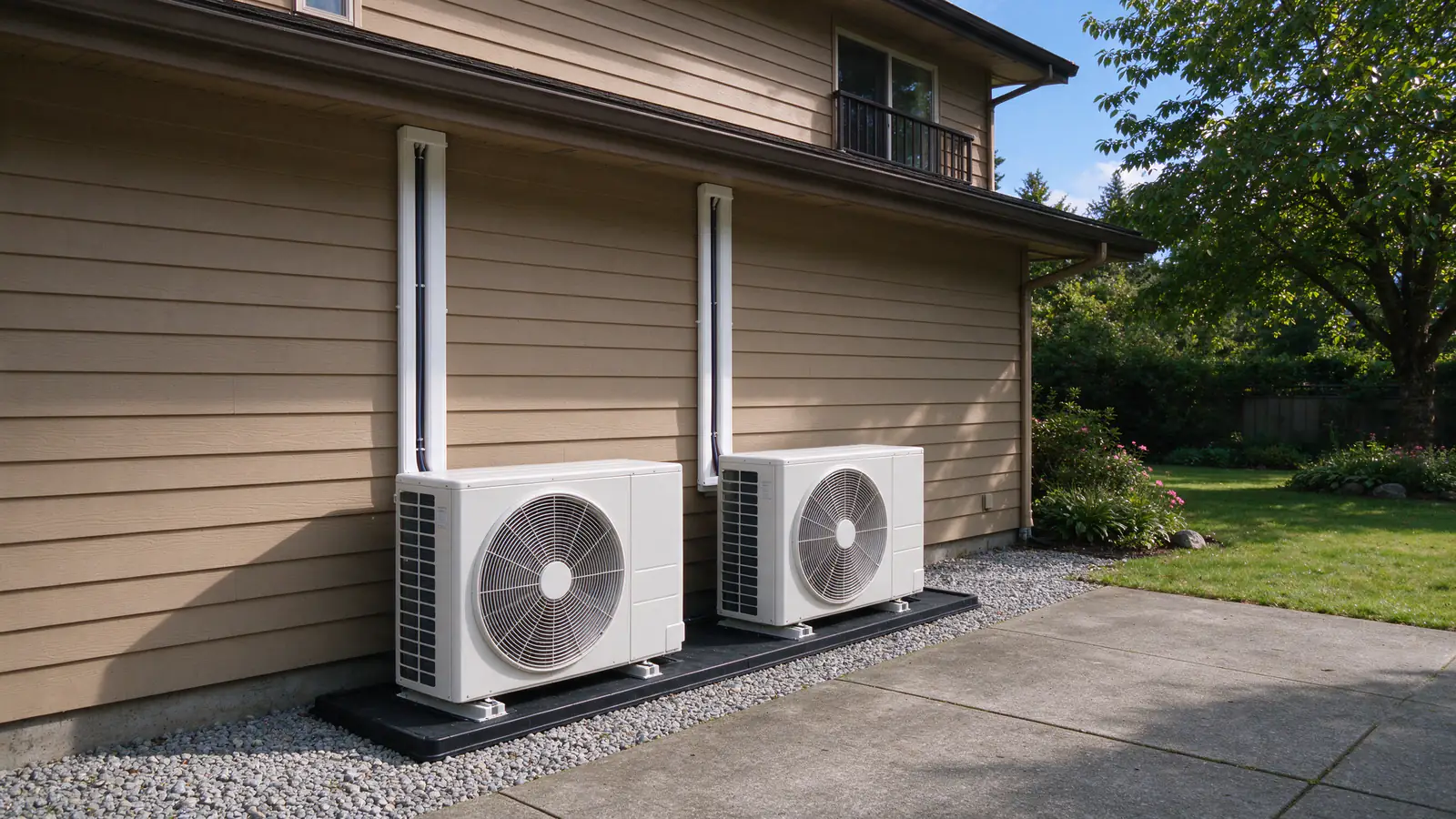
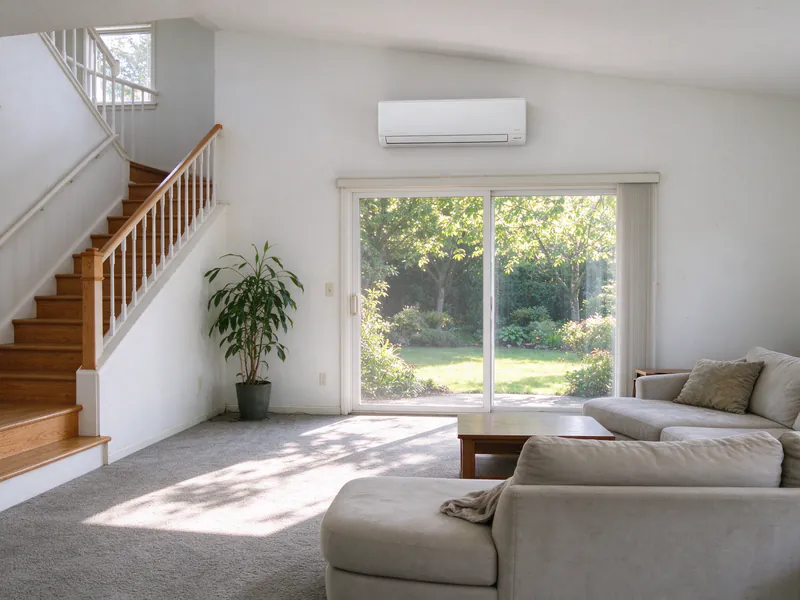
Five heads on two outdoor units, one per floor, so each floor's unit modulates to its own load: 15,000 BTU in the family room and 12,000 in the living room on one, and 12,000 in the primary suite with two 7,000s in the small bedrooms on the other. The furnace comes out completely, and the old ducts are capped.
The work
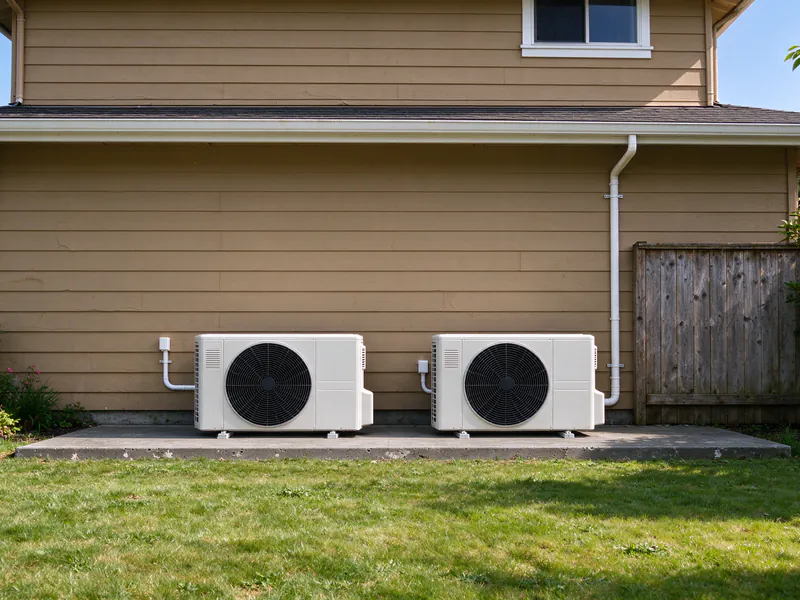
Upstairs line sets run through the attic to one stacked cover on the back wall; downstairs ones go straight through the wall. Both outdoor units sit side by side on one pad with the right spacing. Two 240-volt circuits replace the furnace's large one. Five line sets, each pressure-tested and evacuated below 500 microns; five drains, each tested with water.
Two outdoor units cost more than one, but each one runs in its sweet spot instead of one large unit cycling to feed a single small bedroom. The furnace removal frees enough panel capacity that the 200-amp service stays as it is.
What it changes
Every room has its own temperature, the upstairs stops running warm, and the house qualifies once for Clark Public Utilities' $900 ductless rebate.
- Location
- Orchards, unincorporated Clark County
- House
- 1994 two-story, about 2,300 square feet, failing electric furnace
- Equipment
- Five heads on two cold-climate outdoor units (one for each floor)
- Price
- $21,500, permit fees included
- Time on site
- 4 days, then the final inspections
The upstairs-downstairs gap
A two-story house with one furnace and one thermostat in the hallway runs warmer upstairs and cooler down, in every season.
Warm air rises, the upstairs gets the sun through the roof, and the ducts to the far bedrooms are the longest. The furnace answers to the thermostat downstairs, so the upstairs overheats while it runs. Heads put each room on its own control, so the gap closes. Whole-house mini split explains the layout.
How many heads an Orchards house needs
We count heads by how the rooms are used and how open they are, not by floor area alone.
| Space | Typical plan |
|---|---|
| Open family room and kitchen | One head, sized for the largest load in the house |
| Formal living room | One head, or shared with the family room if open to it |
| Primary suite | One head |
| Two small bedrooms | One small head each, or a hall head with doors open |
| Bathrooms and laundry | Usually a small baseboard as backup |
Five heads is common for a 2,000-plus square foot two-story. How many mini splits do I need? has the method, and mini split sizing explains the load calculation behind each number.
One outdoor unit per floor
On a two-story Orchards house, we often split the system by floor, with one outdoor unit for the downstairs heads and one for the upstairs.
Why split it
- each unit runs at a steady, efficient speed for its floor’s load
- a small bedroom head doesn’t force a large unit to cycle
- if one needs service, the other floor still has heat
What it takes
Two outdoor units cost more than one, and they need two circuits and twice the clearance. They usually sit side by side on one pad behind the house. Single-zone vs multi-zone covers the trade-off.
The panel and the old furnace circuit
Taking the electric furnace out frees more electrical capacity than a whole-house heat pump uses, so an Orchards panel often needs no upgrade.
An electric furnace draws a large circuit for its heat strips. Two heat pump outdoor units together typically draw less, and we confirm that with a load check at the visit.
If the panel still falls short
If the panel still comes up short, the estimate shows a service upgrade; Firlands’ typical range for one is $2,500 to $6,000. Under Washington’s rules, the new circuits are electrical-contractor work, as mini split electrical requirements explains.
Three ways to replace the furnace
Before you commit to heads in every room, it’s worth putting the three options side by side.
| Option | What you get | What it costs you |
|---|---|---|
| New electric furnace | Same comfort as today, same resistance-heat bill | Lowest upfront, highest running cost |
| Ducted heat pump or ducted mini split | Heat-pump efficiency through the ducts you have, one thermostat | Mid-range; the upstairs-downstairs gap stays |
| Heads in each main room | Heat-pump efficiency and room-by-room control | Highest upfront, lowest running cost |
The written estimate can price more than one option, so you can compare them on paper before anything is ordered.
Sizing for the cold and the heat
We size each head to its room’s load at Clark County’s 28°F design low and check the outdoor units’ published output colder than that.
Upstairs heads also get checked against summer: the county’s cooling design figure is 88°F, and a west-facing bedroom under the roof gets a little extra margin. A small baseboard left in each bathroom covers the odd ice-storm night. Do mini splits work in cold weather? explains low-temperature output.
Permits from Clark County and L&I
Orchards is unincorporated Clark County, so the county handles the mechanical permit and Washington L&I the electrical one.
| Permit | Covers | Issued by |
|---|---|---|
| Mechanical | Heads, outdoor units, line sets, drains | Clark County Community Development |
| Electrical | New circuits, furnace circuit removal | Washington L&I |
Clark County doesn’t issue electrical permits; it sends that work to L&I. Permit fees are in our price, and we meet both inspectors for the finals.
One rebate per home
Clark Public Utilities pays $900 toward a ductless heat pump that replaces permanently installed electric heat, and an electric furnace qualifies.
It’s paid once per home, however many heads there are. The house has to be one you own and live in, the equipment rated HSPF2 7.5 or higher, and the installer from the utility’s contractor network, which is how we schedule Clark County work. We confirm the current terms before the estimate is final.
Five heads, four days
A whole-house job in Orchards usually runs four days on site, then the final inspections.
- Day one. Outdoor units set on their pad; downstairs heads mounted and lines run straight through the wall.
- Day two. Upstairs lines routed through the attic to one stacked cover on the back wall.
- Day three. Circuits, disconnects and the furnace removal.
- Day four. Five pressure tests, five vacuums held below 500 microns, five drains tested with water, startup and a walk-through.
Orchards prices
Firlands’ typical range for a whole-home system with five or more heads is $15,000 to $30,000 and up; three or four heads run $9,000 to $18,000 and up.
The written estimate lists each head and capacity, both outdoor units, routes, drains, circuits, permits and exclusions. The cost estimator gives a first range, and what a mini split does to your electric bill shows the savings side.