You turn the mini split on for the first warm week and the room fills with a musty, damp-sock smell. Or the air feels weaker than it did last year, and there are dark specks in the vents.
That’s a head that needs more than a filter rinse. Firlands Portland Mini Splits deep cleans mini split coils, blower wheels and drains, and does yearly maintenance visits that keep a system clean before it starts to smell.
What’s behind the smell and the weak air
Every time a head cools, its coil gets wet. Dust, pollen and smoke particles that slip past the filter stick to the wet coil and the blower wheel behind it, and growth follows.
| What you notice | What’s usually going on |
|---|---|
| Musty or sour smell when it starts | Growth on the blower wheel and in the drain pan |
| Dark specks blowing out | Buildup flaking off the wheel’s blades |
| Weaker airflow | Matted wheel, dirty coil or clogged filter |
| Water dripping from the head | A blocked drain line or a failed pump |
| Higher power bills | A dirty coil makes the system work harder |
The filters are only mesh screens. They stop lint and hair, not the fine particles that coat the coil and wheel over time.
Project
A typical Lake Oswego deep clean after a smoky summer
The problem
After a summer of smoke days with the windows shut and the system running hard, every head smells musty for the first few minutes it runs. The upstairs bedroom head blows noticeably weaker than the others, and dark specks show on the wall below it.
The house
The system has heads in the living room, the kitchen and two upstairs bedrooms, all on one outdoor unit on a pad beside the garage. The filters have been rinsed now and then, but the coils and blower wheels have never been cleaned. The bedroom head sits in a room kept closed most of the day.
What we decide, and why
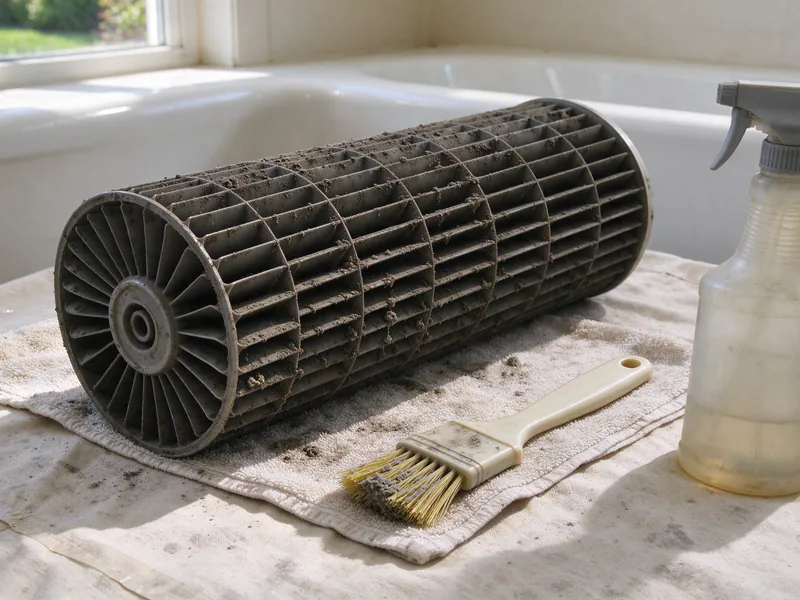
All four heads get a deep clean, because the smell comes from the blower wheels and drain pans that a filter rinse never reaches. Three wheels clean well in place. The bedroom wheel is matted with buildup across its blades, so we take it out and wash it separately rather than try to rinse it on the wall.
The work
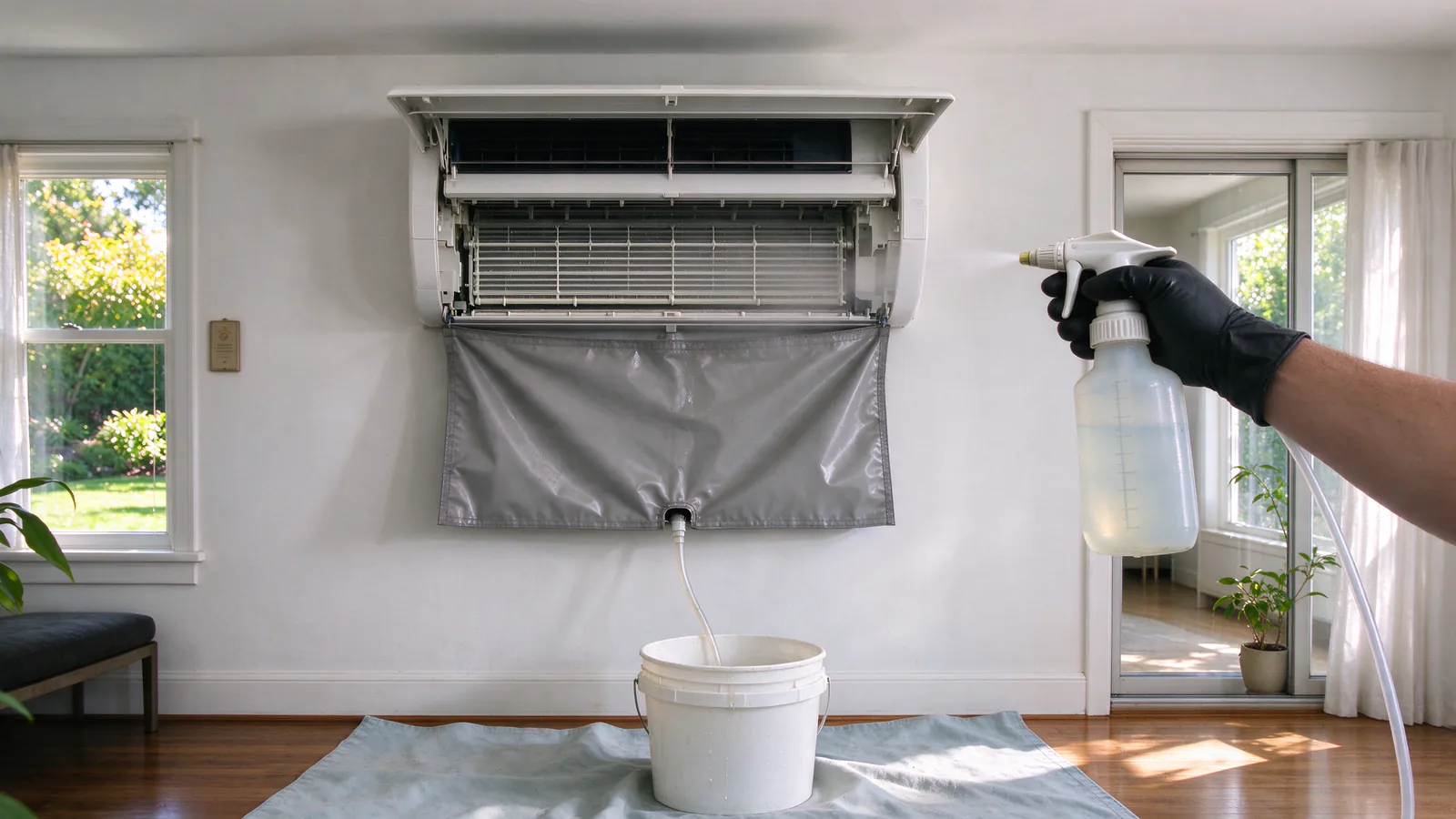
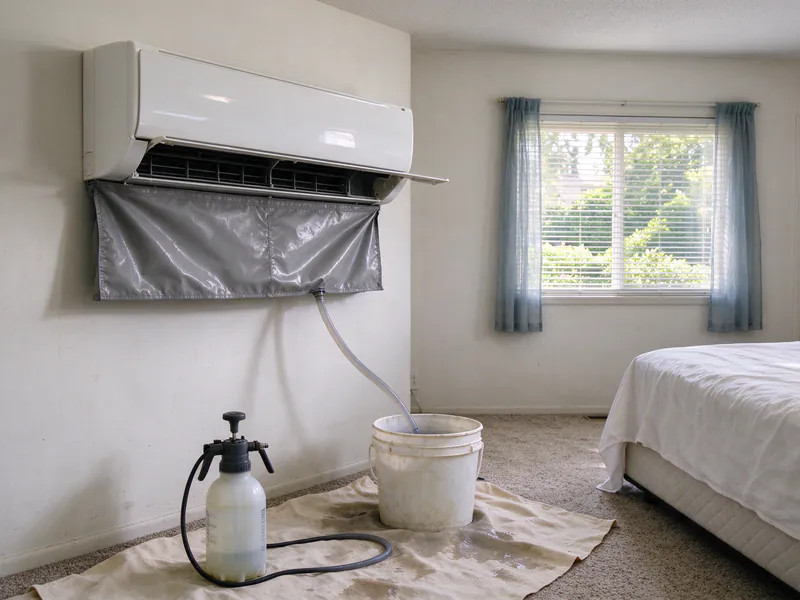
We run each head first and note its supply air temperature. Then each head gets a fitted bib wrapped underneath and a drop cloth below, the filters come out, and the coil and blower wheel are sprayed with coil cleaner and rinsed through with a low-pressure sprayer into the bib. The bedroom wheel comes out of the head, is washed in the bathtub, dried and refitted. We flush all four drain pans and lines and pour water through each. Outside, the coil is rinsed gently from the inside out and a summer's worth of leaves is cleared from around the unit.
The kitchen head's drain line runs slow, with a plug of slime at the outlet behind the line-hide; we clear it and flush it until the water runs freely. The supply air from the bedroom head comes out about five degrees cooler after cleaning, and the readings for all four heads go on paper for the owners.
What it changes
The musty smell is gone at startup, the bedroom head moves its full airflow again, and the owners know to rinse the filters every week or two through the next smoke season.
- Location
- Lake Oswego
- House
- 1984 two-story house with a four-head mini split system
- Equipment
- Four wall heads on one outdoor unit: coil and blower-wheel deep clean on all four
- Price
- $1,280 for all four heads, outdoor unit included
- Time on site
- 1 day, about six hours
What happens at a cleaning visit
We start by running the system and checking how it’s working, so we know what normal looks like and what the cleaning changes.
- Check first. Supply air temperature, airflow and any error codes, noted before we touch anything.
- Protect the room. Furniture moved back, a drop cloth down, and a fitted bib wrapped under the head to catch the rinse water.
- Clean the head. Filters washed, then the coil and blower wheel cleaned with a coil cleaner and rinsed through. A wheel that’s badly matted comes out to be washed on its own.
- Clear the drain. The pan and drain line flushed, and any pump and float switch tested with water.
- The outdoor unit. Coil rinsed gently from the inside out, leaves and debris cleared, and clearance around it restored.
- Check again. The same checks after, and we tell you about anything that needs repair.
Maintenance visit or deep clean?
A maintenance visit keeps a clean system clean. A deep clean is for a head that already smells, drips or blows weak.
Maintenance visit
Filters, the coil surface, the drain and the outdoor unit, plus a look at the wiring and the line-set insulation. Once a year suits most houses, before the cooling season.
Deep clean
The coil and the blower wheel washed through, the pan and drain flushed. It takes longer and costs more per head, but it reaches the buildup a maintenance visit can’t.
Heads in bedrooms that stay closed, or in kitchens with cooking grease, usually need a deep clean first.
Smoke season and your filters
Wildfire smoke loads mini split filters and coils faster than a normal summer. The fine particles that get past the mesh end up stuck to the wet coil and wheel.
- During a smoky stretch. Rinse the filters every week or two, let them dry fully before they go back in, and keep the windows closed.
- Cleaner air. A mini split’s mesh screen isn’t a MERV filter, so it won’t clean smoke out of the air; a portable HEPA unit in the room does that job. Do mini splits filter wildfire smoke? explains what they do and don’t catch.
- After the smoke clears. A head that smells when it starts, or blows weaker than it did in spring, is a good candidate for a deep clean before the next season.
What you can do between visits
Most of what keeps a mini split clean is simple, and none of it needs tools.
| Task | How often |
|---|---|
| Rinse the filters in the sink and let them dry | About monthly in use, more in smoke season |
| Wipe the cover and the vanes | When you rinse the filters |
| Clear leaves and plants from around the outdoor unit | Each fall and spring |
| Brush snow and ice off the top of the outdoor unit | After a storm, gently |
| Look for drips on the wall under each head | Whenever you’re in the room |
Don’t hose the outdoor coil at high pressure or bend its fins, and leave the inside of the head to us. If you’re planning more heads, a multi-zone system puts each one where its filter is easy to reach.
Drains: the part that leaks
A head drains water every time it cools, and a slimy drain pan or a clogged line is the usual cause of water running down the wall.
We flush the pan and the line, clear the outlet outside, and pour water through to watch it leave the house. Where a head has a condensate pump, we test it and lift its float switch to make sure it shuts the head off. The condensate drain guide explains pumps, gravity drains and what clogs them.
What it costs
Firlands’ typical range for a maintenance visit is $150 to $250 for one outdoor unit and one head, plus $40 to $120 for each additional head. A deep clean typically runs $200 to $450 per indoor head.
| What moves the price | Why |
|---|---|
| Number of heads | Each head is its own cleaning |
| Head type | Ceiling cassettes and ducted units take longer to reach |
| Blower wheel removal | A badly matted wheel has to come out |
| Height and access | A head over stairs or a high ceiling needs more setup |
Your price depends on the number and type of heads, and we tell you the price before we start.
When cleaning isn’t the fix
Cleaning restores airflow and stops smells. It doesn’t fix a leak, a failed part or an aging system.
- Still blowing warm after a cleaning. That points to refrigerant, a sensor or a part: see mini split repair.
- An older system with repeated problems. Compare the repair against a replacement, which can often reuse the line set.
- A head that needs room to breathe outside. Shrubs and fences too close to the outdoor unit cut its efficiency; mini split placement has the clearances.
- A power bill that keeps rising. Your mini split’s electric bill shows what’s normal.