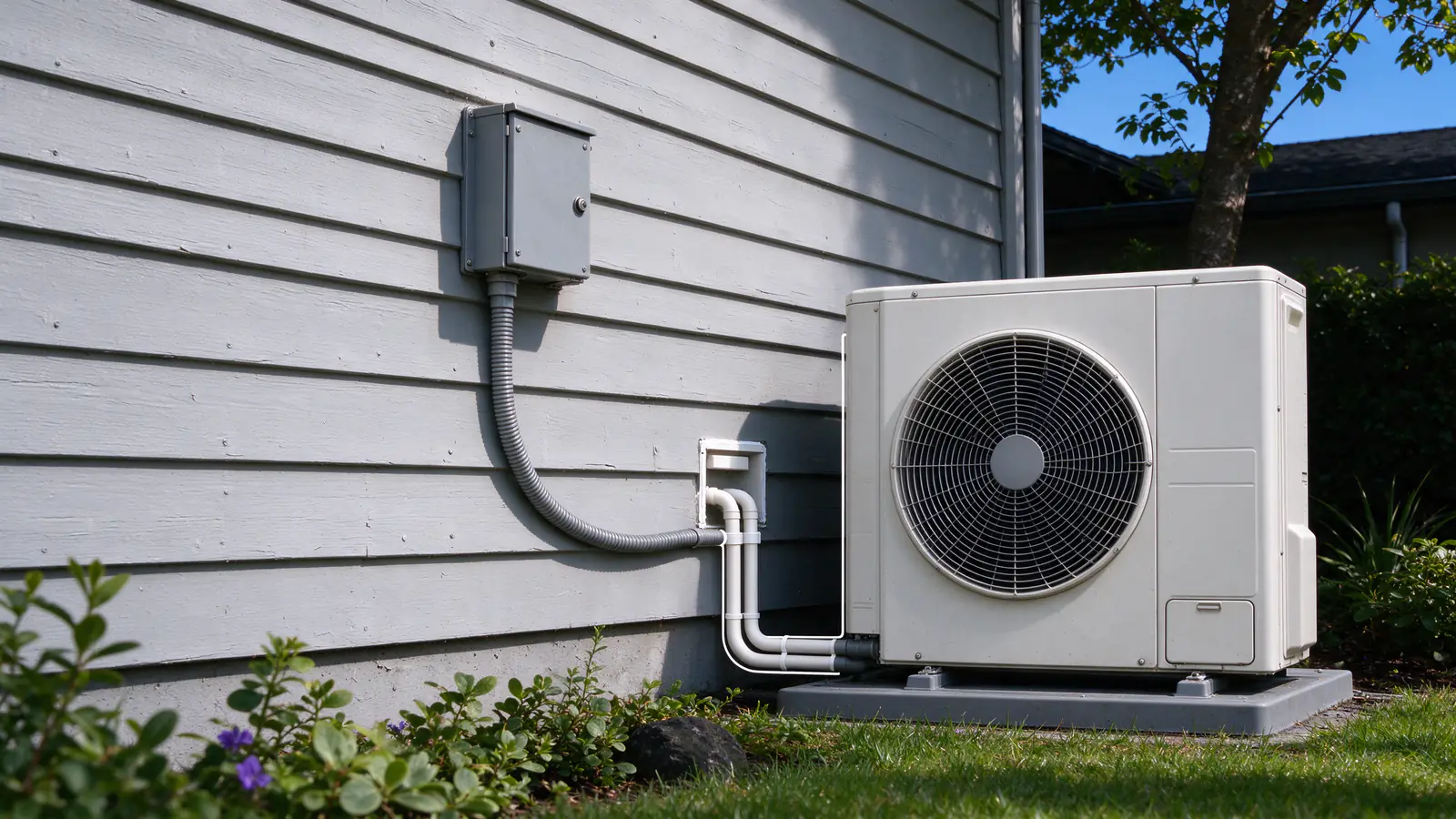
Before a mini split goes on the wall, the panel has to be able to feed it. On every visit, Firlands Portland Mini Splits opens the panel, reads the outdoor unit’s nameplate requirements against it, and puts the circuit and any panel work on the written estimate. Here’s what goes into that.
The circuit: dedicated and 240 volts
Each outdoor unit gets its own circuit from the panel, with nothing else on it. For almost every system, that’s a 240-volt circuit using a two-pole breaker.
Sized from the nameplate
Every outdoor unit lists a minimum circuit ampacity (MCA) and a maximum overcurrent protection (MOCP) on its nameplate and in its manual. The wire is sized to the first and the breaker to the second. A small single-zone unit may call for a 15- or 20-amp breaker; a large multi-zone outdoor unit can call for 30 amps or more.
What feeds the heads
On most systems, the heads don’t get their own circuit. A four-wire communication cable runs from the outdoor unit to each head alongside the refrigerant lines, carrying both power and control signals. Some ducted air handlers are the exception, and the manual says so.
The disconnect by the outdoor unit
The electrical code requires a way to cut power at the outdoor unit, within sight of it, so whoever services it can make it safe without walking to the panel.
That’s a small weatherproof box on the wall next to the unit, with a pull-out or a switch inside. It sits beside the line-hide, and on a painted house it can be painted to match. We place it where it’s easy to reach but not in a walkway.
Is your panel big enough?
Your panel needs two open breaker spaces for each new 240-volt circuit and enough spare capacity for the new load. Either can be the problem.
Space
A panel with no open spaces can sometimes take a tandem breaker or have circuits reorganized. That depends on the panel’s make and labeling, and some older panels allow neither.
Capacity
Capacity is about the total load. A load calculation adds up the house’s big draws and compares them with the service size.
Many older Portland houses have a 100-amp service, which is often enough for a mini split on top of gas heat and a gas range. It gets tight when the house already has electric heat, an electric range, an electric dryer, a hot tub or an EV charger.
| Situation | What usually happens |
|---|---|
| Open spaces, capacity to spare | A new circuit, done on install day |
| No open spaces, capacity to spare | Tandem breakers or reorganized circuits, where the panel allows |
| Capacity tight on a 100-amp service | A load calculation decides; a service upgrade may come first |
| Old fuse box or an obsolete panel | Replacement before new loads are added |
When the service needs an upgrade
Firlands’ typical range for a panel or service upgrade from 100 to 200 amps is $2,500 to $6,000, as separate electrical scope. It needs PGE or Pacific Power to reconnect the service, so it’s planned ahead of install day. We tell you at the visit if your panel needs it.
Replacing baseboards frees up capacity
If the mini split is replacing electric baseboard or wall heaters, the old heater circuits come out of the load. That often frees enough capacity on a 100-amp panel that no upgrade is needed.
A heat pump moves heat rather than making it, so the outdoor unit draws less than the baseboards it replaces for the same warmth. See baseboard heat to mini split for how we plan those jobs, and the electric bill guide for running costs.
Old wiring in old houses
Many pre-1940 Portland houses still have some knob-and-tube wiring. The mini split doesn’t run on it: it gets a brand-new circuit straight from the panel.
What the old wiring can affect is the panel. A house with knob and tube often has an older fused panel or an undersized service, and those come up at the visit. We note what we see and tell you before we price the job (adding air conditioning to an old Portland house).
Permits and who does the wiring
The new circuit is electrical work with its own permit, separate from the mechanical permit for the heat pump.
In Oregon
Oregon law (ORS 479.620) requires an electrical contractor license to do electrical installations. The state’s limited HVAC maintenance label covers repairing or replacing equipment, not running a new circuit.
- Portland: the electrical permit for a first new branch circuit is $174, plus $21 for each additional circuit, with the state surcharge on top. We include the city fees in your price.
- Gresham, Milwaukie and Lake Oswego: each city issues its own electrical permits.
- Oregon City, West Linn and Happy Valley: Clackamas County handles electrical while the city handles mechanical.
- Replacements: swapping an old system for a new one can often reuse the existing circuit if it matches the new nameplate (mini split replacement). Mini split permits in Portland has the details.
In Vancouver and Clark County
Washington draws the line in a similar place. Under WAC 296-46B-920, an HVAC/refrigeration specialty electrician can wire the equipment but may not install a new branch circuit from the panel. Bidding electrical work in Washington takes a Washington electrical contractor license (RCW 19.28.041). Inside Vancouver city limits, the City issues the electrical permit rather than the state.
What the electrical part costs
For a standard install, the new circuit, the disconnect and the city electrical permit are inside Firlands’ typical range for the system.
Firlands’ typical range for a single-zone install is $4,000 to $8,500, including the circuit and permits. A service upgrade is priced separately. The cost guide breaks down every range, and the installation process shows where the electrical work falls on install day. For a whole-house plan, see multi-zone installation.