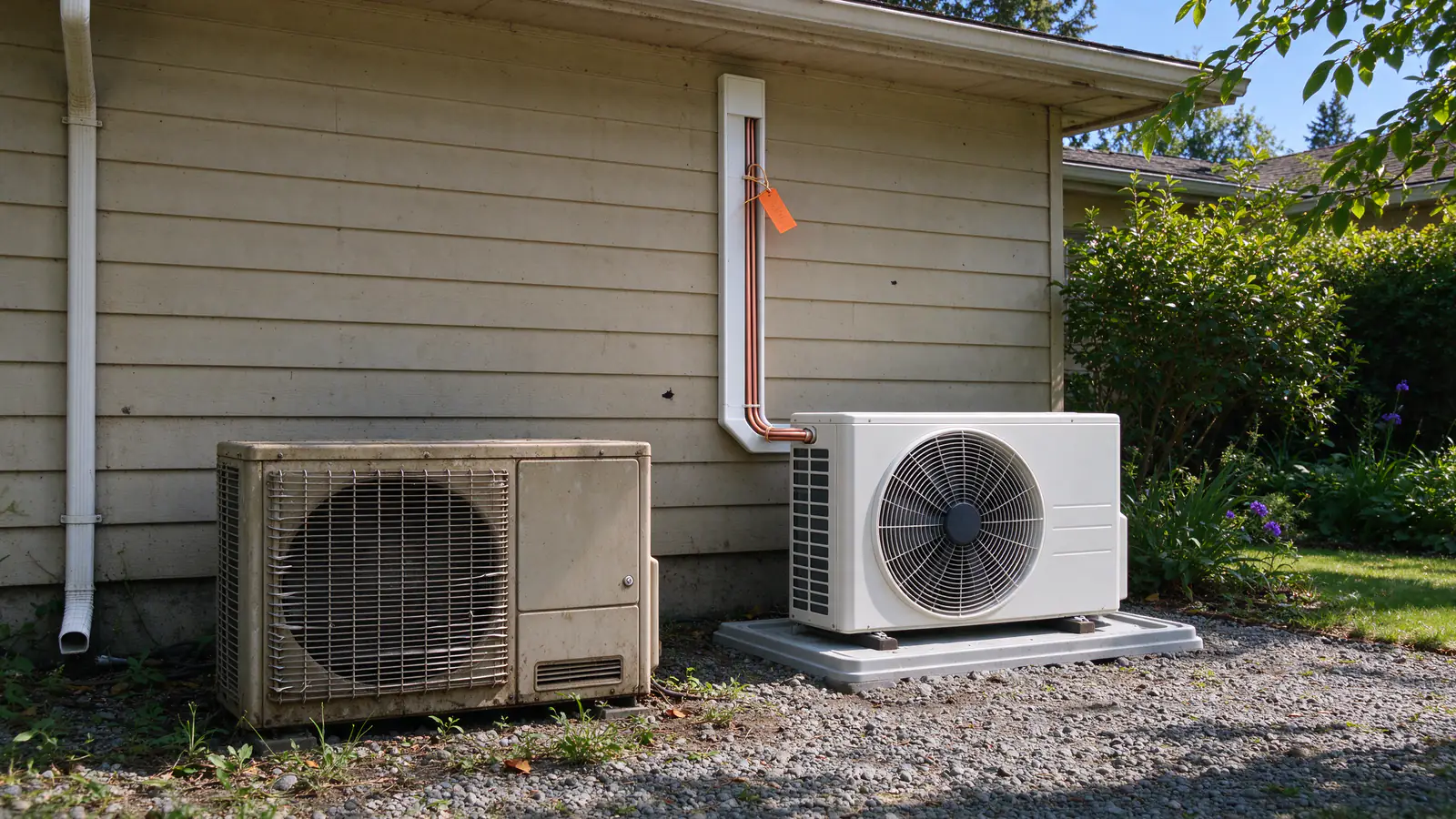
The head blows lukewarm air, the outdoor unit hums and quits, or the system has needed refrigerant twice in two years. At some point, fixing it again stops making sense.
A replacement swaps the old indoor and outdoor units for a new matched pair, reusing what’s still sound. Firlands Portland Mini Splits tests the old line set before trusting it, checks the circuit and the bracket, and recommissions the system as if it were new.
Repair or replace: where’s the line?
Repair a younger system with one failed part; replace an aging one with a failed compressor or a leak that keeps returning.
| Usually worth repairing | Usually time to replace |
|---|---|
| A drain, pump, sensor or fan motor | A failed compressor on an older system |
| A board on a system under ten years old | A third recharge for the same leak |
| A single leak found and fixed | A system that can’t keep up and never could |
A compressor typically runs $1,200 to $2,800 and up, which is a large share of a new system on equipment near the end of its life. If yours just needs a part, see mini split repair.
Project
A typical Overlook mini split replacement
The problem
The 12-year-old single-zone system in the living room struggles to start on cold mornings, and it has been recharged twice in three years. The owner wants to know whether to fix it again or replace it.
The house
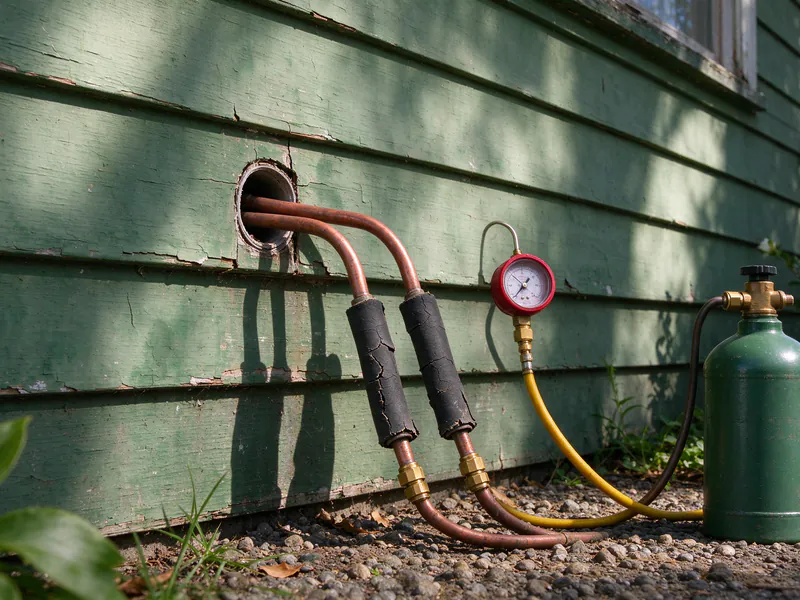
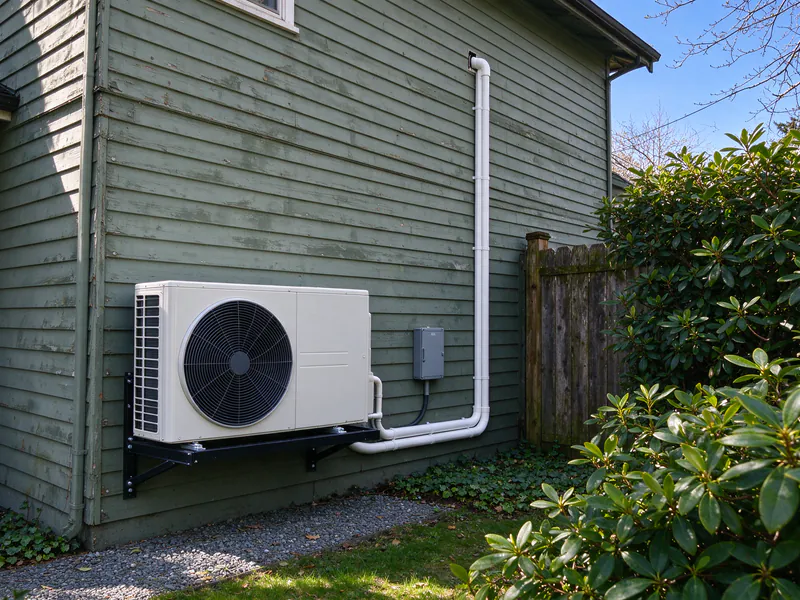
The head sits high on the south living-room wall. The outdoor unit hangs on a wall bracket below it, above a strip of garden bed. The line set runs 25 feet down the outside wall under a cover whose insulation has cracked in the afternoon sun.
What we decide, and why
A compressor on a 12-year-old system that keeps losing charge is the point where replacement makes more sense than another repair. We keep the same layout to hold the price down: new head in the same spot on the wall, through the same hole, and the new outdoor unit on the same bracket after we check its bolts and rating for the new unit's weight. The old line set gets a nitrogen pressure test before we decide whether it stays.
The work
We recover the old refrigerant and take the old units away. The old line set drops pressure within ten minutes, and the leak traces to a flare hidden behind the old head. With the insulation also failing, we replace the whole 25-foot run and its cover. The existing circuit is checked against the new unit's nameplate and reused with a new disconnect whip. The new lines are pressure-tested, held below 500 microns, and charged for their length.
Reusing an old line set saves money only when it passes. This one fails, and a new unit charged into a leaking line puts the owner back where they started within a season.
What it changes
A new system in the same footprint, a line set that holds pressure, and the test readings on paper for the owner's records.
- Location
- Overlook, North Portland
- House
- 1920s two-story; one wall head in the living room
- Equipment
- One 12,000 BTU cold-climate head and outdoor unit, new 25-foot line set
- Price
- $8,350, permits included
- Time on site
- 1 day after permits, then the final inspection
What happens on the first visit
We look at the old system first, then decide what carries over.
We ask how old it is, what has gone wrong and what’s been fixed. Then we check the room: if it was always too hot or too cold, the old head may have been the wrong size, and the new one shouldn’t copy that. After that we look at the parts that could be reused:
- The line set. Its size, its route, the state of its insulation, and any sign of a past leak.
- The drain. Whether it falls cleanly outside, or relies on a pump.
- The bracket or pad. Whether it’s sound and sized for the new unit’s footprint.
- The circuit. Breaker and wire size against what the new unit calls for.
You get a written estimate that says what’s reused, what’s replaced, the new equipment and its capacity, the permits, the price and what’s not included. Where the line set’s fate depends on the pressure test, the estimate shows both prices.
Can the old line set stay?
Only if it passes. A line set is reused when it’s the right size, clean, well insulated and holds a nitrogen pressure test.
What we test
We cut off the old flares, make new ones, and pressurize the lines with dry nitrogen. If the pressure holds, the copper and the joints inside your walls are tight. If it drops, there’s a leak somewhere along the run.
Why reuse isn’t always the saving it looks like
A new outdoor unit charged into a line set with a slow leak loses its refrigerant the same way the old one did. Old lines can also be the wrong size for the new unit, or carry oil left from the old system. Insulation that has cracked in the sun lets the lines sweat and lose efficiency.
When the lines go
We replace the run and its cover, usually through the same hole, so the wall doesn’t get a second patch. The cost depends on the run’s length and route, and it’s shown on the estimate before we start. The installation process covers flares, testing and vacuum step by step.
Getting the new system right
A replacement is a chance to fix what the old install got wrong, not just copy it.
The size
If the room never felt right, we work out its load again instead of matching the old nameplate. How to size a mini split explains the load.
The charge
New outdoor units ship with refrigerant for a set line length. On a longer run we add refrigerant by weight for the extra length, then check the system’s operating pressures and temperatures against the maker’s figures once it’s running. That’s what confirms the charge is right, not a guess at the gauge.
The circuit
A new unit can call for a different breaker or wire size. We check the nameplate against the circuit and change what needs changing. Mini split electrical requirements covers breakers and disconnects.
The bracket or pad
A new unit can be heavier or wider. We check the bracket’s bolts and rating, or level and reset the pad.
What a replacement costs
Firlands’ typical range for replacing a single-zone system where the lines and circuit can be reused is $4,000 to $8,000.
| Job | Typical range |
|---|---|
| Single-zone, line set passes, circuit reused, same location | $4,000 to $8,000 |
| New line set, a new location, a new circuit, or several heads | $8,000 to $18,000+ |
What moves the number: whether the line set passes, the new unit’s size and cold-climate rating, a move to a new wall, and circuit work. Your price comes from the visit and the written estimate, with the city’s permit fees included. Mini split installation cost in Portland breaks the number down, and the permit guide covers what the city requires.
Replacing a multi-zone system
A multi-zone replacement follows the same steps for every line set, one at a time.
- Every line set is tested on its own. One can pass while the next fails, and the estimate prices each.
- The heads and the outdoor unit are replaced together. They’re a matched set, and an old head won’t talk to a new outdoor unit.
- The layout is open for review. If a room was always too warm or never used, a multi-zone plan can change at this point.
- One head trying to heat a floor may need a second head or a new single-zone system beside it.
What happens to the old system
The old refrigerant is pumped into a recovery cylinder, never vented to the air, and the old units leave with us.
Federal rules under EPA Section 608 require certified technicians for refrigerant work. We then disconnect and haul away the old head and outdoor unit, patch around the hole if the new head’s plate doesn’t cover it, and leave the room as we found it.