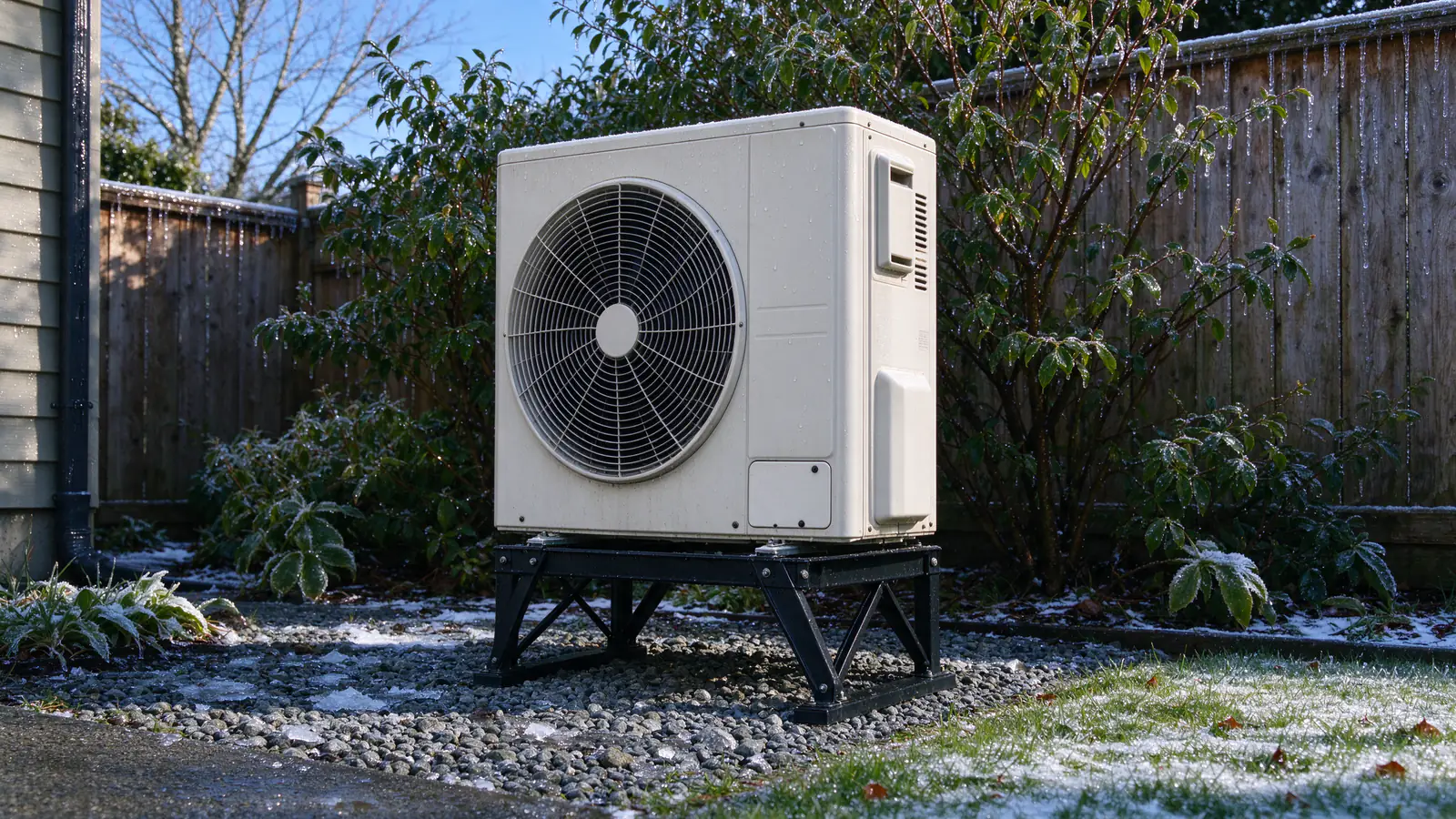
You remember the ice storm: the trees down, the power out, the freezing rain on everything. If you’re thinking of heating with a mini split, you want to know how it handles a night like that. At Firlands Portland Mini Splits we plan every heating system around Portland’s winter, which is less about deep cold than about ice and wind.
How cold does Portland get?
Most winters here are mild. The hard part is a few nights a year, and the ice and wind that come with them.
| Measure | Portland International | Troutdale | Hillsboro |
|---|---|---|---|
| Heating design low | 24°F | 24°F | 27°F |
| Nights a year at or below 32°F | about 32 | about 28 | about 64 |
| Nights a year at or below 20°F | about 1 | about 1 | about 3 |
| Coldest night of the last six winters | 15°F | 14°F | 13°F |
Vancouver’s design low is 28°F. The design low is the temperature the area drops below only about 1% of winter hours, and it’s what we size heating to (mini split sizing).
What a heat pump does in the cold
A heat pump pulls heat out of the outdoor air and moves it inside. Even 20°F air still holds plenty of heat to move.
As the air gets colder, the outdoor unit has to work harder to collect that heat, so its output and efficiency fall. A standard model can lose a large share of its heating capacity by the mid-20s. A cold-climate model is built to hold most of its output there and keeps running well below it.
What cold-climate means
ENERGY STAR’s cold-climate certification tests heat pumps down to 5°F and verifies their output and efficiency there. The maker’s published data shows how many BTUs a model still delivers at 17°F and 5°F. That’s the number we compare to your room’s heat loss, not the rating on the box.
Cooling-only models
Some mini splits only cool. They’re no use in winter, and they don’t qualify for heating incentives. Every head we install for a room you live in is a heat pump, whether it’s a single head or part of a multi-zone system (ductless heat pump vs mini split).
The January 2024 ice storm
In January 2024 an Arctic outbreak and freezing rain hit the metro. Portland International fell to 15°F on January 13 and topped out at 21°F that afternoon.
Troutdale, at the mouth of the Columbia River Gorge, dropped to 14°F with gusts of 53 mph that day and again on January 17. Freezing rain followed from January 16 to 18, with highs between 25°F and 38°F. That week showed what a Portland winter actually tests.
What it tests
- Capacity at the bottom. 15°F is below the design low, so output falls short of the coldest-night load for a while.
- Ice on the outdoor unit. Freezing rain glazes the coil and the base pan and can block the drain.
- Wind. East wind pushes cold air straight through the coil and drives ice and snow into the unit.
- Power. Ice brings down lines, and a heat pump needs power like any electric heat.
The east wind
Winter east winds pour out of the Gorge, and they’re strongest in Troutdale, Gresham and the east side of the metro.
Over six recent winters, Troutdale’s airport logged 122 days with gusts of 40 mph or more, against 40 at Portland International and 15 at Hillsboro. A unit facing that wind on an exposed east wall works harder and ices faster.
How we place for it
- On the west or south side of the house, in the lee of the wind, where the yard allows
- Away from corners that funnel wind
- Anchored to its stand or bracket so gusts can’t shift it
- With a wind baffle where it can’t be sheltered
Mini splits in Gresham covers the east-county conditions.
Defrost, stands and drains
In cold, damp weather frost builds on the outdoor coil. The unit melts it with a defrost cycle, and that water has to go somewhere.
The defrost cycle
Every so often the unit reverses for a few minutes, warming the outdoor coil to shed its frost. The indoor fan slows or stops so you don’t feel cold air, and steam may rise outside. It’s normal, and it’s why heat pauses briefly on frosty mornings.
Why the stand matters
The meltwater drips from the base pan. If the unit sits on a pad at ground level, that water refreezes under it, and ice builds up into the coil. Portland averages about 4 inches of snow a year, little in most winters, but ice is the real risk.
So for heating systems we lift the outdoor unit on a stand or wall bracket, clear of ice build-up and drifting snow. We keep it out of the roof’s drip line, where meltwater and icicles fall, and leave a clear path for defrost water to drain away from walkways.
Backup heat
For a house that relies on mini splits as its main heat, we plan backup for the few nights below the design low and for any day a unit is down.
| Situation | Usual backup |
|---|---|
| Heads replacing baseboards or wall heaters (baseboard to mini split) | Leave some baseboards in place, set a few degrees lower |
| Heads added to a house with a gas furnace | The furnace stays, for the coldest nights |
| Oil or boiler heat being replaced (oil to mini split) | Keep a small electric heater in key rooms, or keep the boiler for now |
| Whole house on mini splits alone | Two or more outdoor units, so one failure doesn’t leave the house cold |
A power cut stops a heat pump along with the furnace fan and the baseboards. If outages worry you, ask us about a heat source that doesn’t need power, such as a gas fireplace or wood stove you already have.
Running costs in winter
A heat pump’s seasonal heating efficiency is its HSPF2. Against baseboards, any working heat pump lowers the cost of heat.
Against gas it depends on your electric rate, which differs between PGE and Pacific Power, and on how cold the winter is. Cold-climate models stay efficient deeper into the cold.
Where to read more
The electric bill guide works through the numbers, and Energy Trust’s incentive for replacing electric heat is in mini split rebates in Oregon.
How we plan a heating system
On the visit we work out each room’s heat loss at your area’s design low, then choose equipment and placement around it.
- Size for the design low: 24°F in Multnomah and Clackamas counties, 27°F in Washington County, 28°F in Clark County.
- Pick cold-climate models for every head that heats, and check their published low-temperature output.
- Place the outdoor unit out of the east wind and the drip line, on a stand above ice.
- Plan the backup before we price the job.
For a house that will heat mainly with mini splits, see whole-house mini splits, or call us with what heats your house today.