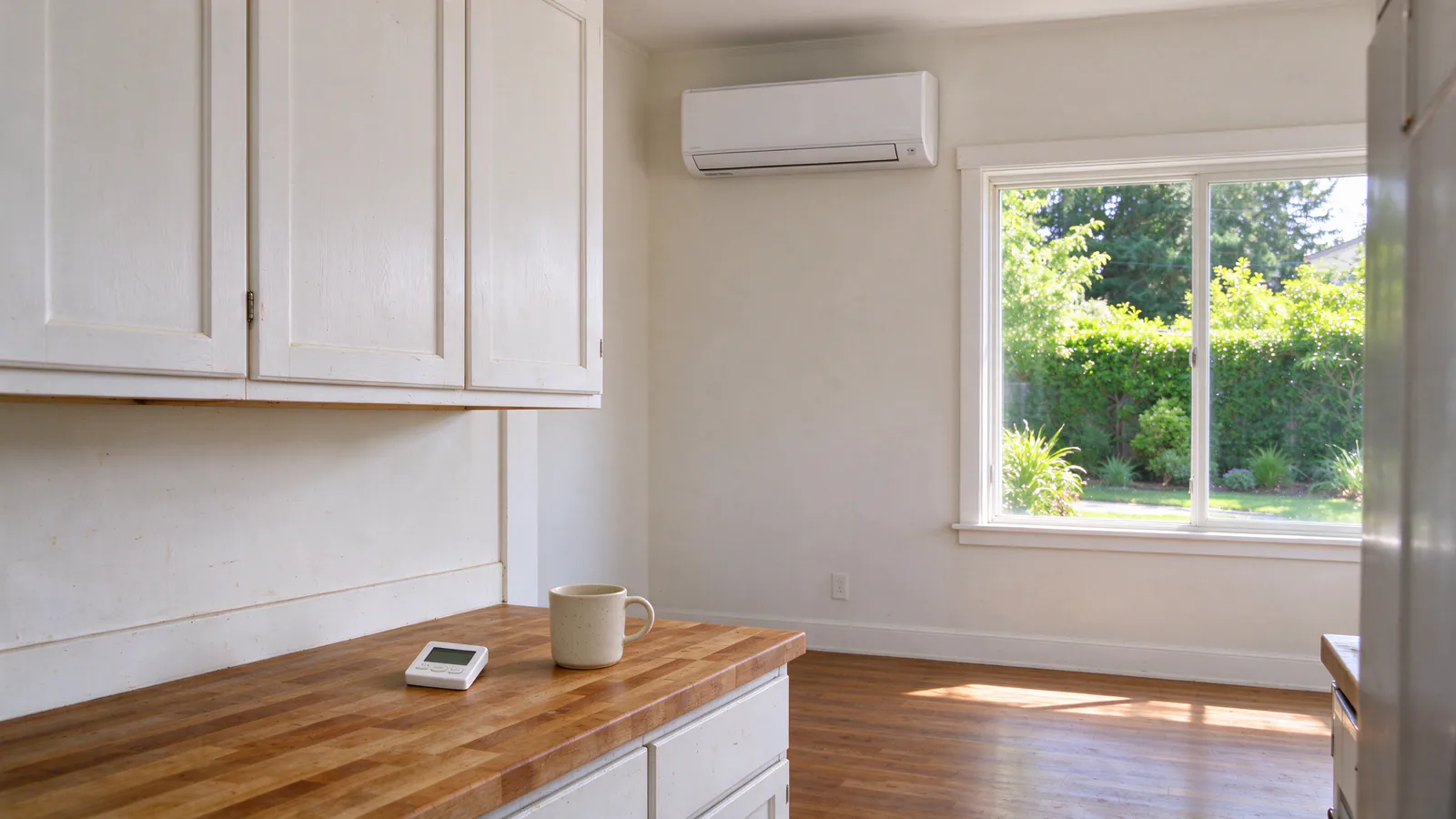
Before people commit to a heat pump, they want to know what happens to the bill. At Firlands Portland Mini Splits we won’t promise a savings number, because it turns on your house, your habits and what you heat with now. What we can do is show the arithmetic with the rates Portland actually pays.
The short answer: it depends on what it replaces
A mini split’s running cost is mostly heating. What it does to your bill depends on whether it takes over from baseboards, a gas furnace, or nothing at all.
| If the mini split replaces | Likely effect on energy cost |
|---|---|
| Electric baseboards or wall heaters | Lower for the same heat, often by half or more |
| A gas furnace | About even; it turns on the heat pump’s real efficiency and your utility |
| Window AC units | Lower for the same cooling; inverter heads are far more efficient |
| Nothing (a room that had no heat or cooling) | A new cost, usually modest |
How efficiency is measured
Heat pump efficiency comes down to one idea: how much heat you get for each unit of electricity.
COP, HSPF2 and SEER2
- COP (coefficient of performance) is heat delivered divided by electricity used, at a moment. A COP of 3 means three kWh of heat for every kWh. Baseboards have a COP of 1.
- HSPF2 is the heating efficiency over a rated season, in BTU per watt-hour. Dividing it by 3.412 gives a seasonal COP: an HSPF2 of 8.1, Energy Trust’s floor for its ductless incentive, works out to about 2.4.
- SEER2 is the same idea for cooling. A SEER2 of 20 means 20,000 BTU of cooling per kWh over the rated season.
Ratings versus your house
Ratings come from a standard test season, not Portland’s. A heat pump’s COP drops as it gets colder outside, and rises in mild weather.
Portland’s winters are mild for a heat pump: the airport’s December-to-February average is about 42.5°F, and it falls to 20°F or below only about one night a year. That’s why we choose cold-climate models for heads that heat, and size them for the 24°F design low.
Portland’s electric and gas rates
Most of Portland is on PGE; most of Northeast Portland, Piedmont and the downtown core are on Pacific Power. Their per-kWh charges differ, and that changes the math.
| Utility | Energy charge used here | What it includes |
|---|---|---|
| PGE, residential default plan | About 17.1 cents per kWh | Transmission, distribution, energy and the power-cost adjustment, from PGE’s tariff filing with the Oregon PUC |
| Pacific Power, Oregon residential | About 14.0 cents per kWh | Delivery and supply, system benefits and Energy Trust charges, less the BPA credit, from Pacific Power’s Oregon price summary |
| NW Natural, residential gas | About $1.71 per therm, derived | Worked out from the Oregon PUC’s figures for a typical 54-therm month, fixed charge included |
All three change from season to season, and each carries a monthly basic charge on top. Your own bill is the best source for your rate. In Vancouver, Clark Public Utilities sets its own rates.
Cost per unit of heat, worked out
The fairest comparison is the cost of 100,000 BTU of heat delivered into the house, about one therm. These figures are derived from the rates above.
| Heat source | PGE customer | Pacific Power customer |
|---|---|---|
| Electric baseboard (COP 1) | $5.01 | $4.11 |
| Mini split averaging COP 2.5 | $2.00 | $1.64 |
| Mini split averaging COP 3.0 | $1.67 | $1.37 |
| 95% gas furnace, NW Natural | $1.80 | $1.80 |
Against baseboards
Any heat pump beats baseboards on energy cost, because any COP above 1 is cheaper per BTU. At a seasonal COP of 2.5, each unit of heat costs about 40% of what baseboards charge.
Energy Trust of Oregon also pays an incentive when a ductless heat pump replaces electric resistance heat in the main living space (mini split rebates in Oregon).
Against a gas furnace
Here it’s close. Dividing the baseboard cost by the gas cost gives the break-even seasonal COP: about 2.78 on PGE and 2.28 on Pacific Power. Above that, the heat pump costs less to run; below it, gas does.
One caveat matters. The gas figure spreads NW Natural’s monthly fixed charge across every therm. If you keep gas for a water heater or a range, that charge stays, so each therm the furnace stops burning saves a little less than $1.71. That pushes the break-even COP a bit higher.
What a month might look like
Here’s a worked example, using the figures above, for a house whose baseboards use 1,000 kWh in a cold month.
- Baseboards: 1,000 kWh (replacing baseboards is where this matters most), about $171 on PGE or $140 on Pacific Power.
- Mini split averaging COP 2.5: the same heat for 400 kWh, about $68 on PGE or $56 on Pacific Power.
- The difference: about $100 on PGE in that month, before basic charges.
Your numbers will differ with the weather, the house and how you set the heads. This is arithmetic, not a promise.
Cooling
Cooling costs little here. Portland’s airport averages about 15 days a year at 90°F or above. A single-zone head at SEER2 20 cooling a bedroom with 50,000 BTU overnight uses about 2.5 kWh, roughly 43 cents at PGE’s rate.
Getting the lowest bill from a mini split
How you run the heads matters nearly as much as which ones you buy.
- Hold a steady temperature. Inverter heads are most efficient running slowly all day, not off and on.
- Clean the filters. A clogged filter cuts airflow and efficiency (cleaning and maintenance).
- Size it right. An oversized head short-cycles; an undersized one leans on backup heat (mini split sizing).
- Keep the outdoor unit clear. Leaves, snow and shrubs choke the coil.
- Look at time-of-day pricing. PGE and Pacific Power offer optional plans with cheaper off-peak hours; a heat pump that holds steady through the evening peak can sometimes benefit.
For the up-front side, see the cost guide or try the cost estimator, and for replacing baseboards room by room, baseboard heat to mini split.