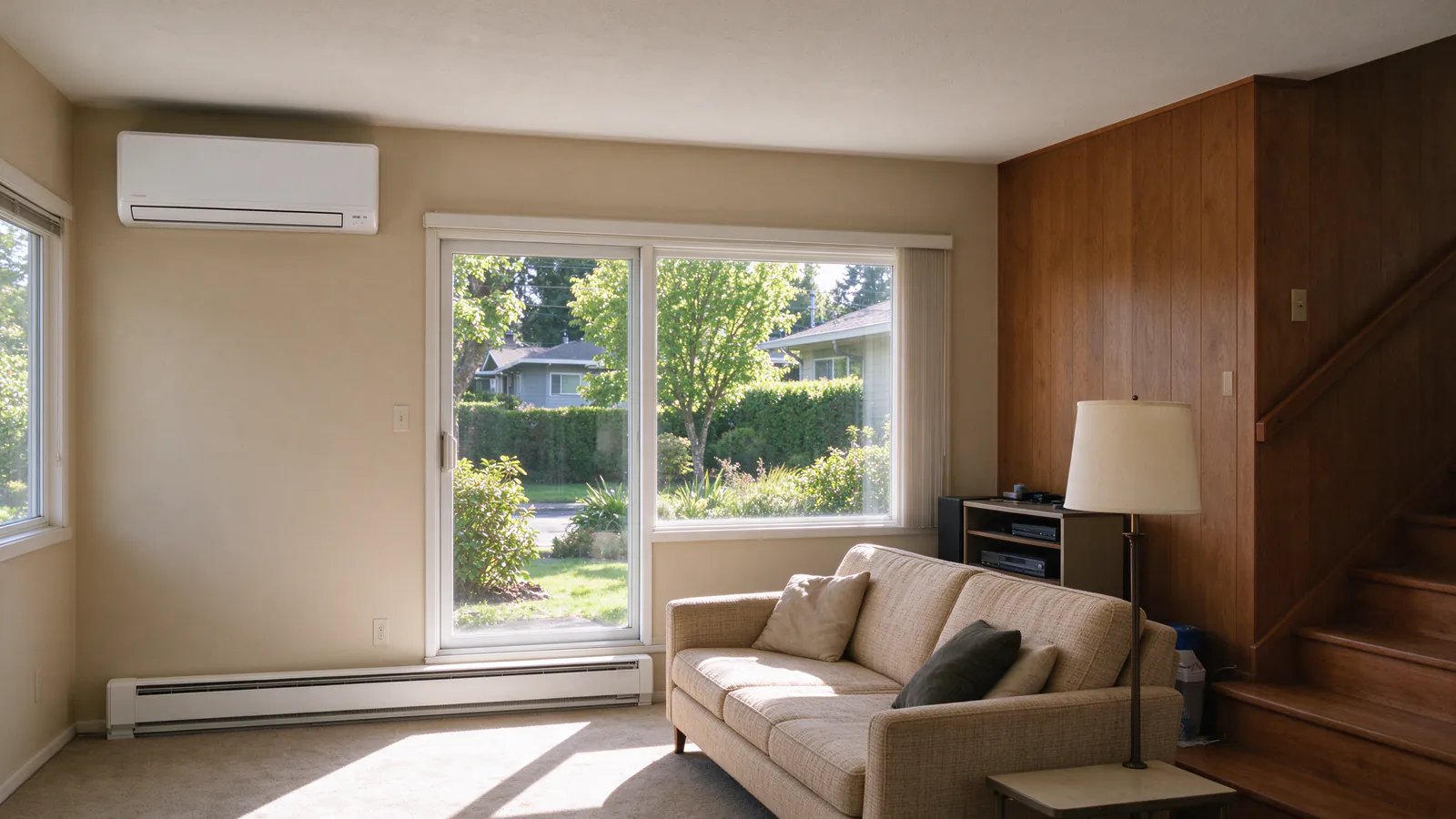
Every room has a baseboard heater, the January bill keeps climbing, and summer means fans and a window unit. You’ve heard a mini split can fix both, and want to know how much of the house it has to cover.
Swapping baseboards for a mini split puts ductless heads in the rooms that use the most heat and takes those heaters out. Firlands Portland Mini Splits plans which rooms get heads, which keep a baseboard, and lines up the Energy Trust paperwork.
Why baseboard heat costs so much to run
A baseboard turns each kilowatt-hour into exactly one kilowatt-hour of heat. A heat pump moves heat in from outside instead of making it.
Over a Portland winter a ductless heat pump typically delivers two to three units of heat for every unit of electricity it uses. Even on a cold January night it still beats a baseboard. That’s why houses on baseboard heat are the clearest case for a mini split: any heat pump costs less per unit of heat than electric resistance.
Cooling comes with it
The same heads cool in summer, which baseboards never could, and they pull moisture out of the air as they do. What will a mini split do to my electric bill? works through running costs.
Project
A typical Powellhurst-Gilbert baseboard conversion
The problem
Baseboard heaters in every room, January electric bills that keep climbing, and no cooling at all for summer.
The house
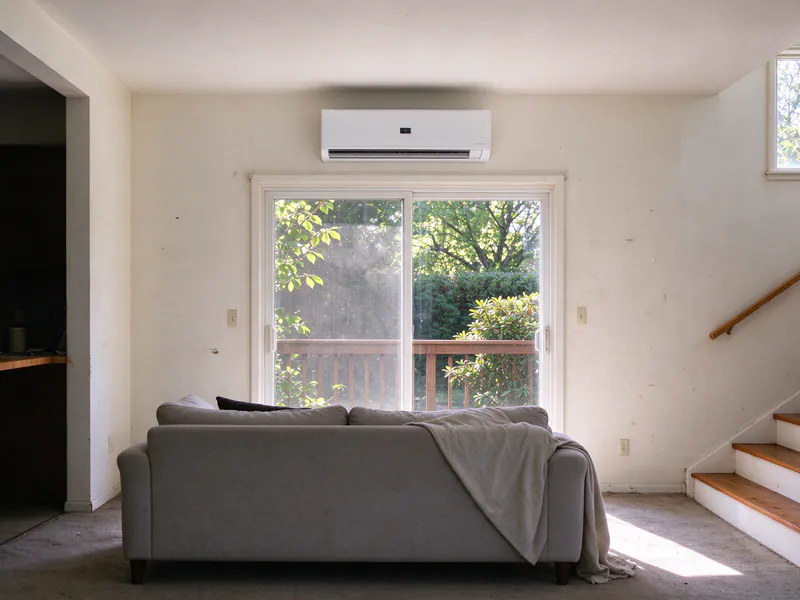
The open living and kitchen space sits on the middle level, the two bedrooms half a flight up, and a small family room half a flight down. The back yard drops toward a patio, and the panel is in the garage on the lower level.
What we decide, and why
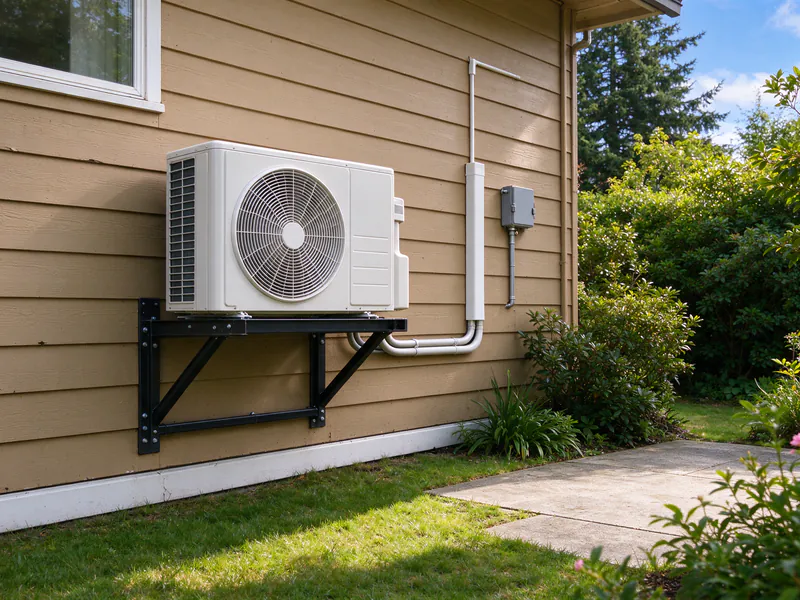
Three heads cover the rooms the family uses most: a 15,000 BTU head in the open living and kitchen space, and a 9,000 in each upper-level bedroom. The small baseboard stays in the bathroom, and the lower family room keeps its baseboards for now. The outdoor unit goes on a wall bracket on the back wall instead of a pad, because the yard falls away there and a pad there sits in the path of water running to the patio.
The work
Three three-inch holes, line sets run in one cover up the back wall, and a 240-volt circuit from the garage panel to a disconnect beside the unit. The baseboard circuits in the living room and both bedrooms come off, which frees the breaker space. The bracket is bolted into framing with rubber isolators so the compressor hum stays out of the bedroom wall. Every line set is pressure-tested and evacuated below 500 microns, and all three heads drain outside by gravity.
The bracket holds the unit high enough to stay above drifting snow and to let defrost water drip clear, which matters on the few winter nights a year Portland drops into the teens.
What it changes
The baseboards come off in the rooms that used the most electricity, the house gets cooling for the first time, and because the heads replace electric resistance heat in the main living space, the owner can apply for Energy Trust's ductless incentive.
- Location
- Powellhurst-Gilbert, East Portland
- House
- 1960s split-level heated entirely by electric baseboards
- Equipment
- Three heads (one 15,000 BTU, two 9,000 BTU) on one cold-climate outdoor unit on a wall bracket
- Price
- $13,400, permits included
- Time on site
- 2 days after permits, then the final inspections
Do you have to replace every baseboard?
No. Put heads where you spend your time, and keep a baseboard where a head doesn’t earn its place.
| Usually gets a head | Usually keeps its baseboard |
|---|---|
| The open living, dining and kitchen space | The bathroom |
| The bedrooms you use most | A guest room you rarely heat |
| A west room that overheats in summer | A small laundry or mudroom |
The main living space matters most twice over: it’s where most of the heat goes, and it’s what Energy Trust’s incentive looks at. If you want every room covered, see whole-house mini splits. How many mini splits do I need? helps with the count.
What happens on the first visit
We walk each room with you and decide room by room, not heater by heater.
We note the size, windows, insulation and how each room is used, and work out its load. A baseboard’s wattage tells us little: they were often sized generously and never changed. Then we look at:
- The panel. Which breakers feed the baseboards, and how much space their removal frees.
- The outdoor spot. A pad, a stand, or a wall bracket where the yard slopes or the side yard is narrow.
- The line-set route. One cover down a back wall can carry two or three line sets.
- The drains. Heads on outside walls drain by gravity; inside walls need a small pump.
You get a written estimate listing each head and its capacity, the outdoor unit, which baseboards come out and which stay, the line-set route, the drains, the circuit, the permits, the price and what’s not included.
Taking the baseboards out
Once the heads are running, the baseboards they replace come off the wall and their circuits are dealt with properly.
The heaters
We disconnect each heater, remove it, and cap and label its wiring at the panel, or reuse the circuit where its wire suits the outdoor unit. The wall behind is often a different color; we leave it ready for paint.
The thermostats
Wall thermostats for removed heaters come out, and their boxes get blank covers.
The breakers
Removed baseboard breakers usually free the space for the outdoor unit’s 240-volt circuit. Where they don’t, we say so at the visit. Mini split electrical requirements covers panels and circuits.
Heating through a Portland winter
For heads that heat, we choose cold-climate models by their published output in the cold, not their rating on a mild day.
Portland’s design low is 24°F, and the city drops into the teens on only a few nights a year. Cold-climate units keep heating well below that. The baseboard you keep in the bathroom, or a back room, covers you if the outdoor unit needs a repair in winter. Do mini splits work in cold weather? explains the ratings.
What it costs, and the Energy Trust incentive
Firlands’ typical range for a three- or four-head system is $9,000 to $18,000 and up; two heads typically run $6,500 to $12,000.
| Job | Typical range |
|---|---|
| One head for the main living space | $4,000 to $8,500 |
| Two heads on one outdoor unit | $6,500 to $12,000 |
| Three or four heads on one outdoor unit | $9,000 to $18,000+ |
| Whole house, five or more heads | $15,000 to $30,000+ |
Your price comes from the visit and the written estimate, with the city’s permit fees included.
The incentive
Energy Trust of Oregon currently pays $800 toward a ductless heat pump for a typical owner-occupied single-family home, and more for income-qualified, rental and attached homes. The heat pump has to replace electric resistance heat in the main living space, and its largest indoor unit has to be there.
You apply within 60 days of the install, and we sign the application. Mini split rebates in Oregon lists what else is open.
Living with heads instead of baseboards
Heads work best left running at a steady setpoint, not switched off and on like a baseboard.
A baseboard heats a cold room quickly from off. A heat pump is most efficient holding a temperature, so most people pick a setpoint for each room and leave it, perhaps a few degrees lower at night.
- Filters. Each head has a washable filter behind the front panel; rinsing it every month or two in heating and cooling season keeps the airflow up.
- Handover. We show you the remotes and filters, and leave the test readings on paper.
When a different job fits better
A baseboard conversion isn’t always the first step, or the whole answer.
- You’d rather cover one room first. Start with a single-zone system in the living space and add later.
- Every room needs it. A multi-zone or whole-house plan covers the lot.
- You rent the house out. See mini splits for rental property.