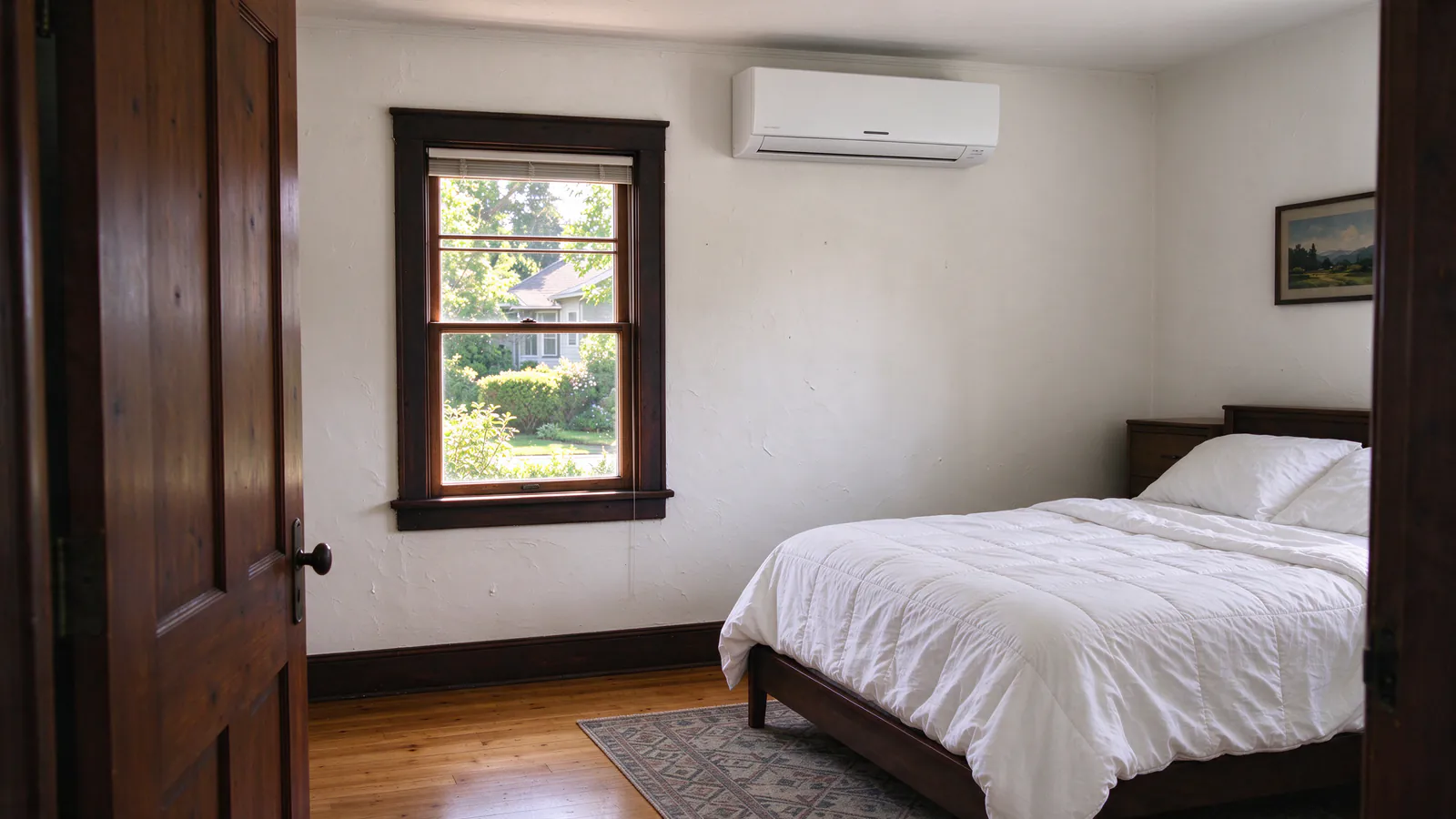
Last summer it was the attic bedroom, the office over the garage, or the west room where the afternoon sun comes straight in. The furnace heats the main floor and nothing reaches that one room.
A single-zone mini split fixes one room properly: one head on the wall, one outdoor unit outside, and a line set between them. Firlands Portland Mini Splits sizes it to that room, places it where its air reaches you, and tests it before we leave.
Is one head enough for your room?
One head is enough when the space is one room, or one open area where nothing closes off the air.
| Usually one head | Usually more than one |
|---|---|
| A bedroom or an attic office | Three bedrooms off a hallway |
| A bonus room over the garage | An upstairs with doors that close |
| An open living and kitchen space | A main floor split by walls |
It stops being enough when doors close. A head throws air across the room it’s in; it won’t push air down a hallway into the bedrooms off it.
If two closed rooms need it, look at two heads on one outdoor unit or two single-zone systems, and we’ll price both. How many mini splits do I need? walks through the count.
Project
A typical Sellwood attic-bedroom single zone
The problem
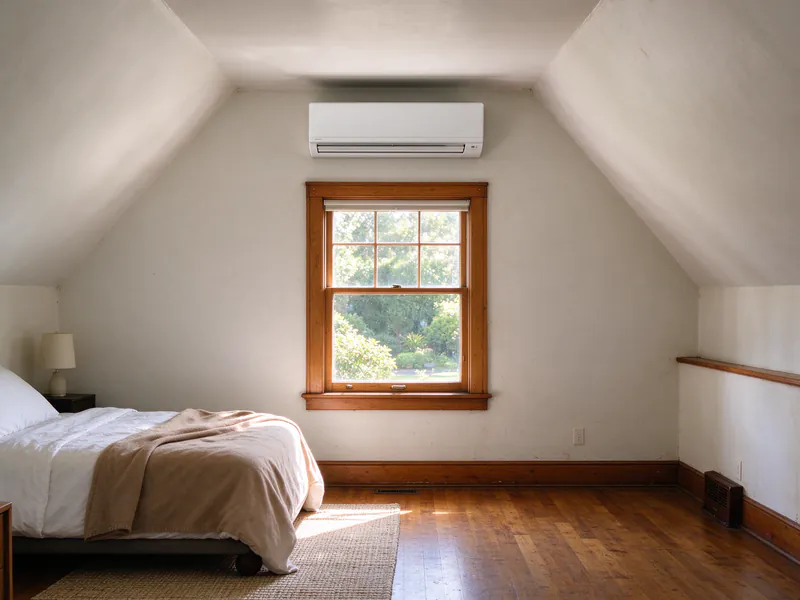
The finished attic bedroom under the roof hit 90°F most July afternoons. The gas furnace heats the main floor through ducts, but nothing reaches the attic, and the window unit in the gable blocked the only window.
The house
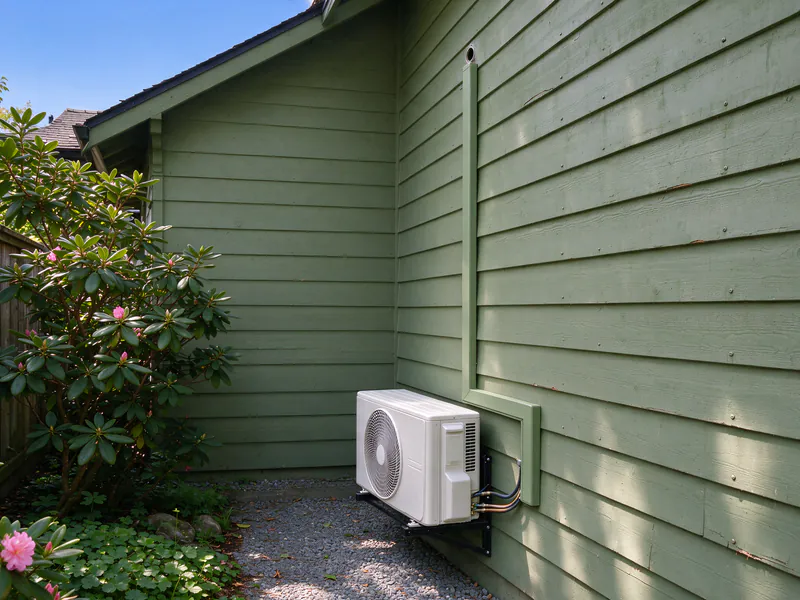
The room is 12 by 14 feet with knee walls, two small dormers and a west-facing gable window. The side yard between this house and the next is about six feet wide, and the electrical panel is in the basement, two floors down.
What we decide, and why
We size the room from its load, not its floor area: the west gable and the thin roof insulation push it to 12,000 BTU, where a 9,000 runs flat out on hot evenings. We pick a cold-climate model so the head can carry the room through winter too. The head goes on the gable wall above the window line, throwing air along the room instead of onto the bed.
The work
We core one three-inch hole through the gable wall, run a 25-foot 1/4 by 3/8 inch line set with the control cable and the drain down 18 feet of line-hide painted to match the siding, and set the outdoor unit on a wall bracket at the back corner of the narrow side yard, away from the neighbor's bedroom window. A new 20-amp, 240-volt circuit runs from the basement panel up through a closet chase. The flares are torqued to spec, the line set holds a nitrogen pressure test, and we pull a vacuum below 500 microns and watch it hold before releasing the refrigerant.
The drain shares the wall hole with the line set and falls the whole way outside by gravity, so this head needs no pump. We test it with a quart of water before closing up.
What it changes
The attic becomes a room you can sleep in through a Portland July, heated in the shoulder seasons without running the furnace for the whole house.
- Location
- Sellwood-Moreland, Southeast Portland
- House
- 1924 one-and-a-half-story bungalow
- Equipment
- One 12,000 BTU cold-climate wall head, wall-bracket outdoor unit
- Price
- $7,240, permits included
- Time on site
- 1 day, then the final inspections
What happens on the first visit
We start with the room, not the equipment: its size, its windows, the insulation above it, and how you use it.
A bedroom that has to be cool at 10 p.m. is a different load from an office used at noon. Then we look at three things that decide the price:
- The wall. The head goes high on an outside wall when possible, so the line set runs straight through one hole. An inside wall means a longer route and usually a condensate pump.
- The outside. A pad in the side yard, a stand, or a wall bracket where the yard is narrow. Portland keeps outdoor equipment out of the front setback and under five feet tall in a side or rear setback.
- The panel. Each outdoor unit needs its own 240-volt circuit. We check for breaker space and how far the wire runs.
You get a written estimate naming the head and its capacity, the outdoor unit, the line-set route, how the head drains, the circuit, the permits and the price.
Sizing: why square footage alone gets it wrong
Two rooms the same size can need very different heads, so we size from the room’s heat load, not its floor area.
A shaded north bedroom with good insulation might be comfortable on 6,000 to 9,000 BTU. A west-facing attic room under an old roof, with a big gable window, can need 12,000 or more. We work it out room by room, the method the trade calls Manual J.
What a wrong size costs you
| Too small | Too big |
|---|---|
| Runs flat out on the hottest evenings and never catches up | Cools fast, shuts off before it pulls the moisture out, and leaves the room clammy |
| Struggles on the coldest nights if you heat with it | Spends its life near its lowest output, cycling on and off |
Sizing for winter too
Portland’s design low is 24°F, and the January 2024 ice storm took the airport to 15°F. For a room you also want to heat, we choose a model whose published heating capacity holds up at those temperatures. How to size a mini split goes into the load in detail.
Where the head and the outdoor unit go
Inside, the head goes high on an outside wall; outside, the unit goes where the line set stays short and the unit can breathe.
Inside
We leave clearance above the head so the filters slide out, and aim it to throw air along the room, not straight onto the bed or the desk.
Outside
We look for a spot that:
- keeps the line set short and gives the unit room to breathe
- sits above ice and drifting snow, out of the roof’s drip line
- stays away from a neighbor’s bedroom window
Portland’s noise code allows 55 dBA at the property line in the day and 50 at night, and we place the unit so it stays inside those limits. Mini split placement has the full checklist.
The drain, the line set and the circuit
Three details decide whether a mini split stays trouble-free: where its water goes, how tight its refrigerant lines are, and how it’s wired.
The drain
Every head makes water when it cools. On an outside wall it drains by gravity through the same hole as the line set.
On an inside wall it needs a small pump with a float switch that shuts the head off before water reaches your floor. Drains are a common cause of callbacks, so we pour water into every one before we leave. The condensate drain guide explains the options.
The line set
Two insulated copper lines and a control cable. We torque the flares to the maker’s spec, pressure-test with nitrogen, and pull a deep vacuum and watch it hold before the refrigerant goes in. That’s what keeps it from slowly losing charge a year later.
The circuit
A dedicated 240-volt line from your panel to a disconnect within sight of the outdoor unit. If the panel is full, we say so at the visit and price the fix separately. Mini split electrical requirements covers panels and breakers.
What it costs
Firlands’ typical range for a single-zone install is $4,000 to $8,500, with one head, a short line run, a pad or bracket, a new circuit and the permits.
| Job | Typical range |
|---|---|
| Standard single-zone: one head, short run, pad or bracket, new circuit, permits | $4,000 to $8,500 |
| Complex single-zone: long or multi-story run, high bracket, pump, line-hide, larger cold-climate unit | $8,500 to $12,000+ |
Your price comes from the visit and the written estimate.
Mini split installation cost in Portland breaks down what’s inside the number. If the room has electric baseboard heat today, Energy Trust of Oregon may pay an incentive when a ductless heat pump replaces it in the main living space; see mini split rebates in Oregon.
When a single zone isn’t the right call
When more than one closed room needs it, or the room is part of a bigger change, another job fits better.
- The whole upstairs is warm. A multi-zone system with a head in each bedroom beats one big head in the hall.
- Your old mini split died. A replacement may reuse the line set and cost less than a new install.
- It’s a new ADU or addition. Plan it at framing so the line set goes in before the drywall: see ADU mini splits.
- It’s only for one summer. Compare a mini split with a window unit before you decide.