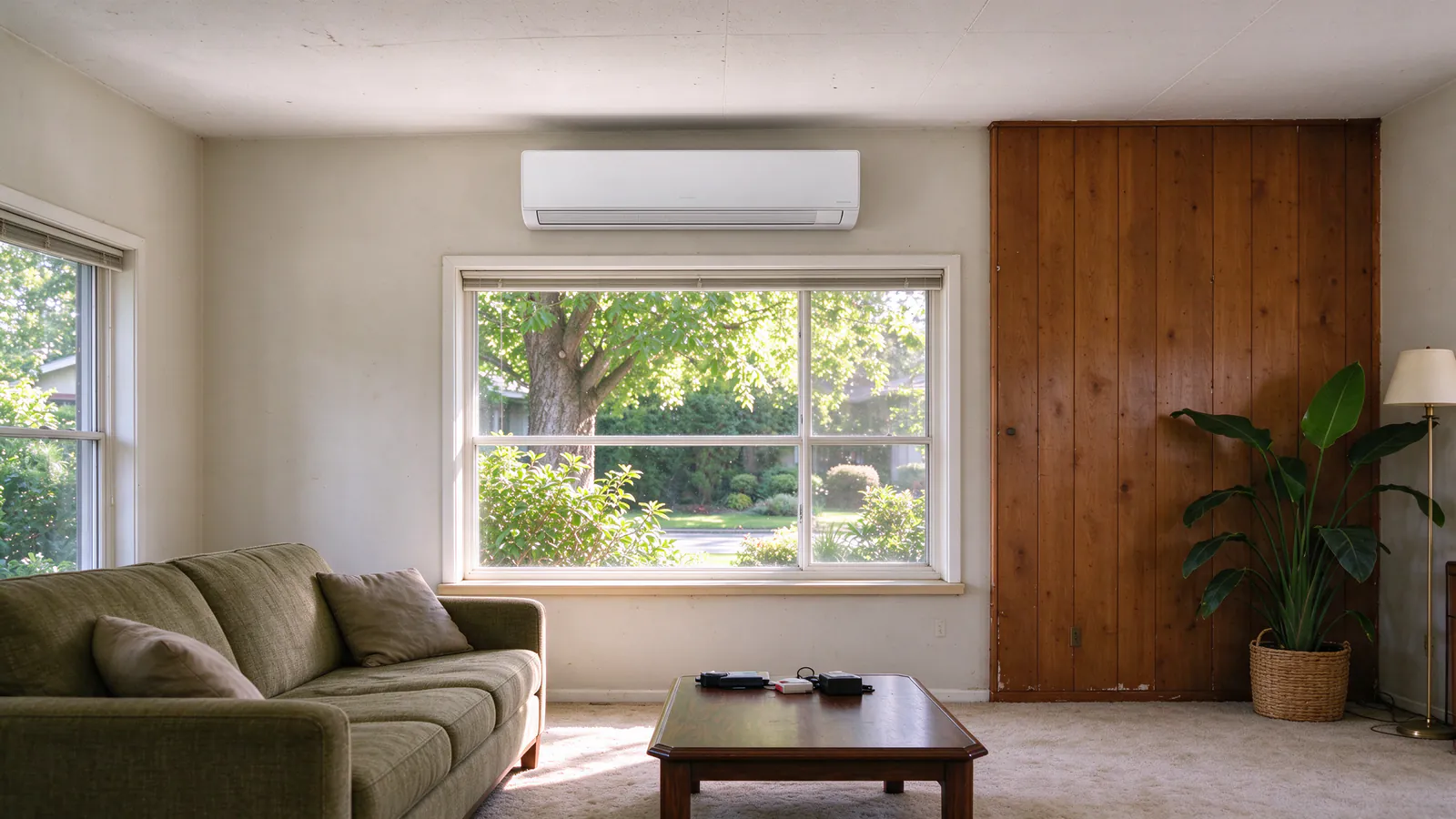
Heat that comes from the ceiling
If your Minnehaha house has a thermostat on every wall and no vents anywhere, it probably heats with resistance cables in the ceiling. That’s comfortable, quiet and expensive.
Radiant ceiling heat turns electricity into heat one for one, room by room. A ductless heat pump carries the same rooms for a fraction of the power and adds cooling. Firlands Portland Mini Splits plans the heads so the cables become backup, not a casualty of the install.
Project
A typical Minnehaha ceiling-cable ranch
The problem
Heat comes from resistance cables buried in the plaster ceilings, room by room, with a thermostat in each. It's slow, it's expensive, and when a cable fails inside the ceiling there's no clean way to fix it.
The house
Three bedrooms, one bath, a living room and kitchen on a crawlspace, with an attached carport on the west side. The address is outside Vancouver city limits, so Clark County issues the mechanical permit and Washington L&I the electrical one.
What we decide, and why
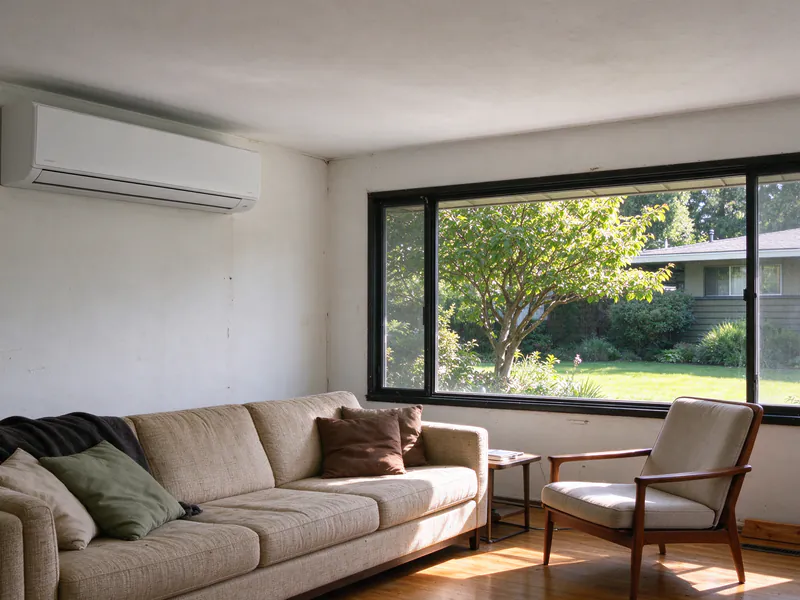
A 12,000 BTU head in the living room covers the living and kitchen area; a 9,000 in the hallway near the bedrooms carries them with the doors open. The ceiling cables stay wired as backup in each room, and their thermostats get turned down rather than removed.
The work
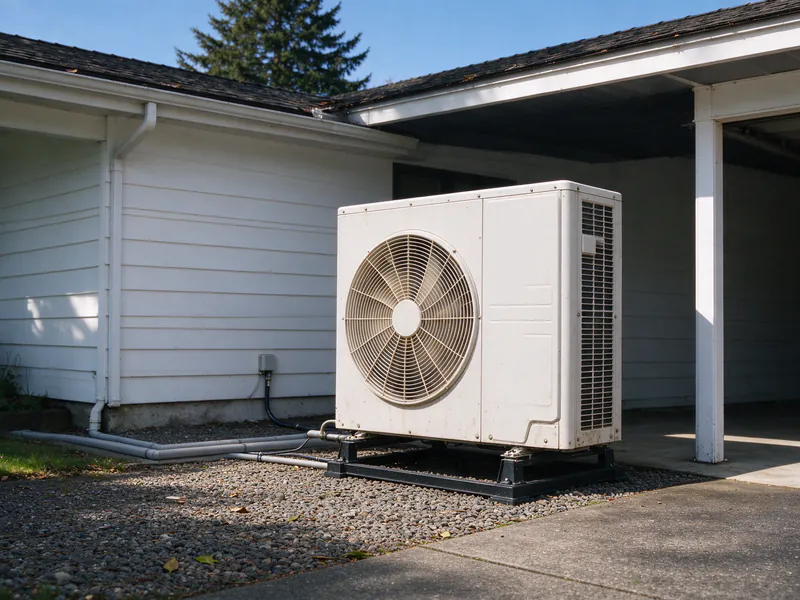
We avoid drilling into the plaster ceilings, where the cables run; heads go on exterior walls at the right height to clear them. Line sets run through the crawlspace to the outdoor unit on a stand under the carport's open side, out of the roof drip. A 20-amp, 240-volt circuit runs from the panel with a disconnect at the unit. Pressure test, vacuum below 500 microns, startup.
Clark Public Utilities names cable ceiling heat in its ductless rebate, so the $900 applies when the owner lives in the house. We check the bedroom doors with the heads running before we leave.
What it changes
The ceiling cables become backup heat for the coldest week, and the living space heats and cools on a heat pump for the first time.
- Location
- Minnehaha, unincorporated Clark County
- House
- 1962 single-level ranch, about 1,200 square feet, radiant ceiling cable heat
- Equipment
- Two heads (12,000 and 9,000 BTU) on one 18,000 BTU cold-climate outdoor unit
- Price
- $9,800, permit fees included
- Time on site
- 2 days, then the final inspections
Working around a ceiling full of cables
The cables run in a grid inside the plaster or drywall ceiling, so the rule is simple: nothing gets drilled or screwed into a heated ceiling.
How we keep clear of them
- heads mount on exterior walls, below the ceiling line, where no cable runs
- line sets and the circuit route through the crawlspace, not the attic floor
- the cable thermostats stay, turned down a few degrees as backup
When a cable has already failed
If a cable has already failed in one room, fixing it means opening the ceiling. Putting a head in that room first makes the repair unnecessary.
Minnehaha is county, Vancouver is next door
Minnehaha is an unincorporated community, so Clark County and Washington L&I issue the permits here, not the City of Vancouver.
| Permit | Covers | Issued by |
|---|---|---|
| Mechanical | Heat pump, line sets, drains | Clark County Community Development |
| Electrical | 240-volt circuit and disconnect | Washington L&I |
The Vancouver city line runs close by, so a house a few streets away can be inside the city, with both permits from the City of Vancouver. We check the parcel on the first call, include the permit fees in the price, and book both finals.
Which rooms get the heads
Most Minnehaha houses are compact, so two heads on one outdoor unit usually carry the main living space and the bedroom wing.
Ranches from the 1960s and 1970s
About a quarter of the homes here date from those decades. A head in the living room and one in the hall near the bedrooms, with the doors open, covers a three-bedroom ranch of about 1,200 square feet. A small bathroom keeps its own heater.
Newer houses
Almost half of Minnehaha’s homes were built in 2000 or later, many with an electric furnace or baseboards. Two-story ones often need a multi-zone system with a head upstairs. How many mini splits do I need? helps you count rooms.
The Clark Public Utilities rebate
Clark Public Utilities pays $900 toward a ductless heat pump that replaces permanently installed electric heat, and it names cable ceiling heat among the systems that qualify.
The conditions
- a home you own and live in, heated by ceiling cable, baseboards, wall heaters or an electric furnace
- new equipment rated HSPF2 7.5 or better, one head or several
- one rebate per home, installed by a contractor in the utility’s network
We schedule Clark County installs with network contractors, file the paperwork with your test readings, and confirm the program’s current terms before the estimate is final.
What changes on the bill
Resistance heat makes one unit of heat from each unit of electricity; a heat pump moves two to three on a mild day and still more than one on a cold night.
How much you save depends on how many heating hours the heads take over. In a ceiling-heat house where the living room and bedrooms move to the heat pump, most of the winter’s heating runs through it. What a mini split does to your electric bill walks through the arithmetic.
Sizing for the coldest Clark County nights
We size the heads to carry the house at 28°F, the county’s design low at Pearson Field, and read each outdoor unit’s published output in the teens.
Pearson Field, about three miles south, sees roughly 45 freezing nights a year and two or three at 20°F or below. A cold-climate unit keeps heating on those nights, and the ceiling cables stay wired for the rare ice storm when you want more. Do mini splits work in cold weather? has the detail.
Why we don’t oversize
A head that’s too big for the room cycles on and off through the mild months, which wastes power and leaves the room clammy in summer. Sizing to the load, with backup in place, avoids that. Mini split sizing explains the load calculation.
How a crawlspace job runs
Most Minnehaha ranches sit on a crawlspace, and that’s where the line sets and the circuit travel.
- The visit. We measure each room, check the crawlspace height and the panel, and mark where each head and the outdoor unit go.
- The estimate and permits. Once you approve the written estimate, we file with Clark County and L&I.
- Install. Heads on the walls, line sets down through the floor and along the joists, a nitrogen pressure test and a vacuum below 500 microns on each.
- Close-out. Every drain tested with water, the finals booked, and the readings on paper with the rebate forms.
Siting the outdoor unit on a small lot
Minnehaha lots are mostly modest, so the outdoor unit goes where it’s quiet for you and the neighbors and clear of winter ice.
- beside a carport or at the back corner, on a stand above ice and drifting snow
- out of the roof’s drip line, with a path for defrost water to run off
- at least a foot from the wall and away from a bedroom window next door
Mini split placement covers clearances in more detail.
What a Minnehaha conversion costs
Firlands’ typical range for one head is $4,000 to $8,500, two heads on one outdoor unit $6,500 to $12,000, and three or four heads $9,000 to $18,000 and up.
The written estimate lists every head and its capacity, the outdoor unit, the line-set route through the crawlspace, the drains, the circuit, permits and exclusions. The utility’s $900 comes after the job. The cost estimator gives a quick range, and baseboard to mini split covers conversions from other electric heat.