Cutting the winter bill in an electrically heated Vancouver house
If your Vancouver house heats with baseboards or wall heaters, January’s bill is the problem, and a ductless heat pump is usually the fix. Firlands Portland Mini Splits plans those conversions room by room, on both sides of the river.
Two out of three Vancouver homes heat with electricity, more than anywhere else in the metro. A resistance heater turns each kilowatt-hour into one unit of heat; a heat pump moves two to three times that much on a mild winter day.
What changes when you cross the bridge
Three things are different here, and they all show up on the estimate:
- the City of Vancouver issues the permits, including the electrical one
- Washington licensing rules decide who runs the new circuit
- the rebate comes from Clark Public Utilities, not Energy Trust of Oregon
Baseboard to mini split covers the conversion itself. The rest of this page covers what’s specific to Vancouver.
Project
A typical Hough wall-heater conversion
The problem
Six recessed electric wall heaters, a winter bill that tops the summer one by a wide margin, and an upstairs bedroom under the roof that runs hot from June to September. The person living there wants one system that heats and cools.
The house
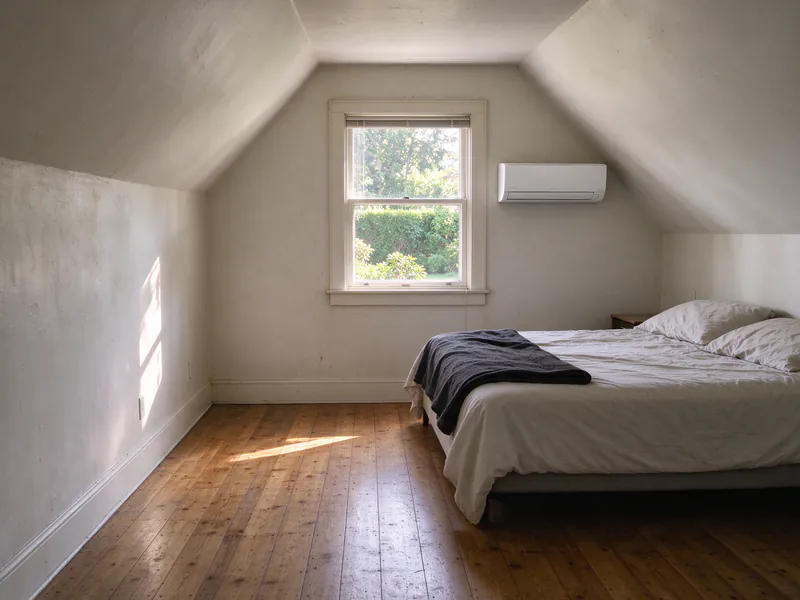
The main floor is an open living and dining room with the kitchen behind; the upstairs is one bedroom with sloped ceilings and knee walls. The back of the lot meets an alley, and the panel is a 200-amp service in the basement. Hough sits inside Vancouver city limits, so the City of Vancouver issues both the mechanical and the electrical permit.
What we decide, and why
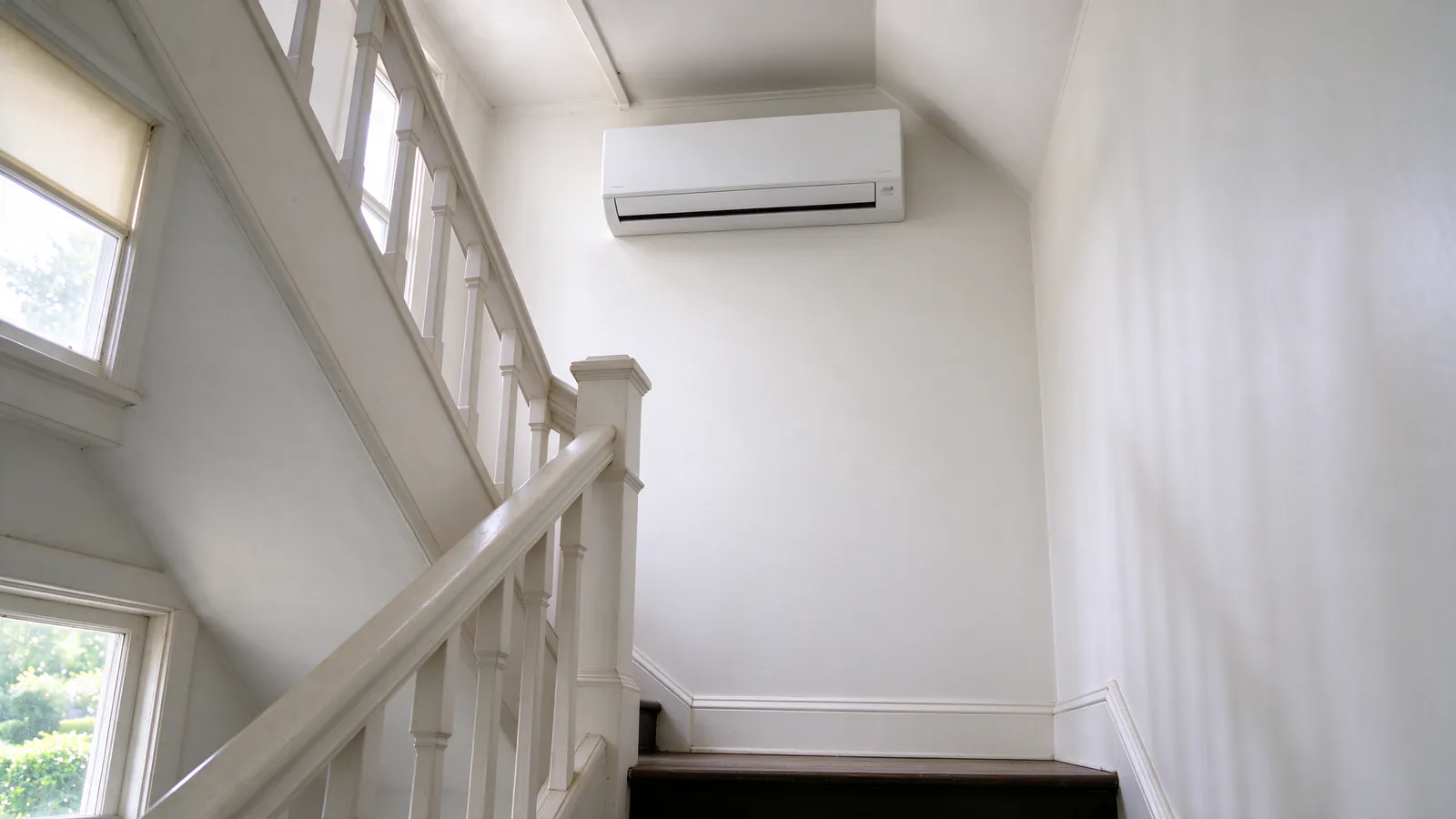
A 12,000 BTU head on the living room's inside wall carries the main floor; a 9,000 in the upstairs gable covers the bedroom. Both run off one 18,000 BTU cold-climate outdoor unit, picked for its output at Clark County's 28°F design low. The bathroom and the back bedroom keep their wall heaters as backup, and the main-floor heater circuits come off.
The work
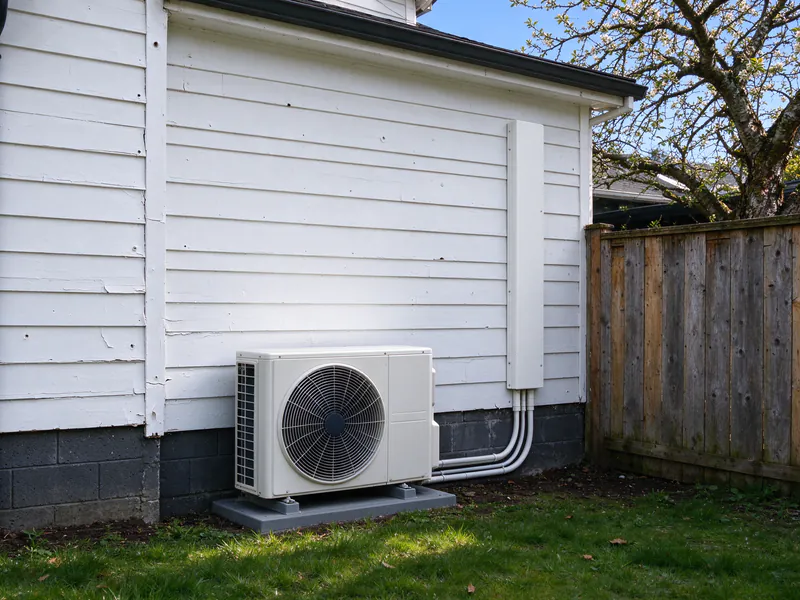
We core two three-inch holes, run the upstairs line set down the back wall in one painted cover, and set the outdoor unit on a pad beside the alley fence, clear of the drip line. A 20-amp, 240-volt circuit runs from the basement panel with a disconnect at the unit. Each line set holds a nitrogen pressure test and a vacuum below 500 microns before the refrigerant goes in.
Because the heads replace permanently installed electric resistance heat in a house the owner lives in, the job fits Clark Public Utilities' $900 ductless rebate. The contractor who installs it is in the utility's network, and we hand over the paperwork with the test readings.
What it changes
The main floor and the upstairs bedroom heat and cool on one quiet system, four wall heaters go cold for most of the winter, and the rebate application goes in with the job.
- Location
- Hough, Vancouver
- House
- 1941 story-and-a-half house, about 1,300 square feet, electric wall heaters
- Equipment
- Two heads (12,000 and 9,000 BTU) on one 18,000 BTU cold-climate outdoor unit
- Price
- $10,400, city permit fees included
- Time on site
- 2 days, then the city's final inspections
Which rooms get a head first
We start with the rooms you live in, then the bedroom you use most, and leave small rooms on their existing heaters.
The living room usually carries most of the heating hours, so it gets the first and largest head. A primary bedroom comes next, often on the same outdoor unit as a multi-zone system. Bathrooms, laundry rooms and a rarely used guest room can stay on their baseboards; they run for minutes a day, not hours.
When a whole-house system makes sense
If every room is used every day and the house is small and open, a head in each main space can replace nearly all the resistance heat. Whole-house mini split explains when that pays, and how many mini splits do I need? helps you count.
Permits from the City of Vancouver
Inside city limits, the City of Vancouver issues both permits a new mini split needs, and it runs its own electrical inspections instead of Washington L&I.
| Permit | What it covers | Who issues it |
|---|---|---|
| Mechanical | The heat pump, its line set and drains | City of Vancouver |
| Electrical | The new 240-volt circuit and the disconnect | City of Vancouver |
The city’s fee schedule charges each permit at least its minimum fee, and we include those fees in your price. Just outside the city line, in Hazel Dell, Minnehaha or Orchards, Clark County issues the mechanical permit and L&I the electrical one. We check your address on the first call.
Who can run the circuit in Washington
Washington’s electrical rules split the job: the HVAC specialty covers wiring at the equipment, but the new branch circuit from your panel is electrical-contractor work.
That matters because a mini split always needs its own 240-volt circuit and a disconnect within sight of the outdoor unit. On a Vancouver job, the estimate names who wires it, and the city inspects it. An Oregon license doesn’t carry across the river. Mini split electrical requirements covers circuit sizes and panel space.
How a Vancouver job runs, from first call to final
Most Vancouver jobs follow the same five steps, and the permit step is the one that differs from Portland.
- Photos and a phone range. Send photos of the rooms, the heaters and the panel, and we give you a rough range on the phone.
- A visit that measures each room. We check windows, insulation and orientation, and look at the panel and the outside walls.
- The written estimate. Heads, capacities, outdoor unit, line-set route, drains, circuit, permits and price, in writing.
- Permits and install. We apply to the City of Vancouver, then install, pressure-test, pull a vacuum below 500 microns and test every drain with water.
- Inspections and paperwork. The city’s final inspections close the permits, and you get the test readings on paper with the rebate forms.
Clark Public Utilities’ ductless rebate
Clark Public Utilities pays $900 toward a ductless heat pump when it replaces permanently installed electric resistance heat in a home you own.
What qualifies
- cable ceiling heat, baseboards, wall heaters or an electric furnace already in place
- a new unit with an HSPF2 rating of 7.5 or higher, single or multi-head
- one rebate per home, installed by a contractor in the utility’s network
Portable space heaters don’t count, and a self-install doesn’t qualify. If you rent the house out, ask us first; the utility sets the rules on who applies. We confirm the current program terms before the estimate is final.
Sizing for a Clark County winter
We size the heating to Clark County’s 28°F design low, measured at Pearson Field, and then check each outdoor unit’s published output colder than that.
Pearson Field averages about 45 nights a year at or below freezing and two or three at 20°F or colder. A cold-climate unit keeps heating through those nights, but its output drops as it gets colder.
What that means for your equipment
We choose each outdoor unit by its low-temperature capacity, not its nameplate, and we leave a wall heater or two wired in for the rare ice storm. Do mini splits work in cold weather? explains the numbers.
Vancouver houses and how they change the job
Vancouver’s housing runs from prewar bungalows near downtown to 1990s subdivisions in the east, and each type routes its line sets differently.
Older houses near downtown
In Hough, Arnada and Shumway, story-and-a-half houses often have wall heaters downstairs and an unheated or poorly heated upstairs room. The upstairs line set runs down the back wall or an inside closet. Before we drill any house built before 1978, we set up lead-safe dust containment.
Postwar ranches
Rose Village, Bagley Downs and Fourth Plain Village have many single-level houses on crawlspaces. Line sets run straight through the wall or under the floor, and a two-head job is usually two days.
East Vancouver two-stories
Around Cascade Park and Fishers Landing, houses from the 1980s and 1990s often have electric forced-air furnaces. A head or two in the main rooms can cut the furnace’s hours, or a ducted mini split can reuse the ducts.
What a Vancouver install costs
Firlands’ typical range for one head is $4,000 to $8,500, and for two heads on one outdoor unit $6,500 to $12,000.
Three and four heads run $9,000 to $18,000 and up. The $900 rebate comes off after the job, once the utility processes it.
What the written estimate lists
- each head, its capacity and the room it serves
- the outdoor unit and where it sits
- the line-set route and how each head drains, by gravity or pump
- the circuit, the permits and the price, with exclusions spelled out
The cost estimator gives a quick range, and what a mini split does to your electric bill covers running costs.