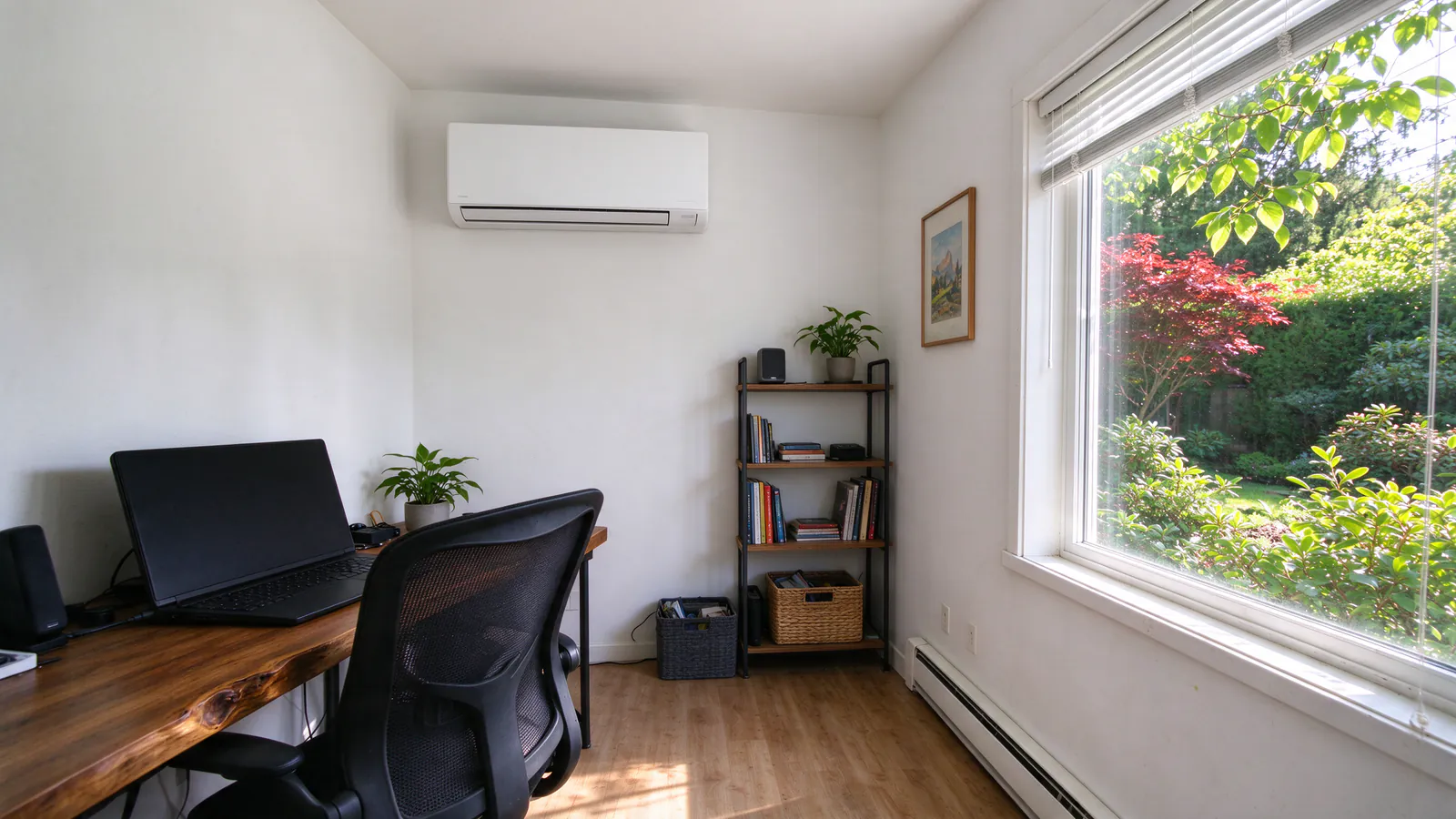
A room out back the house can’t reach
Felida is almost all detached houses. If yours has a building behind it, such as a studio, office, shop or guest room running on a space heater and a fan, that’s the room this page is about.
The house’s furnace can’t reach it, and running ducts across the yard isn’t practical. Firlands Portland Mini Splits puts a small head in the outbuilding with its outdoor unit right beside it, and works out the power from what’s already there.
Project
What a Felida backyard studio install looks like
The problem
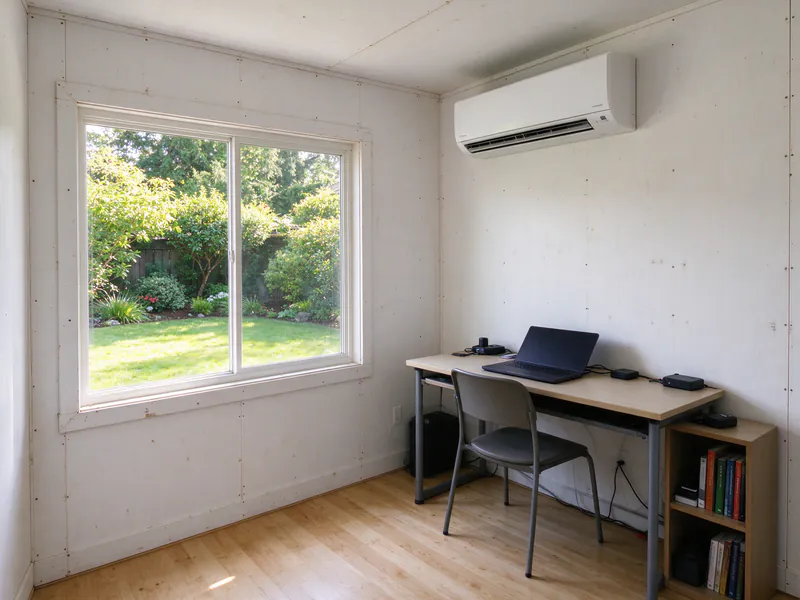
The detached studio used as an office has a plug-in space heater in winter and a box fan in summer, and the space heater keeps tripping the studio's only circuit.
The house
The studio has insulated walls, two windows and a 30-amp feeder from the house panel buried in conduit. It sits 60 feet from the house, behind a lawn the owner doesn't want trenched again.
What we decide, and why
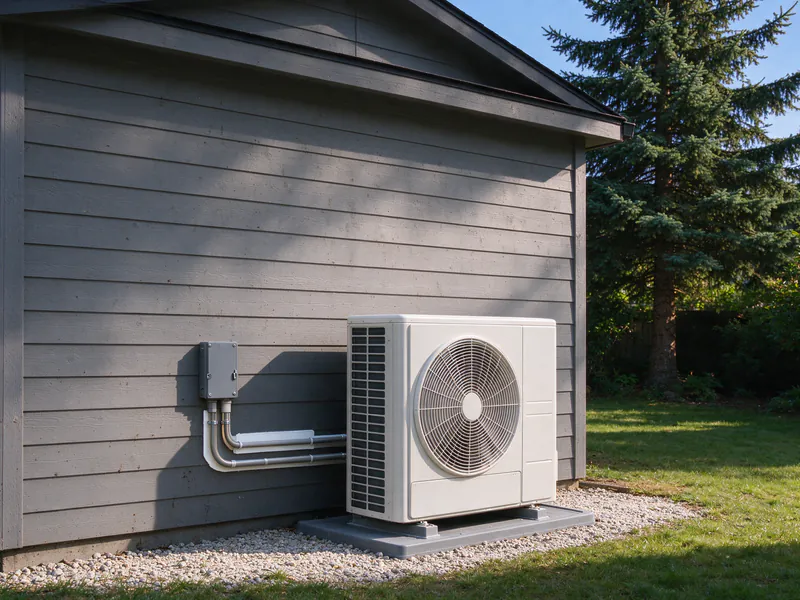
A 9,000 BTU head is plenty for 280 square feet. We power it from a small subpanel in the studio fed by the existing feeder, after a load check shows the feeder has room once the space heater is gone. The outdoor unit sits behind the studio, so the line set is six feet long instead of 60.
The work
A new subpanel in the studio, one 15-amp, 240-volt circuit to a disconnect, one three-inch hole, a short line set and gravity drain to the outdoor unit on a pad. No trench. Pressure test, vacuum below 500 microns, drain water test, startup.
Clark County issues the mechanical permit for an accessory building like this one; Washington L&I issues the electrical permit for the subpanel and circuit.
What it changes
The studio works as an office twelve months a year, the space heater goes to the garage, and the lawn stays as it is.
- Location
- Felida, unincorporated Clark County
- House
- 1998 two-story with a detached 14 by 20 foot backyard studio
- Equipment
- One 9,000 BTU cold-climate wall head and its outdoor unit
- Price
- $6,400, permit fees included
- Time on site
- 1 day, then the final inspections
Powering a head in an outbuilding
The power is the main question for a detached studio. The head itself is simple; what feeds it decides the cost.
Using the feeder you have
Many outbuildings already have a buried feeder from the house panel. With the space heater gone, a small head often fits on it through a subpanel in the studio. We do a load check before promising that.
When it needs more
If the feeder is too small or in poor condition, the estimate shows a new one, with the trench route and any lawn or patio that has to come up. That’s where an outbuilding job can climb toward the top of the range.
Mini split electrical requirements explains circuit sizes and subpanels.
Sizing a small building
A studio is small but exposed on every side, so we size it from its walls, windows and insulation, not just its floor area.
| Studio feature | What it does to the size |
|---|---|
| Insulated walls and ceiling | A 9,000 BTU head often covers up to about 300 square feet |
| Uninsulated walls or a big window wall | Bump up a size, or insulate first |
| A slab floor | More heating in January; a head runs longer |
| Used daily vs a few times a week | Same size, different settings |
If the studio becomes a guest room or rental later, ADU and addition installs covers the bigger version.
The gas house with a hot upstairs
Most Felida houses heat with gas, and many of the two-stories from the 1980s and 1990s get hot upstairs in summer.
Why it happens
The upstairs bedrooms sit at the end of the duct runs, under the roof, and a furnace without air conditioning does nothing for them in July.
What we do
A head in the primary bedroom, or two or three bedrooms on one multi-zone outdoor unit, cools them directly. Because they’re heat pumps, they also heat those rooms in spring and fall without starting the furnace. Single-zone vs multi-zone helps you choose.
Permits for a Felida job
Felida is unincorporated Clark County: the county issues the mechanical permit and Washington L&I the electrical one.
| Permit | Covers | Issued by |
|---|---|---|
| Mechanical | Head, outdoor unit, line set, drain | Clark County Community Development |
| Electrical | Subpanel, circuit, disconnect | Washington L&I |
Permit fees are in our price. An outbuilding with a new subpanel gets its own L&I electrical inspection. Under Washington’s rules, the branch circuit from a panel is electrical-contractor work, and the estimate names who does it.
Where the outdoor unit sits
For a studio, the outdoor unit goes right next to it; for the house, on the side that keeps it quiet and clear of ice.
- beside or behind the studio, on a pad, with a line set a few feet long
- at least a foot off the wall, with open air in front of the coil
- out of the roof’s drip line, and away from a neighbor’s bedroom window
Mini split placement covers clearances.
Is a window unit enough?
For a studio used a few hours a week in summer only, a window unit can do. For year-round use, it can’t.
A window unit cools and blocks the window. It doesn’t heat, so the space heater stays, and the noisy compressor sits in the room with you. A head heats and cools quietly, frees the window, and runs on less power than the space heater it replaces. Mini split vs window AC compares the two.
How a studio job runs
A backyard studio with a usable feeder is usually a one-day install.
- The visit. We measure the studio, open the house panel and the studio’s existing box, and trace where the feeder runs.
- The written estimate. Head size, outdoor unit location, the power plan, the drain, permits, price and exclusions.
- Install day. Subpanel and circuit first, then the head, one wall hole, the short line set and the drain. The line set holds a nitrogen pressure test and a vacuum below 500 microns before the refrigerant goes in.
- Close-out. The drain gets a water test, the county and L&I finals follow, and you get the readings on paper.
Sizing for a Clark County winter and summer
We size heads for 28°F, the county’s winter design low at Pearson Field, and for the 88°F summer design figure, then check each outdoor unit’s output in the teens.
A small studio loses heat fast on a cold night, but a cold-climate head keeps up with it. Because the building is used by day, a head set back at night recovers quickly in the morning. Do mini splits work in cold weather? explains the low-temperature ratings.
Rebates in Felida
Clark Public Utilities pays $900 toward a ductless heat pump that replaces permanently installed electric heat in a home you own and live in.
A gas-heated Felida house usually doesn’t qualify, and a space heater in a studio doesn’t count as installed heat. A house that heats with baseboards, wall heaters or an electric furnace can. We check before the estimate is final.
Felida prices
Firlands’ typical range for a studio, ADU or addition is $5,000 to $12,000 and up; a single head runs $4,000 to $8,500, and two heads on one outdoor unit $6,500 to $12,000.
The written estimate lists the head and its capacity, the outdoor unit, the power plan, drains, permits and exclusions. The cost estimator gives a first range.