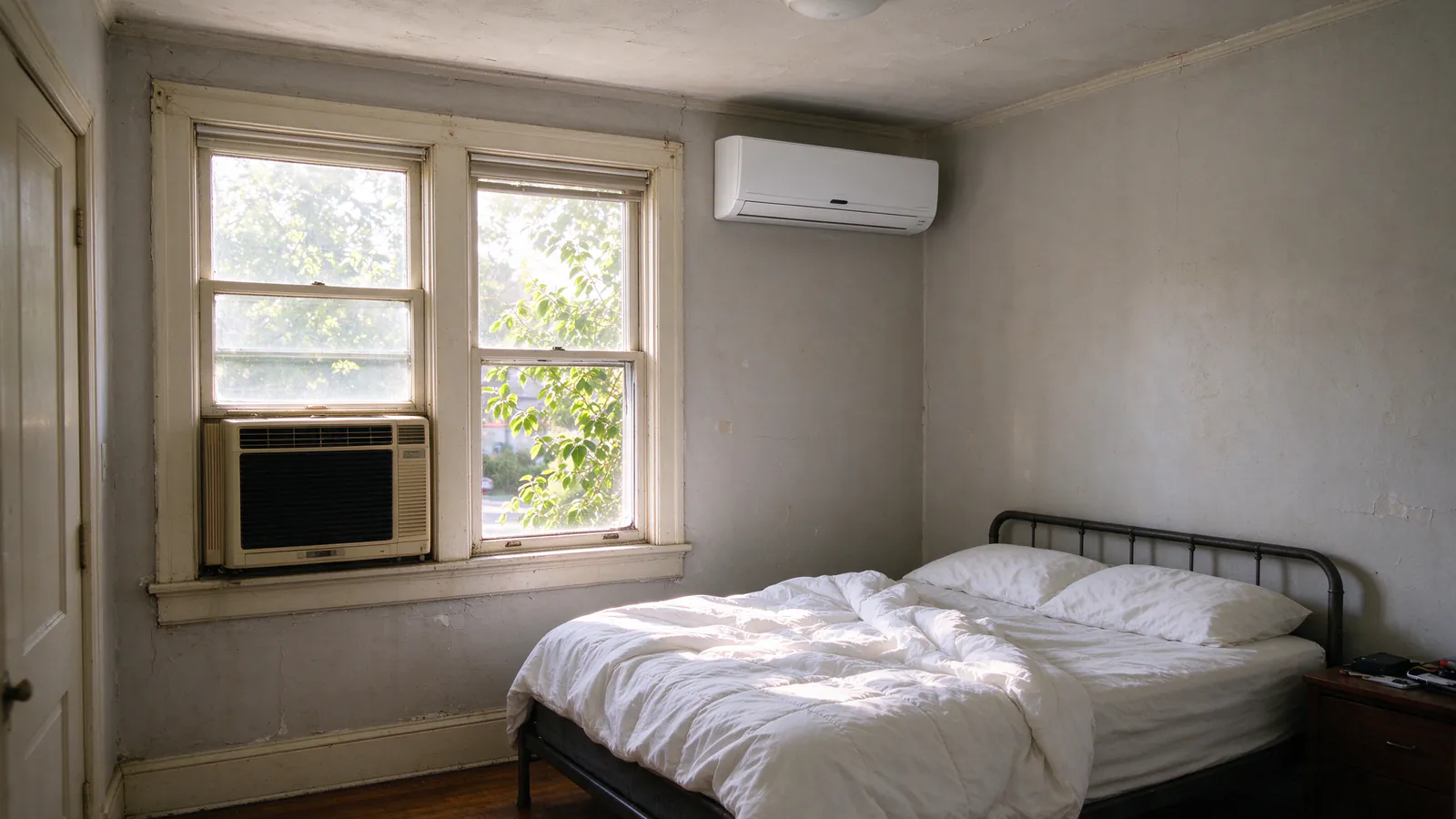
Every June the window units come up from the basement, and every June you wonder whether this is the year to do something permanent. At Firlands Portland Mini Splits we install mini splits, but a window unit is sometimes the right answer, and we’ll say so.
The quick comparison
A window unit cools one room cheaply for a summer. A mini split cools and heats one or more rooms quietly for years.
| Window or portable unit | Mini split | |
|---|---|---|
| Up front | A fraction of a mini split | Firlands’ typical range for one head is $4,000 to $8,500 |
| Install | Plug in, set in the window | One day on site, plus permits |
| Noise in the room | Loud: the compressor is in the window | Low: the compressor is outside |
| The window | Blocked, and harder to secure | Clear |
| Winter | Comes out; no heat | Heats, often replacing baseboards |
| Running cost | Higher for the same cooling | Lower, with an inverter compressor |
| Renting | Allowed in most cases under Oregon law | Needs the owner’s approval |
When a window unit is the right call
A window or portable unit makes sense when the need is short, small, or not yours to change.
- You rent. You usually can’t add a mini split on your own, and Oregon law protects your right to a window or portable unit in most cases.
- One summer. You’re selling, renovating next year, or waiting on a bigger plan.
- One small room you rarely use, where a few hot afternoons a year don’t justify a permanent system.
- Backup. A unit in the closet for the week a heat dome lands is cheap insurance.
When a mini split is the better choice
If you own the house and you’re cooling the same rooms every summer, a mini split usually pays back in comfort and running cost.
It’s quiet where you sleep
With a window unit, the compressor and outdoor fan sit in the window, a few feet from the bed. A mini split puts them outside, often at the side of the house (placement guide). The head inside runs at a low fan speed most of the night.
It heats, too
A heat pump mini split is the same machine in reverse. In a room on electric baseboards, it lowers the cost of heat as well as cooling, and Energy Trust of Oregon pays an incentive when a ductless heat pump replaces electric resistance heat in the main living space (rebates in Oregon).
It uses less power
An inverter mini split slows down once the room is cool rather than switching on and off, so it uses less electricity for the same cooling than a window unit. On a heat-dome week, that difference adds up.
It gives the window back
No bracket, no foam panels, no gap for insects or rain, and nothing to haul up and down the stairs twice a year.
Oregon’s rules on window and portable units
If you rent, Oregon law gives you a right to a window or portable air conditioner in most cases. A permanent mini split is a different matter.
Portable cooling devices
Since 2022, Oregon law (SB 1536) has kept landlords from banning portable cooling devices, meaning window units, floor units and evaporative coolers. The exceptions are listed: a building code issue, the maker’s installation guidelines, damage to the unit or building, or not enough electrical capacity. The landlord can require removal between October 1 and April 30.
The same law voids condominium and planned-community rules that ban portable cooling devices, with similar exceptions.
Why a mini split isn’t covered
The law’s definition leaves out devices whose installation requires altering the home. A mini split needs a hole through the wall, a line set and an outdoor unit, so a condo association or landlord keeps the say over it. If you own a condo, check your association’s rules on outdoor units before you plan one (condo mini splits).
Cooling in newer rentals
For homes whose building permits were issued on or after April 1, 2024, Oregon law requires the landlord to provide cooling in at least one room other than a bathroom. A heat pump, central air or a landlord-supplied portable unit all count. Landlords planning a mini split for a rental can read mini splits for rental property.
Portable units, garages and other spaces
Portable floor units are easy to move, but they’re the weakest coolers of the lot.
A single-hose portable pushes its hot air out the window through a hose, and that pulls warm outdoor air back into the room through gaps. In a big or leaky room, like a garage or an attic office, it can barely keep up on a 95°F afternoon.
A step up for a garage or attic office
For a garage workshop or an attic room you use every day, a small mini split is the step up. Insulate the garage first if you can, since that shrinks the head you need (mini split sizing).
Why it matters in a heat wave
Portland averages about two weeks a year at 90°F or above, and the June 2021 heat dome took the airport to 116°F.
Whatever you choose, cooling helps only if it’s working and switched on when the heat comes. A window unit stored in the garage since last August does nothing on the first 100-degree afternoon; a mini split on the wall is ready whenever you turn it on.
What it costs to make the switch
Firlands’ typical range for a single-zone mini split, one head and one outdoor unit, is $4,000 to $8,500 with the circuit and permits.
| Job | Firlands’ typical range |
|---|---|
| One head replacing a window unit | $4,000 to $8,500 |
| Two rooms on one outdoor unit | $6,500 to $12,000 |
| Complex single-zone: long run, pump, high bracket | $8,500 to $12,000+ |
If you’re replacing more than one window unit, how many mini splits do I need? helps you count, and our single-zone installation page shows what the job includes. Call us with the room you’d start with, and we’ll tell you what it would take.