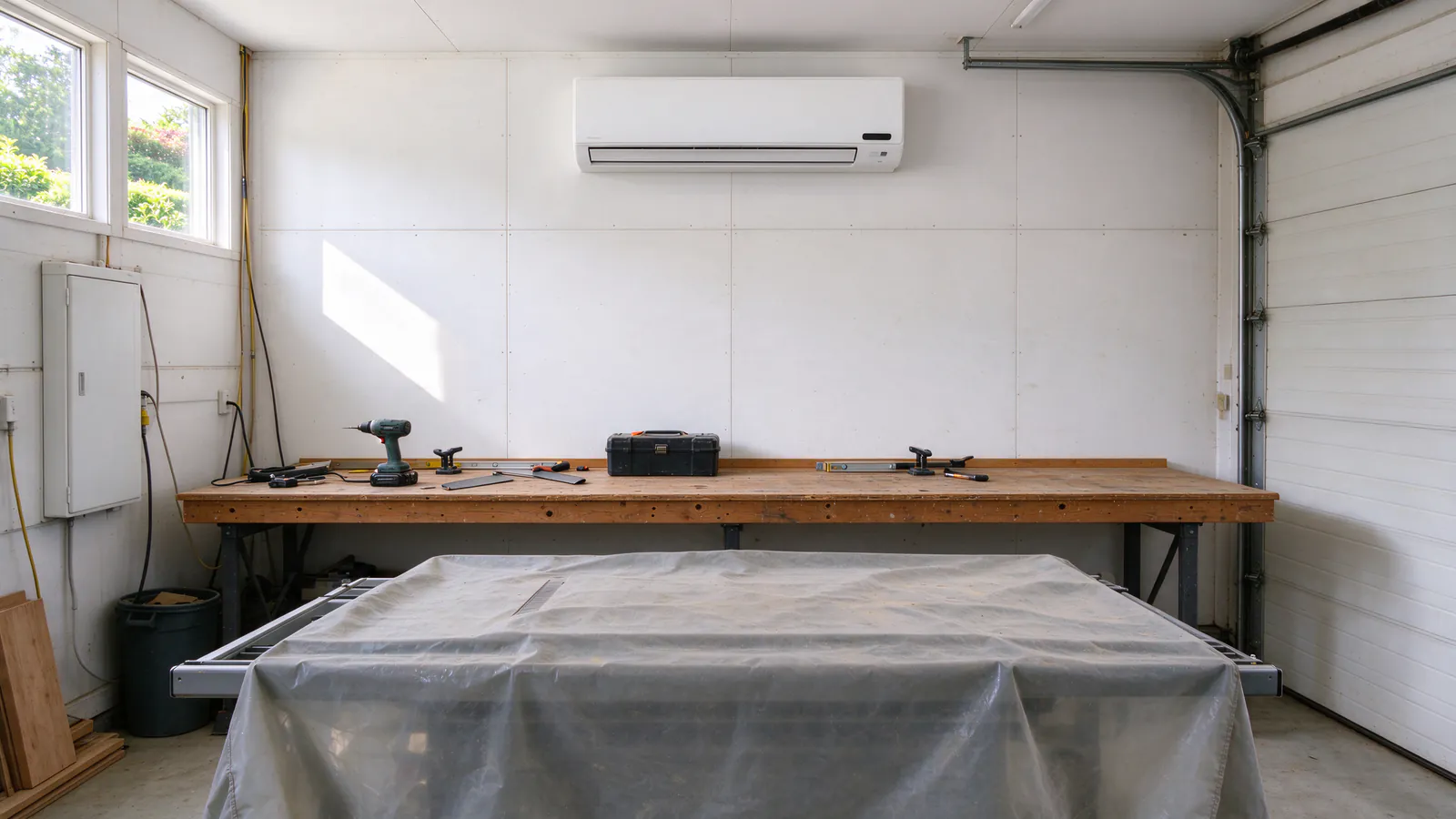
The garage is where you build things, lift weights or paint, but in January your hands go numb and in August it’s an oven. A space heater trips the breaker and a fan just moves hot air around.
A garage mini split heats and cools the space on one head and one outdoor unit. Firlands Portland Mini Splits sizes it for the garage’s real walls, door and slab, checks that the panel can carry it, and pulls the city permits.
What makes a garage different from a bedroom
A garage loses heat through things a house room doesn’t have: a big door, a bare concrete slab and often walls with no insulation. Those decide the size more than the floor area does.
| Garage feature | What it does to the load |
|---|---|
| Uninsulated roll-up door | One of the biggest heat losses in the building |
| Bare slab on grade | Pulls heat out of the room all winter |
| Open studs or a thin ceiling | Heat leaves fast in winter and comes in fast in summer |
| A workbench and tools | Dust on the filters, sometimes heat from the equipment |
A garage that’s insulated and sealed can use a much smaller head than one that isn’t. That’s why the first question we ask is what’s in the walls.
Project
What a garage workshop mini split looks like in Multnomah
The problem
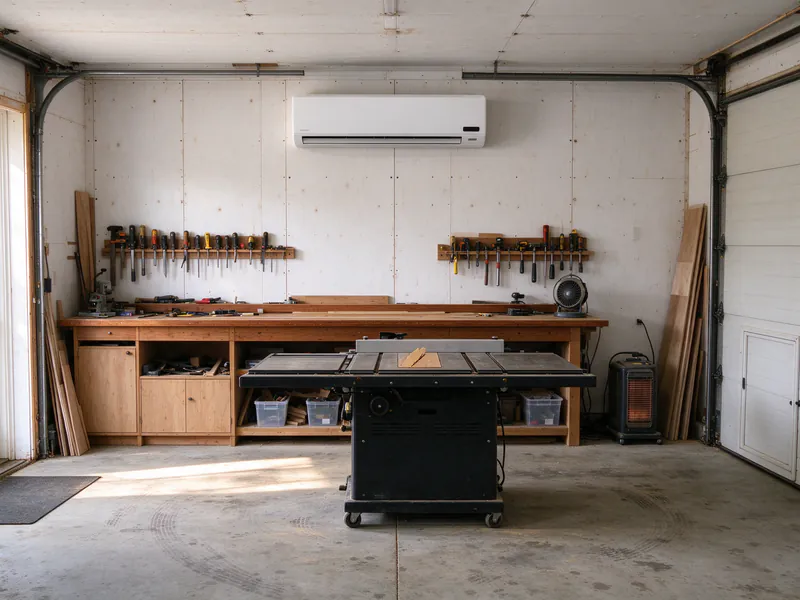
The woodshop is unusable on winter mornings, glue won't set below about 50°F, and in August the garage holds the afternoon heat until late evening. A plug-in heater keeps tripping the garage's 20-amp circuit.
The house
The owner insulated and drywalled the walls and ceiling a few years ago, but the 16-foot roll-up door is bare steel and the slab is uninsulated. A 60-amp subpanel in the garage is fed underground from the house, and it runs the lights, outlets and a 240-volt table saw.
What we decide, and why
With the door as it is, the load comes to 18,000 BTU to hold the shop at 55°F on a 24°F morning. With an insulated door the load drops to about 12,000; the owner is keeping the door, so we size for it rather than undersize the head. The head goes on the back wall above the bench, well away from the saw, throwing air toward the door.
The work
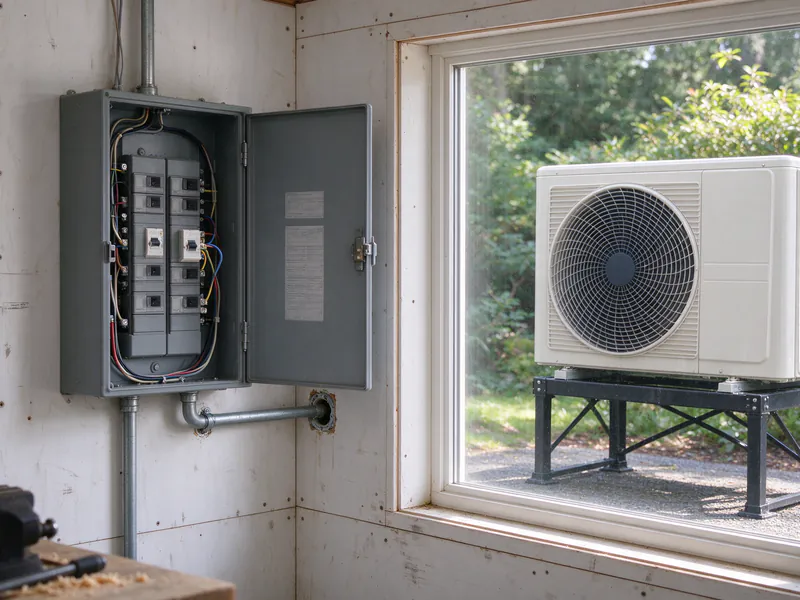
One three-inch hole through the back wall carries the line set, control cable and drain, which falls by gravity into eight feet of line-hide to the outdoor unit on an 18-inch stand beside the garage, clear of the roof's drip line. We add a new 20-amp, 240-volt circuit in the subpanel with a disconnect beside the unit. The flares are torqued to spec, the lines hold a nitrogen pressure test and a vacuum below 500 microns, and we start the system in heat mode.
The subpanel has two open spaces, and its 60-amp feeder carries the saw and the new heat pump as long as the shop's dust collector stays on its own 120-volt circuit, so no new feeder from the house is needed. We show the owner how to pull and rinse the filters, which a woodshop loads quickly.
What it changes
The shop holds 55°F through winter and stays workable on summer evenings, without space heaters tripping breakers.
- Location
- Multnomah, Southwest Portland
- House
- Detached 1948 two-car garage, about 22 by 22 feet, used as a woodshop
- Equipment
- One 18,000 BTU cold-climate wall head, outdoor unit on an 18-inch stand
- Price
- $6,350, permits included
- Time on site
- 1 day, then the final inspections
What happens on the first visit
We look at the building the way it really is: what’s in the walls and ceiling, the door, the slab and the windows. Then we look at how you use it and when.
- Use. A workshop kept at 55°F in winter is a different load from a home gym or studio kept at 68.
- The head. High on a wall away from the saw, the paint booth or the car’s exhaust, with air thrown across the working area.
- The outdoor unit. On a pad, stand or bracket where the line set stays short, out of the drip line and away from a neighbor’s window.
- The power. Which panel feeds the garage, whether it has breaker space, and whether the feeder can carry another 240-volt circuit.
You get a written estimate naming the head and its capacity, the outdoor unit, the line-set route, how the head drains, the circuit, the permits and the price.
Insulation first, or size for what’s there?
If you can insulate before we install, do it: a smaller unit costs less and runs cheaper. If you can’t, we size for the building as it stands.
Insulating first
Insulating the walls and ceiling and sealing gaps around the door often drops the load enough to step down a size. An insulated garage door helps too. Tell us what you plan to do and when, and we size for that.
Sizing for what’s there
If the door stays as it is, we size the head for it. Undersizing a garage head to save money leaves it running flat out on a frosty morning, never getting the shop warm. How to size a mini split shows how the load adds up.
Power: the main panel or a subpanel
Every outdoor unit needs its own 240-volt circuit and a disconnect within sight of it. In a garage the question is where that circuit starts.
- A subpanel in the garage. Simplest when it has two open spaces and its feeder has room for the extra load. We check the feeder size against what’s already on it.
- The main panel in the house. Needed when the subpanel is small or full. It means a longer run, often underground or along the fence to a detached garage.
- A full main panel. If there’s no room, we say so at the visit and price the fix separately.
Mini split electrical requirements explains breakers, feeders and when a panel needs work.
Where the head and the outdoor unit go
Inside, the head goes high on a wall with clear air across the work area; outside, the unit goes where the line set stays short and nothing blocks it.
Inside the garage
Keep the head away from the saw, the sander and the spray area, so it pulls less dust, and away from the car’s exhaust at the door. On an outside wall, the drain falls outside by gravity through the same hole as the line set. The condensate drain guide covers the cases where it can’t.
Outside
A stand keeps the unit above splash and drifting leaves, out of the roof’s drip line, and lets defrost water drain away in winter. Behind a detached garage the unit is often far from the house, and that suits a neighbor’s bedroom window too. Mini split placement has the full checklist.
Heating a garage through a Portland winter
Most of Portland’s winter sits in the 30s and 40s, where a heat pump heats efficiently. Its design low is 24°F, and a few nights a year drop below 20.
For a garage you heat in winter, we choose a cold-climate model whose published capacity holds up on those nights. A garage kept at 50 to 55°F as a workshop is an easy job for it; one kept at 68 needs more capacity. Do mini splits work in cold weather? covers defrost cycles and low-temperature output.
What it costs
A garage head is priced like any single zone: Firlands’ typical range for a single-zone install is $4,000 to $8,500, and harder jobs typically run $8,500 to $12,000 and up.
| What moves the price | Why |
|---|---|
| Head size | An uninsulated garage often needs a bigger unit |
| Where the circuit starts | A subpanel next door is cheaper than a long run from the house |
| Outdoor unit mounting | A wall bracket or stand costs more than a pad |
| Line-set route | A detached garage keeps it short; a garage under a bedroom can mean a longer run |
City permit fees are in the price, and your number comes from the visit and the written estimate. Mini split installation cost in Portland shows what’s inside it.
When it’s more than a garage
If the garage is turning into a bedroom, an office or a rental unit, the plan changes: the space usually gets insulated, finished and permitted as living space. Heat and cooling go in with that work; see ADU and addition mini splits.
Already have a mini split in the shop that blows weak or smells? Dust may have loaded the coil: mini split cleaning brings it back.