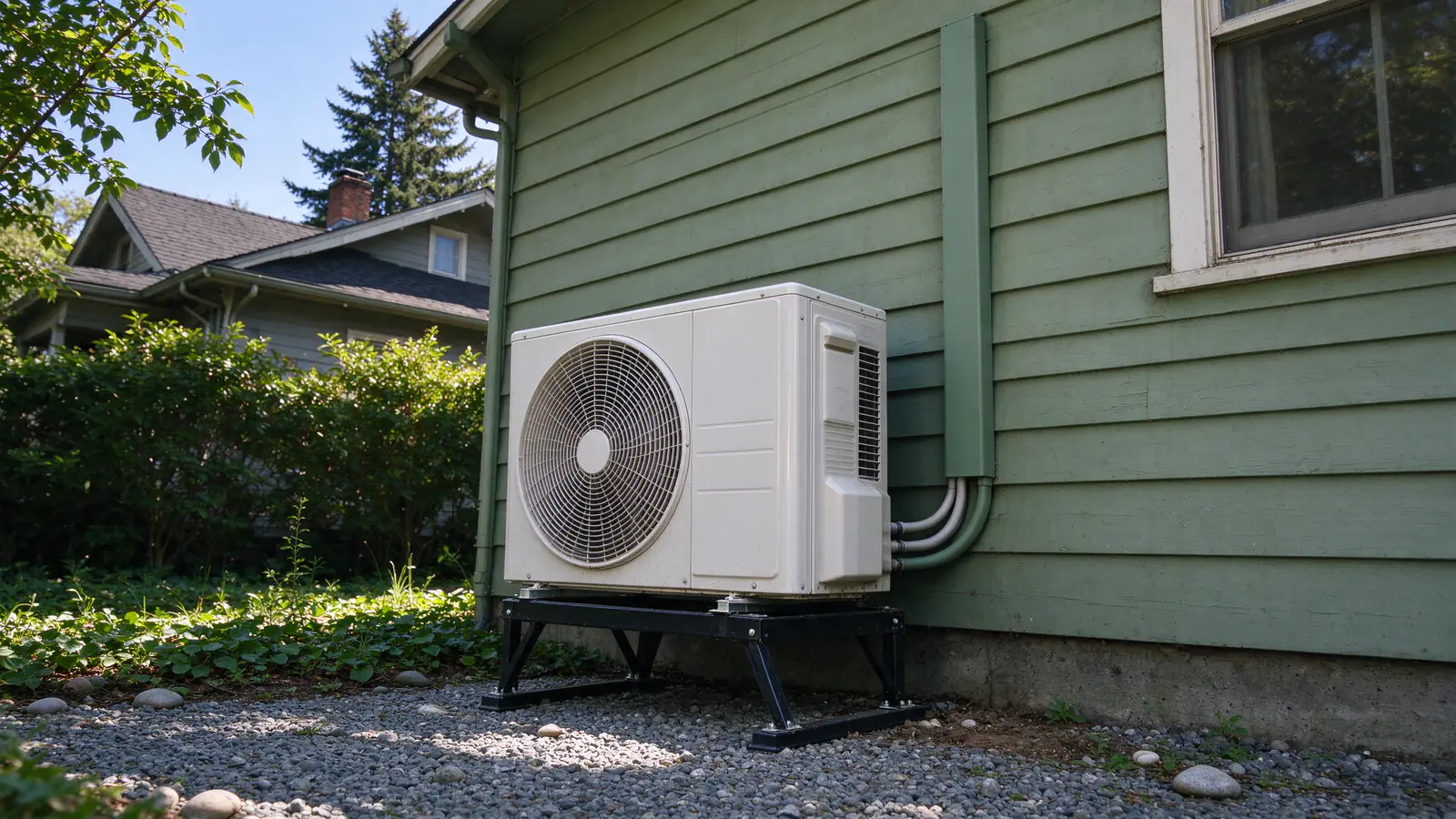
Where the head and the outdoor unit go decides how well a mini split works, how it looks and whether the neighbors hear it. On every visit, Firlands Portland Mini Splits plans the head, the outdoor unit and the line between them together, because moving one moves the other two.
Where the head goes in the room
A wall head goes high on the wall, usually a few inches below the ceiling, facing the longest open stretch of the room. It throws air across the room, not around corners.
Good spots
- An outside wall. The line set, drain and cable go straight through one three-inch hole behind the head, and the drain can run by gravity.
- Across from where you sit or sleep. Air should move across the room and reach you gently, not blow straight down on you.
- Above a clear wall. The head needs open space under it for the air to drop.
Spots to avoid
- Over a TV, a desk or a bookcase. If a drain ever backs up, water drips on whatever is below.
- In direct afternoon sun. Sunlight on the head can confuse its built-in temperature sensor.
- Behind a door, a beam or a deep window return. Anything in the way stops the air short.
- At the end of a hallway. A head in the hall won’t cool the bedrooms off it (how many mini splits do I need?).
If no wall works, a ceiling cassette, a floor console or a ducted unit may fit better. The cassette vs wall mount guide compares them.
Where the outdoor unit can go in Portland
The City of Portland doesn’t allow outdoor equipment like heat pumps in the required front setback. It does allow it in a side or rear setback in most residential zones, if the unit is no more than five feet high.
That covers nearly every single-zone and small multi-zone outdoor unit on a pad, a low stand or a wall bracket. A tall stand that lifts a large unit above five feet in a side setback is the case to check. Every new outdoor unit also needs a site plan on the mechanical permit (mini split permits in Portland).
Noise at the property line
Portland’s noise code limits a home’s sound to 55 dBA at a neighboring home’s property line from 7 a.m. to 10 p.m., and 50 dBA at night. The code, updated by Ordinance 191944, doesn’t exempt heat pumps.
Manufacturers publish a sound rating for each outdoor unit. We compare it with the distance to the property line, and we keep the unit away from a neighbor’s bedroom window. In a narrow Portland side yard, the far end of the yard is often quieter for the neighbor than the spot right beside their house.
Historic districts
In Portland’s historic and conservation districts, such as Irvington, Ladd’s Addition and the Alphabet District, exterior changes can need historic resource review. Zoning code chapter 33.445 exempts the common cases:
| Equipment | Exempt from review when |
|---|---|
| Ground-mounted unit | No more than 5 feet in width, length or height, and not closer to the street than any street-facing facade |
| Rooftop unit | On a roof pitched 1/12 or flatter, set back from the edge 4 feet per foot of height, matte or roof-matched |
| Line sets, conduit and pipes | Not on a street-facing facade, no more than 6 inches across, matte or painted to match |
A wall bracket or line cover on the street-facing side falls outside those limits. In those districts we route lines down a side or back wall and keep the unit behind the front of the house.
Portland weather and the outdoor unit
The outdoor unit sits out through rain, a few freezes, the odd ice storm and, on the east side, hard winds out of the Gorge. Each one shapes where it goes.
Ice and snow
Portland’s airport averages about four inches of snow a year, but the January 2024 ice storm took it to 15°F. When the unit heats, it defrosts itself and sheds water, and that water freezes under it.
We set the unit on a stand or a bracket so the base clears ice and snow and the meltwater can drain away. Never put it over a path or steps.
Roof drip lines
A unit under a roof edge with no gutter takes a sheet of water all winter, and in a freeze, ice falls on it. We keep the unit out from under the drip line or add a small cover approved by the manufacturer.
East wind
Troutdale, at the mouth of the Gorge, had about three times as many winter days with gusts of 40 mph or more as the Portland airport across the six winters from 2020-21 to 2025-26 (NOAA data).
In Gresham, Troutdale and East Portland, we turn the coil away from the east wind or shelter it with a wall or a wind baffle, because a hard wind across the coil cuts heating output.
The line set between them
The line set carries refrigerant between the head and the outdoor unit, with the communication cable and the drain beside it. Shorter and straighter is better.
- Length. Every model has a minimum and maximum line length. Too short can matter as much as too long.
- Height. Each manufacturer sets a maximum rise between the head and the outdoor unit. A head on the third floor of a Portland foursquare is where we check.
- Route. On the outside wall it runs in a line-hide cover painted to match the siding, down a corner or behind a downspout.
- Drain. The drain needs a steady fall to the outside, or a pump (condensate drain guide).
Clearances around the unit
The manufacturer’s manual sets clear space behind, beside and in front of the outdoor unit, so air can flow through the coil and the unit can be serviced. Fences, shrubs and a woodpile count. We measure them on the visit.
Putting it together on the visit
On the first visit we walk the house and the yard together and mark the head, the hole, the line route and the outdoor unit spot for each room.
Your written estimate lists each head and its capacity, where the outdoor unit goes, the line-set route, and whether each drain runs by gravity or a pump. If a spot needs a stand, a bracket or a roof mount, the estimate says so. See the installation process for what follows, and the single-zone service page for a one-room job.