The one room the central air misses
A newer Bethany house with central air can still have a bonus room, top floor or office that never stays as cool as the rest.
Bethany is one of the newest communities on the west side: well over half its homes were built since 2000. Firlands Portland Mini Splits works with those houses differently from older ones.
A different question
The question isn’t how to heat a house with no ducts; it’s why one room won’t follow the thermostat, and whether a head or a duct fix is the answer.
Why the top room runs hot
A third-floor or over-garage room has more roof and outside wall per square foot than any other room. It gets the afternoon sun, the heat that rises from below, and a supply duct sized as an afterthought. The thermostat sits in the hall downstairs and never sees it.
Project
What a third-floor bonus room fix in Bethany looks like
The problem
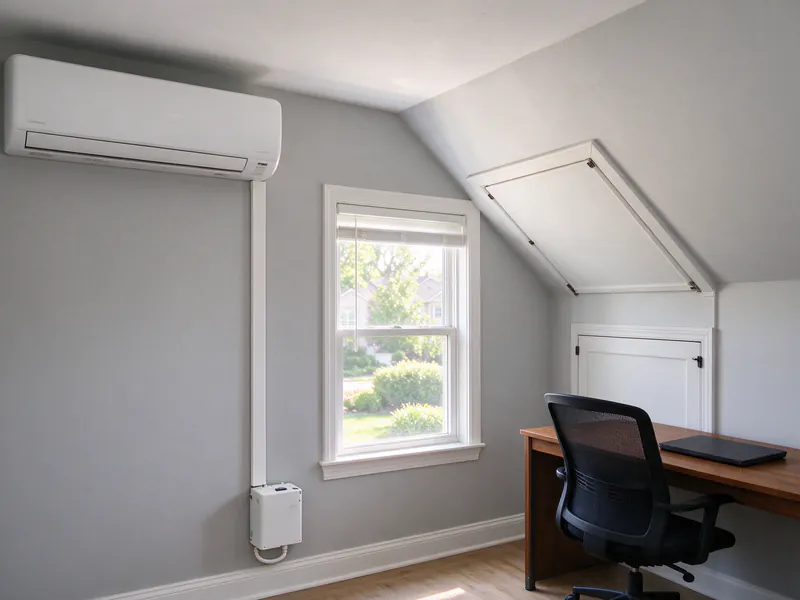
The third-floor bonus room is the warmest room in the house from June on, and the central air can't pull it down without freezing the floors below. It doubles as a home office, so it is in use all afternoon.
The house
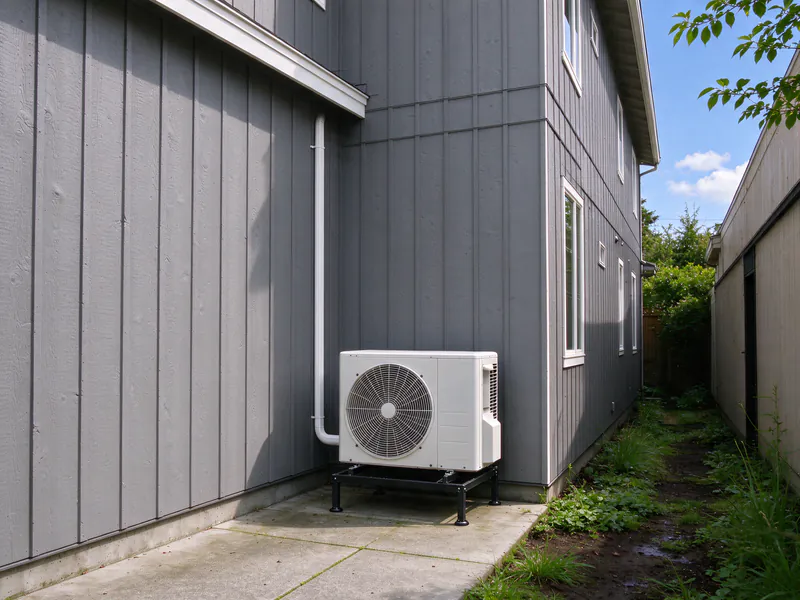
The house is narrow and tall on a small lot, with side yards about five feet wide. The bonus room has outside walls on the front and one side, but the side wall faces the neighbor's house five feet away.
What we decide, and why
Before anything else, we check the ducts: the room has one supply and the return is in the hall below, so a damper change helps only a little. One 12,000 BTU head goes on the inside wall facing the windows, where it throws air across the room. That wall doesn't reach outside, so the condensate runs to a small pump hidden in the line cover.
The work
We run 42 feet of line set from the head through the attic space beside the room and down a cover on the back corner of the house to a ground stand on the back patio edge. The pump sits in the cover just below the head, wired from the same circuit, and discharges to the downspout. The 20-amp circuit comes from the garage panel two floors down. Nitrogen test, vacuum below 500 microns, and the drain and pump tested with water.
The back corner keeps the cover off the street-facing wall, and the outdoor unit faces the yard rather than the neighbor's bedroom window across the five-foot side yard.
What it changes
The office stays at the set temperature on July afternoons, and the central air goes back to serving the floors it was built for.
- Location
- North Bethany
- House
- 2014 three-story, about 2,400 square feet, gas furnace with central air
- Equipment
- One 12,000 BTU cold-climate wall head with a condensate pump
- Price
- $9,140, permits included
- Time on site
- 1 day, then the final inspections
Try the ducts first, then add a head
We look at the ducts before we quote a head, because sometimes a simple duct fix solves the room without a head.
| What we find | What it means | Usual answer |
|---|---|---|
| A closed or half-shut damper | The room is starved by a setting | Open and rebalance it |
| A crushed or disconnected run in the attic | Air is leaking before it arrives | Repair the run |
| One small supply and no return | Air can’t move through the room | A head, or a new return |
| Three outside walls, under the roof | The load is bigger than the duct | A head |
If a duct fix covers it, we tell you, and we don’t sell a head. When it doesn’t, a single-zone mini split takes over the room on its own schedule while the central system keeps the rest.
Where the head and outdoor unit go in a newer house
On tall, narrow Bethany houses the hard part is the outside: small lots, short side yards and close neighbors.
- The head. On the wall that throws air across the room, often an inside wall. That wall can’t drain by gravity, so the head gets a small condensate pump hidden in the cover. The condensate drain guide covers both options.
- The line route. Through the attic or eave space to a back corner, so one cover runs down the back of the house instead of the street side.
- The outdoor unit. On the patio edge or a back-yard stand, facing your yard rather than a neighbor’s bedroom window across a narrow side yard.
- The ceiling option. Where the room has attic above it, a ceiling cassette keeps the wall clear. Cassette vs wall mount compares them.
Mini split placement covers clearances in detail.
Homeowners associations
If your subdivision has an association, its rules may cover what’s visible from the street. We give you a sketch with the outdoor unit’s location and the cover color to send them before we schedule, so nothing has to move later.
Washington County permits north of Highway 26
Bethany isn’t part of Portland, Beaverton or Hillsboro. It’s unincorporated Washington County, and the county issues the permits.
A Bethany home may have a Portland mailing address; the permit office follows the land, not the mail.
How the county permits work
The county takes mechanical and electrical permit applications through its online portal, and county inspectors do the inspections. We apply for both, book them and close the job out with the final, with the fees in your price. Mini split permits explains what the inspector checks.
What a Bethany job costs
Firlands’ typical range for a standard single head is $4,000 to $8,500; the third floor usually pushes a job higher.
Why the top floor costs more
A third-floor room means a longer line set to the ground, often a condensate pump, and sometimes a lift for the cover. Harder single-zone jobs run $8,500 to $12,000 and up, and a pump on its own typically adds $150 to $500.
Two rooms on one floor
When the bonus room and a bedroom on the same floor both run hot, one outdoor unit can serve both. Two heads on one outdoor unit run $6,500 to $12,000 when a second room, such as a bedroom on the same floor, needs help too.
Sizing the outdoor unit for both at the start costs less than adding a second system later, and it keeps the yard to one unit.
Incentives
Bethany is on PGE, and two-thirds of its homes heat with gas. Energy Trust of Oregon’s ductless incentive only applies when the new system replaces electric resistance heat in the main living space, so a head added to a gas-heated house doesn’t qualify. Mini split installation cost has the rest of the breakdown.
Window unit or mini split for a Bethany bonus room?
A window unit is cheaper up front; a head heats as well as cools, runs quieter, and leaves the window free.
Third-floor rooms in newer houses often have small or high windows that make a window unit awkward, and some associations limit units visible from the street. A head also heats the room on its own in spring and fall, so the furnace doesn’t run for the whole house to warm one office. Mini split vs window AC compares running costs.
Rooms over the garage and backyard units
Two other spaces in Bethany houses are worth planning for: the room over the garage, and a finished garage or backyard unit.
- Room over the garage. Cold floors in winter and heat in summer, because the garage below is unconditioned. A head sized for the floor’s heat loss fixes both.
- Converted garage or studio. A garage mini split heats and cools it without touching the house system.
- A backyard unit. An ADU mini split gives it its own heat and cooling.
North Bethany to Rock Creek
Bethany runs from the Sunset Highway north toward the farmland past Kaiser and Springville roads, and the houses get newer as you go north.
- Around Bethany Village and Bethany Boulevard. Houses from the 1990s and 2000s, with central air that’s due for a look, and bonus rooms over garages.
- Rock Creek and the West Union Road area. Similar ages, larger lots in places, and more room for an outdoor unit.
- North Bethany. The newest streets. Where a lot is small and the side yards are narrow, siting the outdoor unit takes the most care.