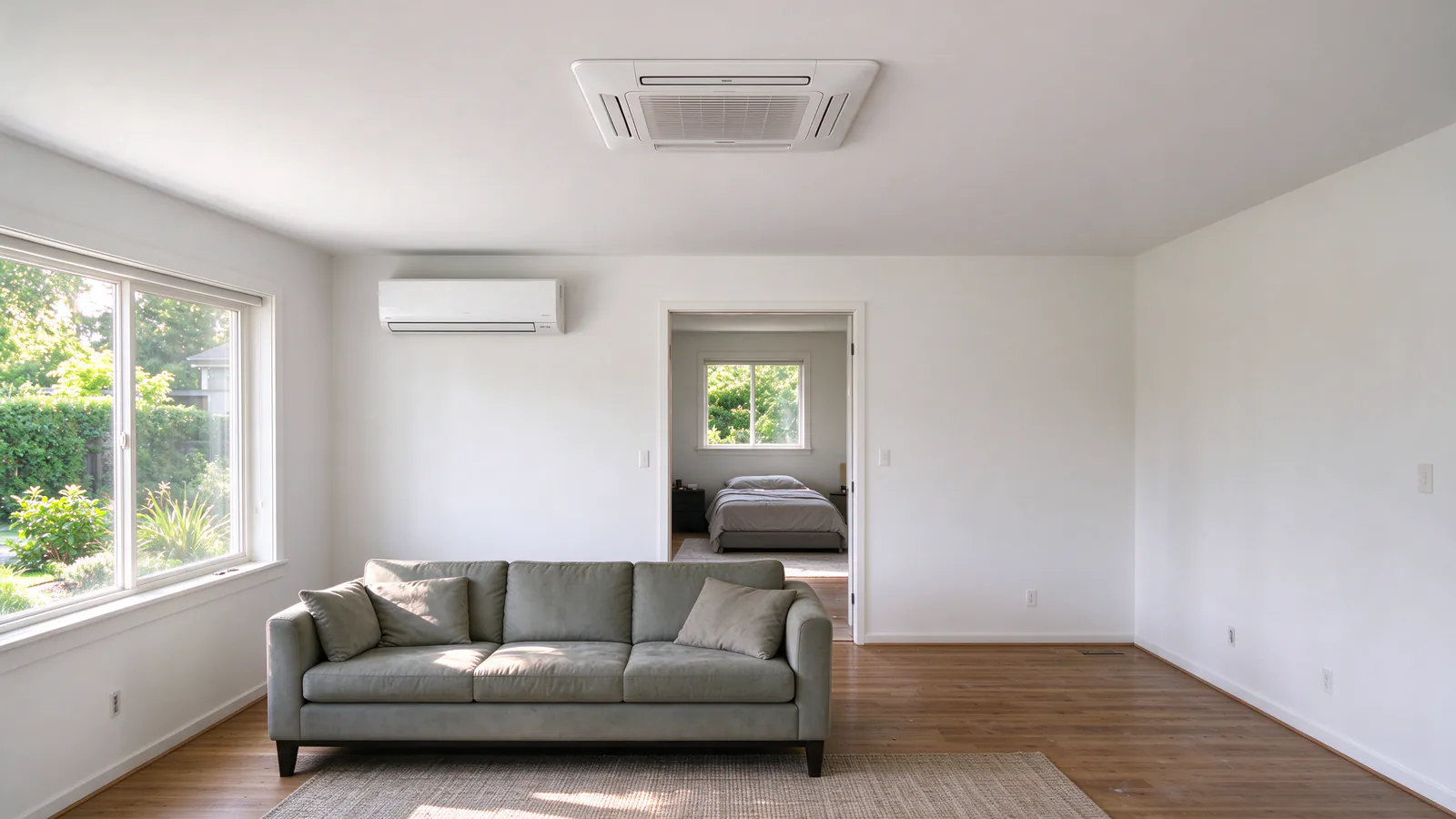
Some people love the look of a wall head; others don’t want one in the living room. At Firlands Portland Mini Splits we plan rooms around all four kinds of indoor unit, and the right one depends as much on what’s above the ceiling as on taste. Here’s how they compare.
The four kinds of indoor unit
Every mini split indoor unit does the same job: it holds a coil, a fan and a drain pan. They differ in where they sit and what they need from the house.
| Indoor unit | Where it sits | Best for | What it needs |
|---|---|---|---|
| Wall mount | High on a wall | Most bedrooms, offices, living rooms | A clear wall, ideally an outside one |
| Ceiling cassette | Flush in the ceiling, a grille showing | Living rooms and open rooms where you want the walls clear | Ceiling depth and access from above |
| Floor console | Low on a wall, like a radiator | Attic rooms with knee walls, rooms with no high wall | Floor-level wall space |
| Concealed ducted | Hidden in an attic, closet or crawlspace | Two or three small rooms close together | Space for the air handler and short ducts |
All four are inverter units: they speed up and slow down to match the room, rather than switching on and off. All four heat as well as cool, so the choice matters for a winter room too (do mini splits work in cold weather?).
Wall mount: the default for most rooms
A wall head is the least expensive indoor unit to buy and to install. It goes up in a few hours and needs one hole through the wall behind it.
Why it’s usually the first choice
- Simple drain. On an outside wall, water runs out by gravity, with no pump (condensate drain guide).
- Short line set. The lines go straight out the back to the outdoor unit.
- Easy to service. Filters lift out of the front, and the coil is reachable from a ladder.
The trade-off is looks. A head is a panel about three feet wide high on the wall. Some come in black, silver or a flat front, but you see it.
Ceiling cassette: nothing on the walls
A cassette sits up in the ceiling with only a square grille showing. It blows air out in two or four directions, which spreads it well across an open room.
What the ceiling has to give
- Depth. The cassette body needs a joist bay deep enough to hold it, and the joists can’t be cut to make room.
- Access from above. We install and service the lines, cable and pump from the attic or a deep floor space above.
- A pump. Water has to leave the ceiling and fall to the outside. Most cassettes have a built-in lift pump; some need an external one.
That’s why cassettes fit best in a top-floor room with an attic above it, or a newer house with deep joists. In many old Portland bungalows, the main floor has a bedroom above, not an attic, and the shallow joists rule a cassette out. Ceiling cassette installation covers the details.
What it costs
A cassette costs more than a wall head, both for the unit and the hours in the ceiling. Where a wall head would drain by gravity, a condensate pump typically adds $150 to $500 on its own. We price each one on the estimate after we’ve looked above the ceiling.
Floor console: for attic rooms and low walls
A floor console sits low on the wall, about where a radiator would. It blows warm air out of the bottom and cool air out of the top.
It suits attic bedrooms with sloped ceilings and short knee walls, where there’s no high wall for a head. Heat starting at the floor also feels good in winter, which makes a console a sensible choice for a room you mostly heat. It takes floor space, and furniture has to stay clear of it.
Concealed ducted: one unit, a few grilles
A ducted mini split hides a slim air handler in an attic, a closet or a crawlspace and runs short ducts to a grille in each room. Nothing shows but the grilles and a wall control.
It works best for two or three small rooms close together, such as the bedrooms under a Portland foursquare’s roof. It needs space for the air handler and the duct runs, a return grille, and usually a pump. A ducted unit can also take a better filter than a wall head, model by model (mini splits and wildfire smoke).
Cost and fit
Firlands’ typical range for a concealed ducted system is $8,500 to $16,000 and up. See ducted mini split installation.
How to choose, room by room
Start with the wall head and move away from it only when the room gives you a reason.
- Is there a clear high wall, ideally an outside one? A wall head.
- Do you want nothing on the walls, with an attic or deep joists above? A cassette.
- Is it an attic room with knee walls, or a room you mostly heat? A floor console.
- Are there two or three small rooms side by side, with space above or below? A ducted unit.
On a multi-zone system you can mix them. Most multi-zone outdoor units accept a mix of indoor unit types within the manufacturer’s rules, so the living room can have a cassette and the bedrooms wall heads.
Controls and comfort
Each indoor unit comes with a handheld remote. Most can also take a wired wall control or a Wi-Fi adapter, which makes a cassette or ducted unit easier to live with.
A cassette’s and a ducted unit’s temperature sensor sits in the return air near the ceiling, which can read warmer than where you sit. A wall control with its own sensor at seat height fixes that. We note which control each room gets on the estimate.
Getting the plan right
The choice comes down to what’s above the ceiling, where the drain can go and how the room is used. We check all three on the visit.
Your written estimate names the type and capacity of each indoor unit, the line route, and whether each drain runs by gravity or a pump. To count rooms first, see how many mini splits do I need?, and for the outdoor side, mini split placement. Price ranges are in the cost guide.