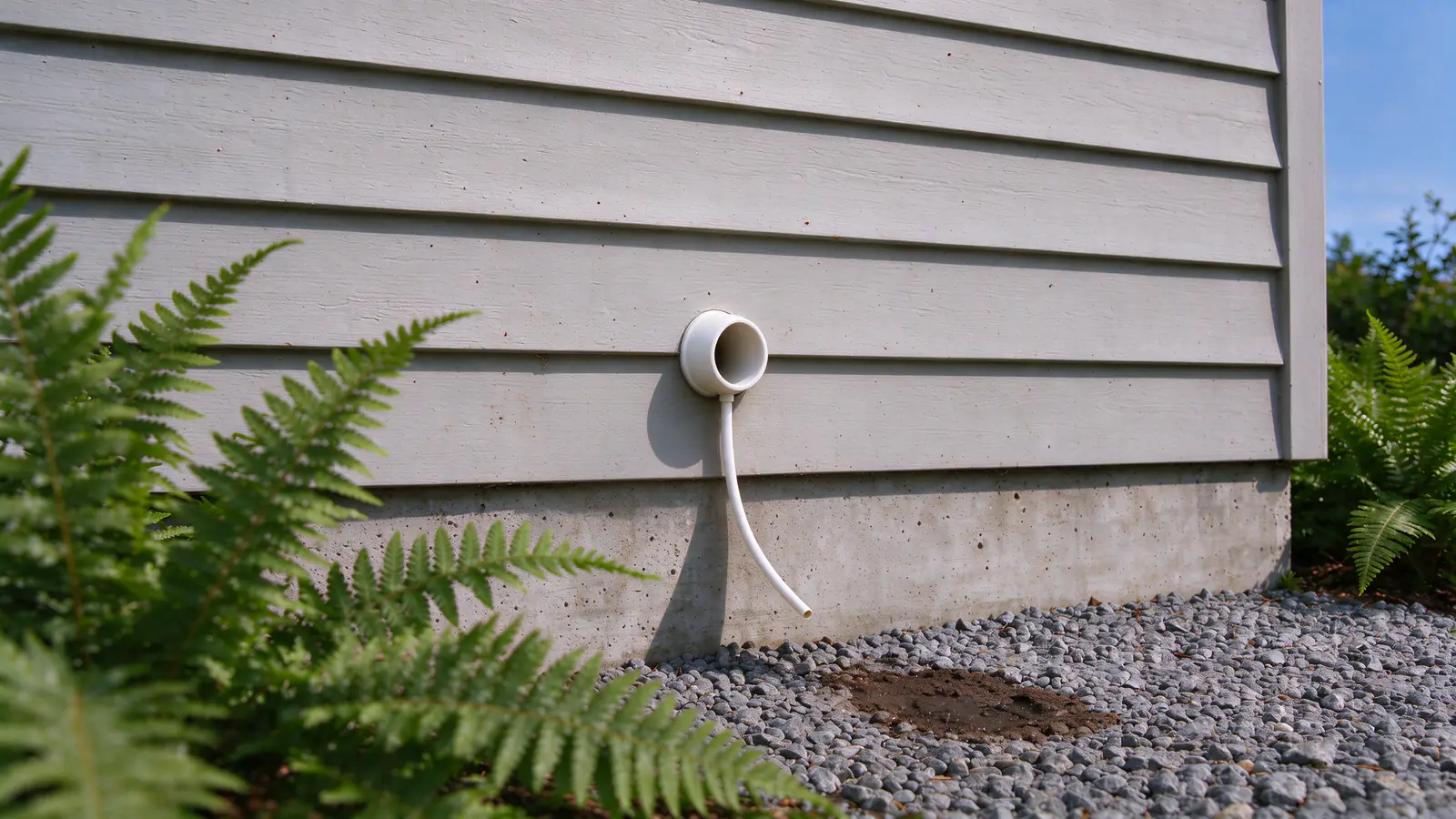
Water on the wall under a head is one of the most common mini split problems, and nearly every case traces back to the drain. At Firlands Portland Mini Splits we plan every drain at the first visit and test each one with water before we leave. Here’s how drains work, and why they fail.
Where the water comes from
A mini split head cools the room by running air over a cold coil. Moisture in that air condenses on the coil, the same way a cold glass sweats, and drips into a pan under it.
The pan has an outlet, and the drain line takes the water from there to the outside. In heat mode the process flips: the outdoor coil gets cold, frosts up, and the unit melts it off in a defrost cycle. That water drains from the base of the outdoor unit, which matters in a freeze.
Gravity or pump
A gravity drain is the simplest and most reliable. A pump is the answer when water can’t fall to the outside on its own.
| Gravity drain | Condensate pump | |
|---|---|---|
| When it fits | Head on an outside wall, drain can fall the whole way | Head on an inside wall, cassettes, most ducted units, basements |
| How it works | Water runs downhill to the outside | A small pump lifts water to a point where it can drain |
| What can fail | Blockage, a flat or uphill spot, a kink | Blockage, a failed pump, a stuck float, a tripped breaker |
| Noise | None | A faint hum when it runs |
| Added cost | None | Typically $150 to $500 at install |
Getting gravity right
The line needs a steady downward slope from the head all the way out; the mechanical code sets at least 1/8 inch of fall per foot. On an outside wall, it runs down in the line-hide beside the refrigerant lines. A single flat spot holds water, grows slime and backs up.
When a pump is the answer
A head on an inside wall, a ceiling cassette or a ducted air handler usually can’t drain by gravity. A small pump, mounted in the line-hide, in the head or beside the air handler, lifts the water to a point where it can fall away.
Float switches and traps
A float switch is the backstop. If water rises in the pan or the pump’s reservoir, the switch shuts the head off before the water spills.
Float switches
Most pumps include one, wired to stop the head when the pump can’t keep up. On a cassette or ducted unit above a finished ceiling, we treat a working float switch as essential. A head that stops cooling for no clear reason, with a full pan, is often the switch doing its job.
Traps
Most wall heads drain straight out with no trap. A trap matters when the drain ties into a plumbing line, where it stops sewer gas coming back up. Some ducted air handlers also need one, because their fan pulls on the drain; the installation manual says which.
Outdoor drains in a Portland freeze
The outdoor end of the drain, and the outdoor unit’s own defrost water, both have to cope with freezing nights. Portland’s airport averages about 32 nights a year at or below freezing; Hillsboro averages about 64.
What we do about it
- End the drain where it can’t freeze shut. We stop the line above a gravel strip or a downspout, not buried in soil or a puddle.
- Keep it off paths. Water from a drain or a defrosting unit freezes on concrete. We route it away from steps and walkways.
- Lift the outdoor unit. A stand or bracket lets defrost water fall clear instead of freezing under the base (placement guide).
- Heat cable where needed. On a long outdoor run in a cold, shaded spot, a small heat cable can keep the line open.
Why a head starts to leak
When a head drips, the cause is usually one of a handful of things. Most are cheap to fix if caught early.
- Slime in the line. Algae and dust grow in the pan and the line, especially after a smoky or dusty summer (mini splits and wildfire smoke).
- A flat or uphill section. Often from a line pushed or bent after install, or one never given enough fall.
- A kinked or crushed line. Behind the head, in the line-hide, or under a deck.
- A failed pump. Pumps wear out; a noisy or silent pump is a sign.
- A head that isn’t level. The pan tips away from its outlet.
- A frozen coil. A dirty filter or low refrigerant can freeze the coil; when it melts, it overflows the pan.
- A blocked outdoor end. Ice, mud, leaves or an insect nest at the outlet.
What you can check first
Turn the head off. Check whether the filter is clogged, and look at the outside end of the drain for a blockage. Don’t push anything up the line from the head end; that can crack the pan’s outlet.
Fixing and preventing drain problems
Clearing a drain is one of the most common repairs, and a yearly cleaning catches most problems before they drip.
Firlands’ typical range for most mini split repairs, drain clearing included, is $150 to $1,000; a simple drain clearing sits toward the low end. A maintenance visit typically runs $150 to $250 for one outdoor unit and one head, and includes flushing the pan and line. See mini split repair and cleaning and maintenance.
On a new install
Every drain is tested with water before we leave, gravity or pump. We pour water into each pan and watch it come out the far end.
A head in a basement almost always needs a pump, because there’s nowhere lower for the water to go. The written estimate says which drains are gravity and which are pumped. The installation process guide shows where that test falls.