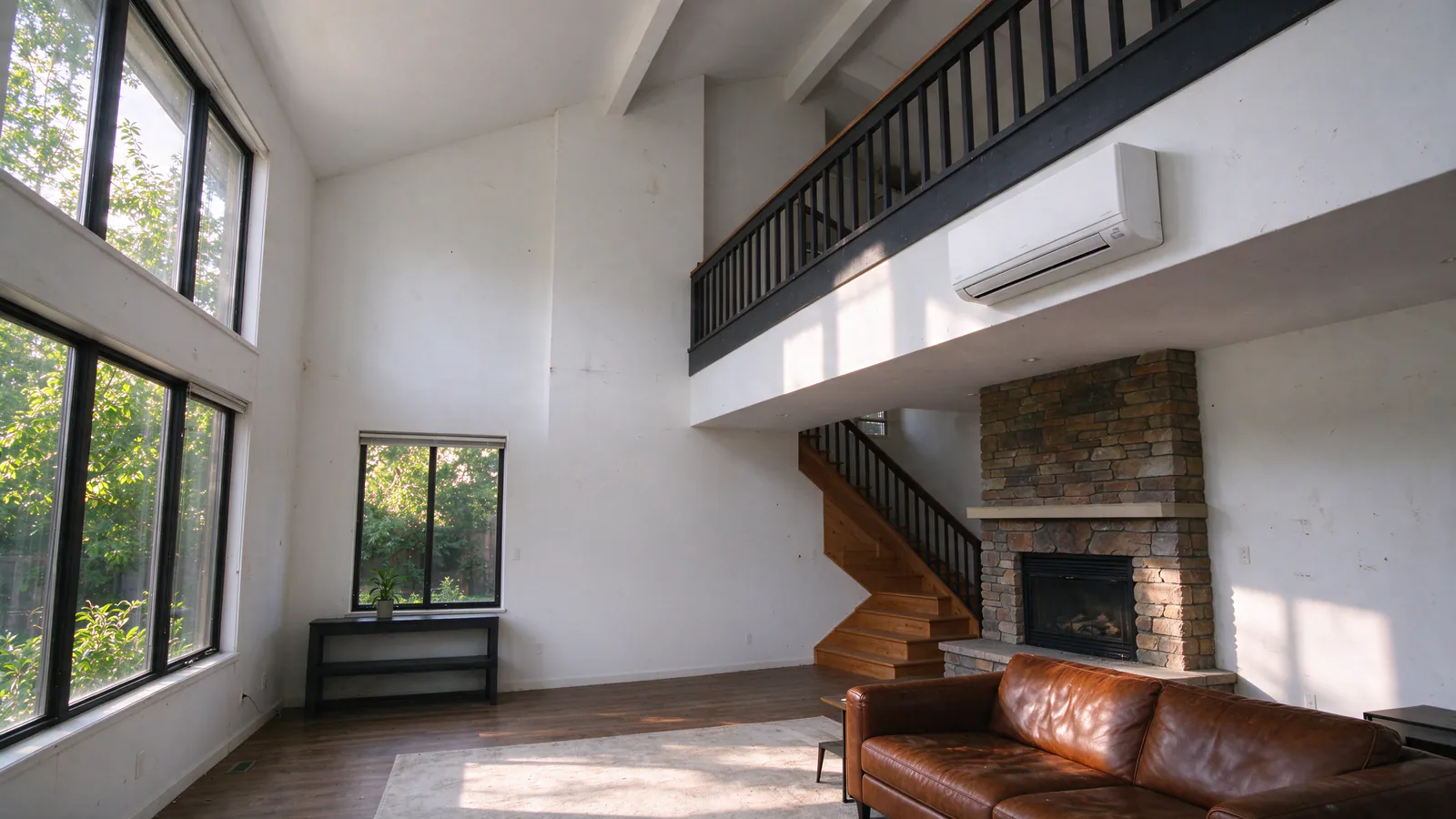
An electric furnace and a winter bill to match
Many Battle Ground houses were built in the last 25 years with an electric forced-air furnace, and every January the bill shows what resistance heat costs.
The furnace works. It’s just resistance heat: its coils make heat one for one from the power they draw, while a heat pump gathers two or three times as much from outside air on a mild day.
What we do about it
Firlands Portland Mini Splits sizes heads for the rooms you use most, leaves the furnace as backup, and handles the city and state paperwork. The furnace’s fan, ducts and thermostat stay exactly as they are, so nothing you rely on today goes away; it just runs far fewer hours.
Project
A typical Battle Ground electric-furnace house
The problem
The electric furnace heats the whole house with resistance coils, so January bills are high, and there's no cooling for the primary bedroom upstairs in a hot spell.
The house
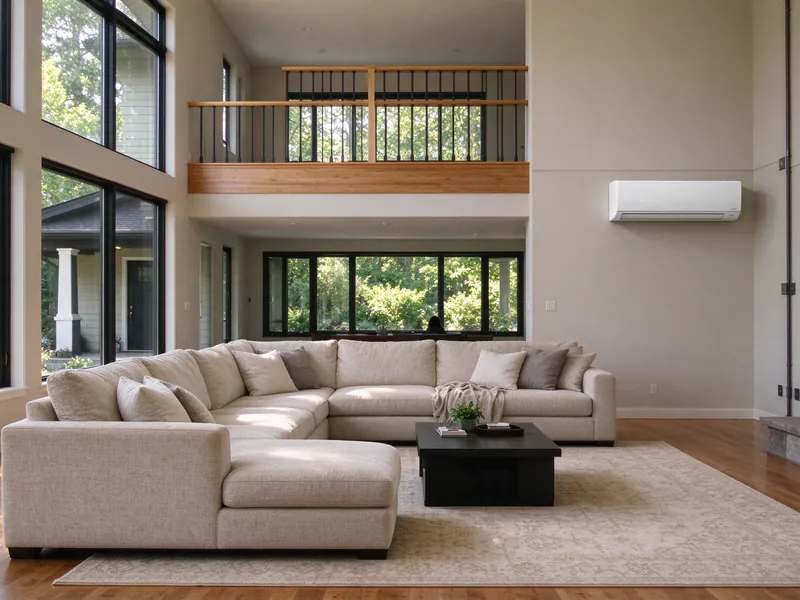
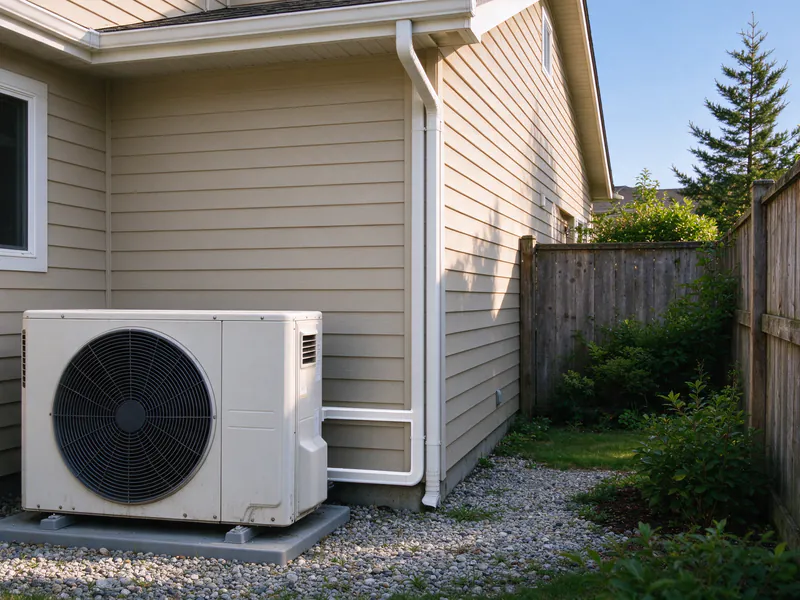
A great room with a two-story ceiling opens to the kitchen; the primary bedroom is upstairs on the south side. The furnace and ducts are only 20 years old and work. The side yard is a five-foot strip along a fence, typical of a subdivision lot from that decade.
What we decide, and why
Keep the furnace and ducts as backup and for the secondary bedrooms, and put the heat pump where the hours are: a 15,000 BTU head high on the great room's back wall and a 9,000 in the primary bedroom. The outdoor unit is sized at 24,000 BTU, leaving room for a third head later.
The work
Two three-inch holes; the bedroom line set runs through the attic and down an outside corner in one cover. The outdoor unit sits on a pad in the side yard with 12 inches of clearance behind it. A 25-amp, 240-volt circuit runs from the garage panel. Both line sets are pressure-tested and pulled below 500 microns; both drains fall by gravity and are tested with water.
The City of Battle Ground issues the mechanical permit and requires a city business license endorsement for the trade doing the work; L&I issues the electrical permit. The furnace thermostat gets a lower setpoint so the heads lead and the furnace only backs them up.
What it changes
The furnace runs far less, the primary bedroom finally has cooling, and the electric-furnace house qualifies for Clark Public Utilities' $900 ductless rebate.
- Location
- Battle Ground, east of SR-503
- House
- 2006 two-story, about 2,100 square feet, electric forced-air furnace, no cooling
- Equipment
- Two heads (15,000 and 9,000 BTU) on one 24,000 BTU cold-climate outdoor unit
- Price
- $11,200, city permit fees included
- Time on site
- 2 days, then the final inspections
Keep the furnace, or replace it?
If the furnace is young, keep it and add heads; if it’s near the end of its life, a whole-house heat pump becomes the better question.
| Your situation | What usually makes sense |
|---|---|
| Furnace under 15 years, comfort problems in one or two rooms | Heads in those rooms, furnace as backup |
| Furnace under 15 years, bill is the problem | Heads in the main living space and primary bedroom |
| Furnace failing, ducts in good shape | A ducted heat pump or a ducted mini split on the same ducts |
| Furnace failing, rooms used separately | A whole-house mini split with a head per room |
Mini split vs central heat pump goes through the trade-off in detail.
Heads in a newer subdivision house
Most Battle Ground houses built since 2000 have a great room, an open kitchen and bedrooms upstairs, and that layout decides where the heads go.
The great room
A two-story ceiling holds warm air up high, so a head mounted high on the back wall, blowing along the room, works better than one aimed at the seating. We size it to the room’s real load, including the tall windows.
Upstairs
The primary bedroom usually gets the second head. Line sets run through the attic and down one outside corner in a single cover, so the front of the house stays clean. Two heads on a slightly larger outdoor unit leave room to add a third later. Our guide to counting heads walks through the rooms.
Battle Ground’s permit counter
Battle Ground issues its own mechanical permits, and like Camas and Ridgefield it leaves electrical permits to Washington L&I.
- City mechanical permit. Covers the heat pump, line sets and drains.
- L&I electrical permit. Covers the new 240-volt circuit and the disconnect at the outdoor unit.
- City business license endorsement. Battle Ground asks each mechanical and electrical trade working in the city for one, through the state Department of Revenue, along with its state specialty license.
City fees are in our price. We apply, schedule both inspections and close the permits with the finals. Addresses outside city limits, in Meadow Glade for instance, go to Clark County for the mechanical permit.
The rebate on an electric-furnace house
Clark Public Utilities pays $900 toward a ductless heat pump that replaces permanently installed electric heat, and an electric furnace counts.
What the utility asks for
- a home you own and live in, heated by an electric furnace, baseboards, wall heaters or ceiling cable
- new equipment with an HSPF2 rating of at least 7.5, one head or several
- an installer from the utility’s own contractor network, which is how we schedule Clark County installs
Gas-heated houses don’t qualify for this one. We confirm the program’s current terms before your estimate is final.
Sizing for winter north of Vancouver
The heads are sized for a 28°F night, the design low for Clark County, and we read each outdoor unit’s spec sheet for what it still delivers in the teens.
Pearson Field in Vancouver, the county’s design station, freezes on roughly 45 nights a year and drops to 20°F or below on two or three. Cold-climate equipment keeps working on those nights.
Why backup changes the sizing
With the furnace staying in place, we don’t oversize the heads for the single coldest night of the decade; an oversized head short-cycles through the mild months. Cold-weather performance is explained in our guide.
Side yards and where the unit goes
Subdivision lots here often have narrow side yards, so we check clearance before we pick the wall.
- at least a foot behind the unit and a clear path in front for airflow
- away from a bedroom window, ours or the neighbor’s
- on a pad or stand that keeps the coil above ice, out of the roof’s drip line
If the side yard is too tight, the unit goes on the back wall, and the line set runs a little further.
Running the system day to day
Once it’s in, set the heads a degree or two above the furnace thermostat, so the heat pump does the work and the furnace only steps in on the coldest mornings. Leave doors open to rooms without heads.
- rinse the head filters every month or two in the heating season
- keep leaves and snow off the outdoor unit
- book a yearly maintenance visit for the coils and drains
We go through running both systems together at the walk-through, with the remote in your hand.
Prices for Battle Ground jobs
Firlands’ typical range for one head is $4,000 to $8,500; two heads on one outdoor unit run $6,500 to $12,000.
Three or four heads run $9,000 to $18,000 and up, and whole-house systems with five or more heads $15,000 to $30,000 and up.
Reading the estimate
Each head appears with its capacity and room, followed by the outdoor unit and stand, how the lines run and how each head drains, the circuit, the permits, the price and what’s excluded. For a number before the visit, use the cost estimator. To see how the furnace’s hours fall, read the electric bill guide.