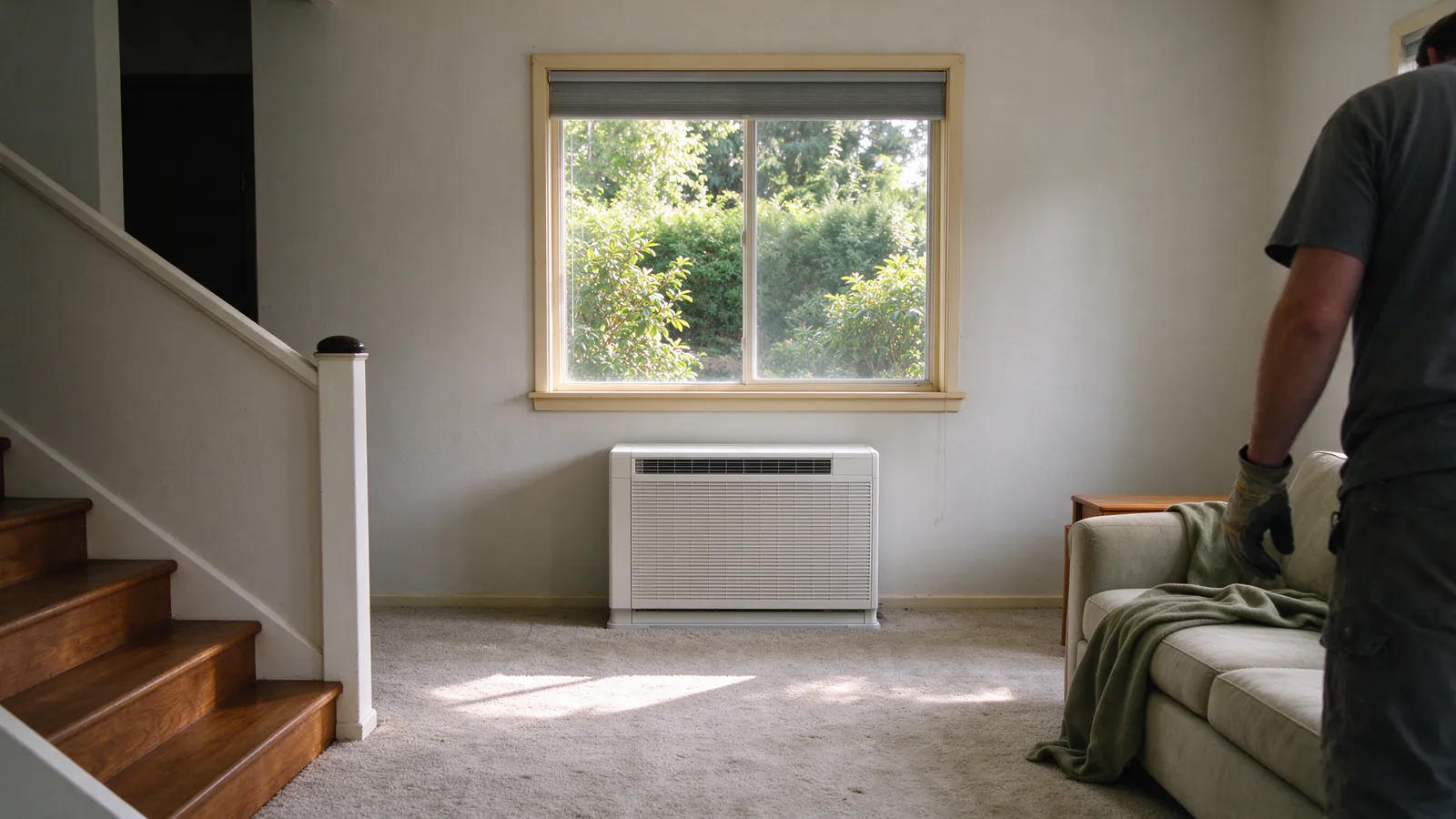
The basement family room should be the coolest place in the house in July, and it is, but it smells damp, the couch feels clammy and in winter nobody goes down there without a blanket.
A basement mini split heats the room, cools it when it needs it and pulls water out of the air while it runs. Firlands Portland Mini Splits sizes it for a below-grade room, plans a drain that works below the ground line and sets it up to keep the room dry.
Why basements feel damp and cold
Below-grade walls stay close to the ground’s temperature all year. In summer, warm, humid air meets those cool walls and the floor, and the moisture settles there.
| What you notice | What’s going on |
|---|---|
| A musty smell in summer | Damp air sitting against cool walls and carpet |
| Clammy furniture | High humidity even when the room isn’t hot |
| Cold floors in winter | The slab and the buried walls drawing heat out |
| Condensation on the window | Warm, moist air on cold glass |
A mini split deals with both seasons: it heats in winter and pulls water from the air while it cools. If water is coming through the walls or the floor, that is a drainage repair to fix first, not a job for a heat pump.
Project
A typical Milwaukie daylight-basement mini split
The problem
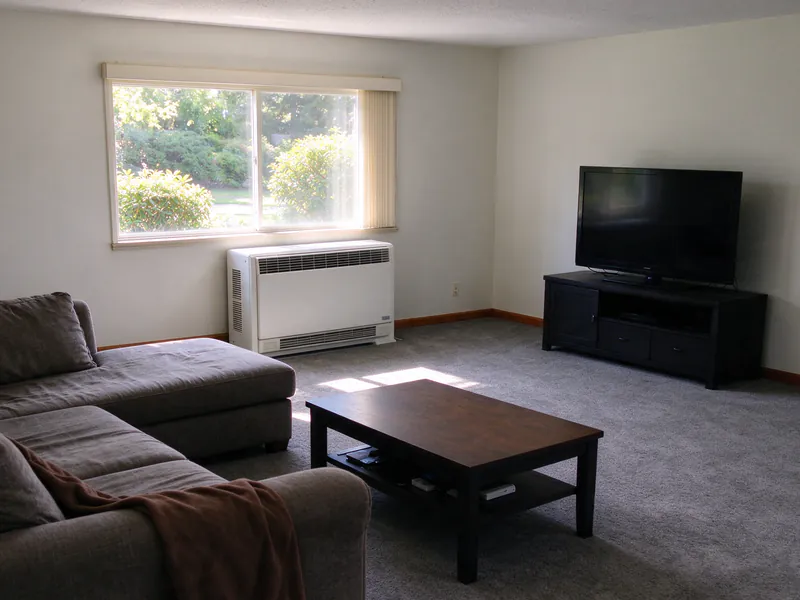
The basement family room smells musty from June to September, the carpet feels damp underfoot and the old baseboard heater barely takes the chill off in winter. The family uses the room mostly in the evenings.
The house
The room is about 15 by 20 feet, carpeted over the slab. Its back wall has a wide window, but the yard slopes up on that side, so the ground outside sits about 30 inches above the floor. The other walls are buried concrete with a short finished wall in front. The panel is in the utility room next door.
What we decide, and why
The only clear wall is under the window, so a floor console fits where a wall head can't. We size it at 9,000 BTU: the buried walls keep the summer load small, and a bigger unit cools the room in minutes and stops before pulling the moisture out. The console's low airflow also puts warm air along the cold floor in winter.
The work
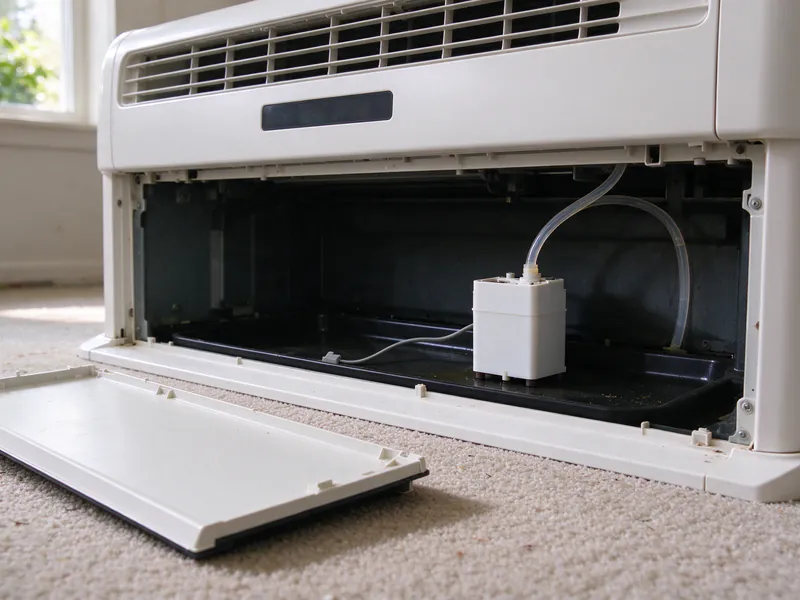
The line set, control cable and drain leave through one hole in the rim joist above the window, and a 15-foot run in line-hide drops to the outdoor unit on a pad at the side of the house. A small condensate pump with a float switch sits in the console's base cabinet and lifts the water about 36 inches to the rim joist, where the drain runs out to a splash block clear of the foundation. A new 240-volt circuit comes from the utility-room panel. The City of Milwaukie issues the mechanical and electrical permits.
At startup we set the console's dry mode and low fan for humid days and show the owners when to use each one. We fill the pan with water, watch the pump lift it out, and lift the float by hand to confirm the console shuts off.
What it changes
The family room gets steady heat in winter and drier, cooler air in summer, and the baseboard heater stays off.
- Location
- Milwaukie, inside city limits
- House
- 1968 daylight ranch on a slope, finished basement family room
- Equipment
- One 9,000 BTU floor console with a condensate pump, cold-climate outdoor unit on a pad
- Price
- $6,980, permits included
- Time on site
- 1 day, then the final inspections
What happens on the first visit
We start with the room: which walls are buried and which are exposed, the windows, the slab and how you use the space. Then we look outside, at where the lines can leave the house.
- The head type. A wall head where there’s a stretch of clear wall above head height; a floor console where the walls are short or broken by a window or beam.
- The way out. The line set leaves through the rim joist, above the ground line, never through a buried concrete wall.
- The drain. If the head sits below the ground outside, the water needs a pump to lift it to the rim joist.
- The panel. Basements often hold the panel, which keeps the new 240-volt circuit short.
You get a written estimate naming the head and its capacity, the outdoor unit, the line-set route, the pump and drain, the circuit, the permits and the price.
Wall head or floor console?
Both work in a basement. The choice comes from the walls you have and how the room is used.
Floor console
A console sits low on the wall, often under a window. In heat mode it blows warm air out along the floor, where a cold slab makes you feel the difference most. It is also easy to reach for cleaning the filters.
Wall head
A wall head throws air across the room from high on the wall and suits a basement with full-height finished walls. In a low basement it can end up blowing straight onto your head. Cassette vs wall mount compares every head type, consoles included.
The drain below grade
Every head makes water when it cools, and a basement head makes plenty in a humid summer. Where it goes is the detail that matters most down here.
- Gravity. If the outside ground sits lower than the head, as it can on the open side of a daylight basement, the drain falls out through the rim joist on its own.
- A pump. More often the head sits below the ground outside, so a small condensate pump lifts the water up to the rim joist and out. Its float switch shuts the head off if the pump ever fails, so water stays in the pan instead of on the carpet.
The drain line outside ends where the water can’t pool against the foundation. We pour water into every drain before we leave. The condensate drain guide explains pumps and gravity drains in detail.
Setting it up to keep the room dry
A mini split only takes water out of the air while its coil is cold and the air is moving slowly across it. Size and settings decide how well it does that.
- Not oversized. A head that’s too big cools the room in minutes and shuts down before it has pulled the moisture out. We size for the basement’s real load, which is usually small in summer.
- Dry mode. It runs the fan slowly and the coil cold, taking water out without chilling the room much. We set it up and show you when to use it.
- Fan speed. Low or auto in humid weather, not high, so more water comes off the coil.
Portland’s summer air is drier than the eastern U.S., with the July dew point averaging about 54°F at the airport, but a basement wall can sit right around that temperature. That’s why the room feels damp when the rest of the house doesn’t. How to size a mini split shows how moisture fits into the load.
What it costs
A basement head is priced as a single zone: Firlands’ typical range for a single-zone install is $4,000 to $8,500, and harder jobs typically run $8,500 to $12,000 and up.
| What moves the price | Why |
|---|---|
| Condensate pump | Where a head can’t drain by gravity, a pump typically adds $150 to $500 |
| Head type | A floor console can cost a little more than a wall head |
| The line-set route | A short run through the rim joist costs least |
| Finished ceilings | Running lines through a finished ceiling means patching |
City permit fees are in the price, and your number comes from the visit and the written estimate. Mini split installation cost in Portland shows what’s inside it.
Basement apartments and ADUs
A basement converted into a separate unit usually gets its own system, so each household has its own controls and power bill.
- Plan it at framing. We set the lines and the drain before the walls close, so nothing runs across finished drywall. See ADU and addition mini splits for conversions.
- One floor of the whole house. If the whole house needs cooling, a multi-zone system can put one of its heads in the basement and the rest upstairs, on one outdoor unit.
- No ducts anywhere. Adding air conditioning to an old Portland house walks through the choices floor by floor, and how many mini splits do I need? helps with the count.