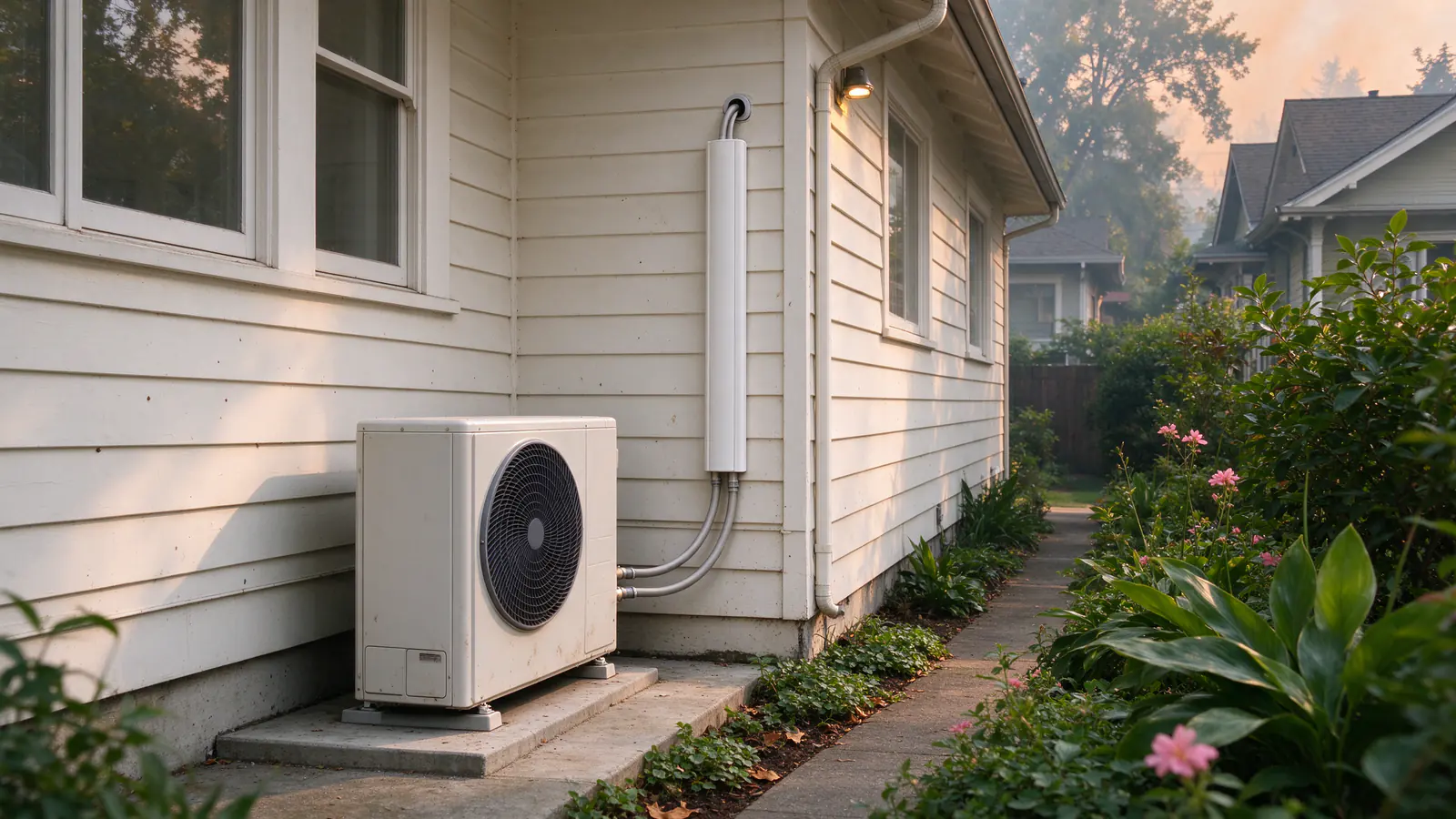
When the sky over Portland turns orange in late summer, most people want two things at once: a cool house and clean air. At Firlands Portland Mini Splits we install heads that handle the first well. This guide explains why they don’t handle the second, and what to add so you get both.
What a mini split does with smoky air
A mini split pulls air from the room, runs it over a cold coil and blows it back. It never draws air from outside, so it doesn’t bring smoke in, and it doesn’t take smoke out.
That matters in a smoke week because the main advice from health agencies is to close up the house. The U.S. EPA tells people with a central system to set it to recirculate or close the outdoor air intake. A mini split already works that way, so there’s no damper to find and nothing to change.
Why that helps
The hard part of a smoke week in an old Portland house is the heat. With no cooling, people open windows at night and let the smoke in.
With a head in the bedroom, you can keep every window shut through a hot spell and still sleep. The Oregon Health Authority says the same: keep windows and doors closed unless it’s extremely hot.
What the filter catches, and what it doesn’t
Each head has a washable plastic mesh filter behind the front panel. It protects the coil from lint, pet hair and household dust. It is not a smoke filter.
Smoke is mostly fine particles, far smaller than the gaps in a mesh screen. They pass straight through the filter and the coil and come back out of the head.
Add-on filters
Some heads have an add-on filter slot with a small carbon or electrostatic insert. Those take a little odor and fine dust out, but the head’s fan is built for low resistance, and the inserts are small.
| Filter | What it stops | Smoke? |
|---|---|---|
| Mini split mesh filter | Lint, hair, coarse dust | No |
| Clip-in add-on filter (some models) | Some fine dust and odor | A little |
| MERV 13 furnace filter (ducted systems) | Most fine particles | Yes, the level the EPA points to |
| HEPA portable purifier | Nearly all fine particles that pass through it | Yes |
If your house has a furnace with ducts, a MERV 13 filter in it is the EPA’s suggested level. A ductless head can’t take one. That’s where a portable purifier comes in.
Pairing the heads with a HEPA purifier
The simplest setup is a cool, closed room with a mini split and a portable HEPA purifier running in it. The head handles the heat and the purifier handles the smoke.
Choosing and placing a purifier
- Size it to the room. The EPA suggests choosing an air cleaner sized for the room, by its clean air delivery rate (CADR). A purifier rated for a small bedroom won’t keep up in an open living room.
- Put it where people spend the most time. For most families in a smoke week, that’s the bedroom with the head in it.
- Avoid ozone. The EPA warns against air cleaners that produce ozone. Look for a HEPA unit that says it doesn’t.
- Keep doors closed. One clean room is easier to keep clean than a whole house.
The clean room
The EPA calls this a clean room: one room, windows and doors shut, a purifier running, and cooling set to recirculate.
A bedroom with a mini split head is close to ideal, because the head keeps it cool without opening anything. In a house with several heads, you can run them all and still focus the purifier on the room you sleep in.
What a smoky summer does to the heads
Smoke doesn’t hurt the compressor, but it leaves residue inside the head. Over a summer, that film builds up on the mesh filter, the coil fins and the blower wheel.
Signs it’s time to clean
- A smoky or musty smell when a head starts up
- Weaker airflow at the same fan speed
- Dark specks blowing out of the louvers
- Water dripping from the head, because a dirty coil and drain pan slow the water away (condensate drain guide)
What you can do, and what we do
Wash each filter in lukewarm water every week or two during a smoke spell, let it dry, and put it back. Don’t run the head without it.
A full cleaning goes further:
- We cover the wall and floor under the head.
- We wash the coil and the blower wheel.
- We flush the drain pan and the drain line.
- We check airflow and temperature afterward.
Firlands’ typical range for a maintenance visit is $150 to $250 for one outdoor unit and one head, plus $40 to $120 for each added head. A full deep clean of the coil and blower wheel typically runs $200 to $450 per head. See mini split cleaning and maintenance.
Do other systems filter smoke better?
A ducted system can, because its return air passes through a filter slot that takes a thick MERV 13 filter. That’s one real advantage of ducts in a smoke week.
| System | Smoke filtering | Cooling in a smoke week |
|---|---|---|
| Wall-mount mini split | Mesh only; add a purifier | Yes, without opening windows |
| Ducted mini split | Can take a better filter at the air handler, model by model | Yes |
| Central heat pump or furnace with AC | MERV 13 in the filter slot | Yes |
| Window unit | Mesh only; leaks outside air around the panels | Yes, but seals poorly |
A concealed ducted mini split sometimes has room for a better filter at the return. It depends on the model and the static pressure the fan can handle, so we check before promising it. For the trade-offs between systems, see mini split vs central heat pump and mini split vs window AC.
What doesn’t help
Some fixes sound good but don’t do much for smoke.
- Turning the head off. It doesn’t stop smoke getting in; it only makes the room hot enough that you open a window.
- Running “fan only” with the windows open. That just moves smoky air around.
- A thicker filter stuffed behind the mesh. It chokes airflow, can freeze the coil and drips water.
- An ionizer or ozone generator. The EPA advises against ozone-producing air cleaners.
Planning ahead of smoke season
If you’re adding cooling mainly for heat and smoke, put the first head where you’ll sleep.
Start with the bedroom
A bedroom head plus a purifier gives you one cool, clean room through a heat wave with smoke on top.
You can start there and add more heads later. If you’re weighing a whole-house system, ask us whether a ducted unit with a better filter makes sense for part of the house. The cost guide has the ranges.