Heat that stands up to the Gorge
Washougal gets the east wind before any other town we serve, and that shapes every heat pump job here more than the house does.
If you heat with an electric furnace, baseboards or a wood stove, a ductless heat pump can carry most of the winter at a fraction of the resistance-heat cost. Firlands Portland Mini Splits plans Washougal jobs around two things: where the outdoor unit sits, and what stays as backup heat.
Project
What a Washougal manufactured-home install looks like
The problem
The original electric furnace pushes warm air through belly ducts that leak into the crawlspace, the bill climbs every winter, and the living room on the east end takes the brunt of the gorge wind.
The house
The home sits on a pier foundation with a skirted crawlspace and 2x6 exterior walls. The living room, dining area and kitchen form one open space of about 600 square feet. Washougal sits further into the Gorge mouth than any other town we serve, directly across the river from the Troutdale airport.
What we decide, and why
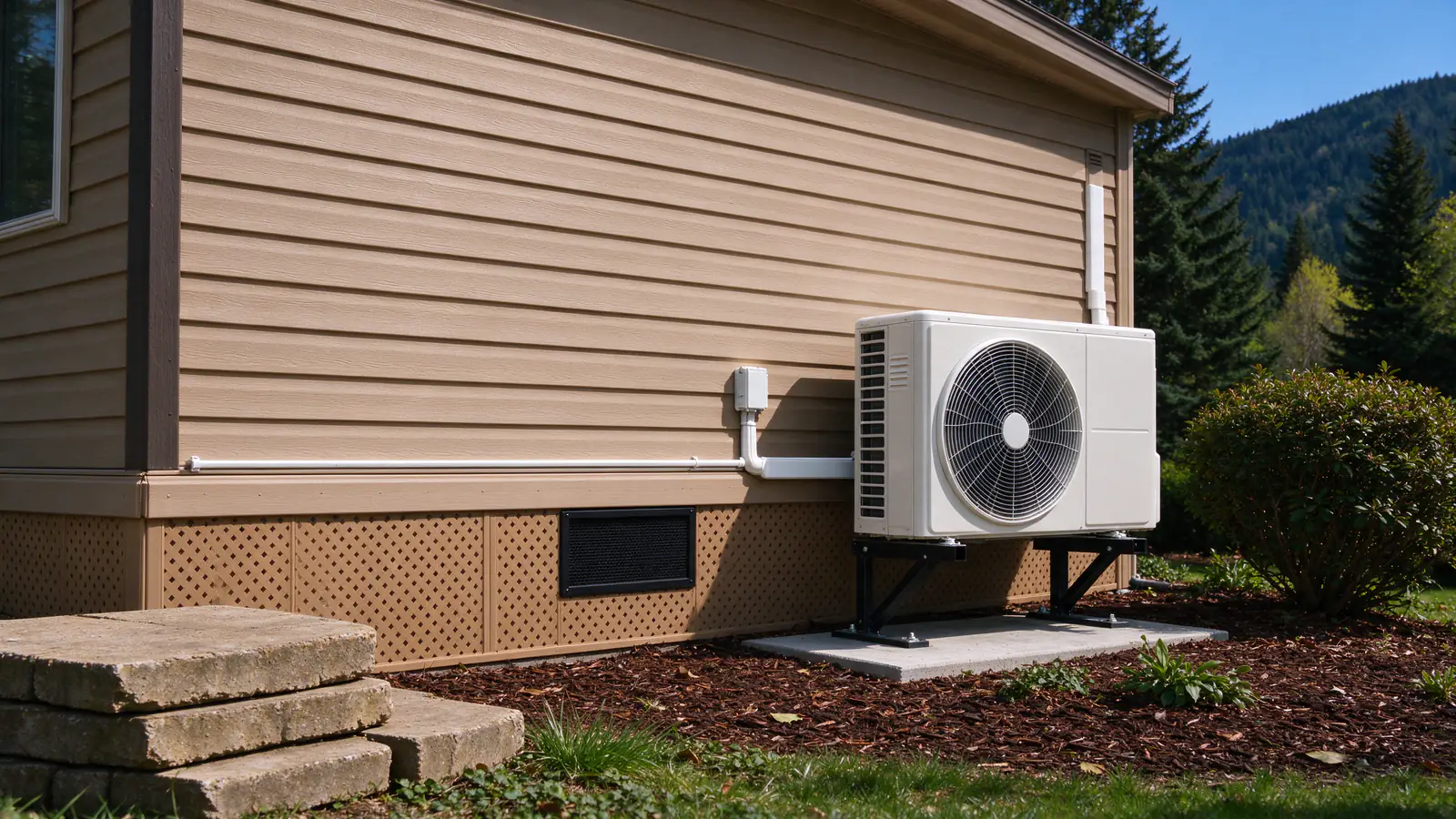
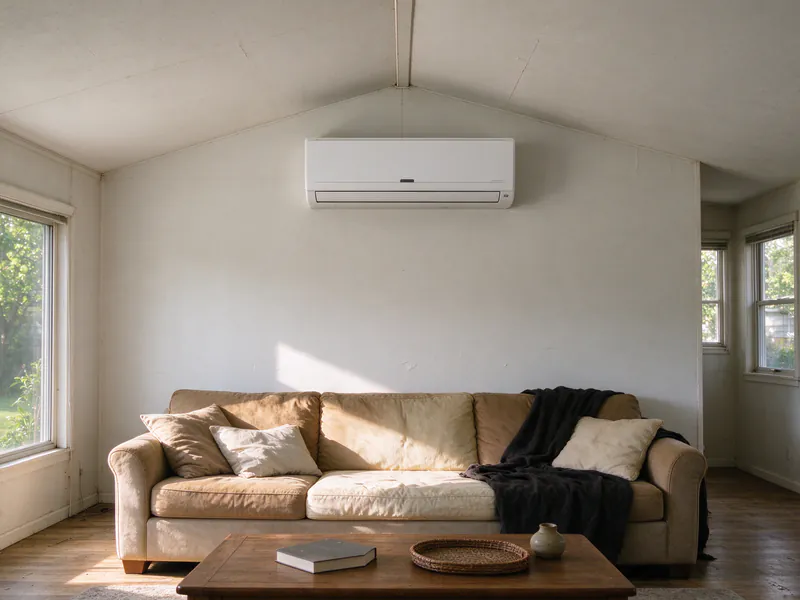
One 18,000 BTU cold-climate head on the open living area's interior-facing wall carries most of the heating, and the electric furnace stays as backup for the bedrooms. The outdoor unit goes on the west end, on a stand bolted to a poured pad, not on the skirting or a bracket on the home's wall.
The work
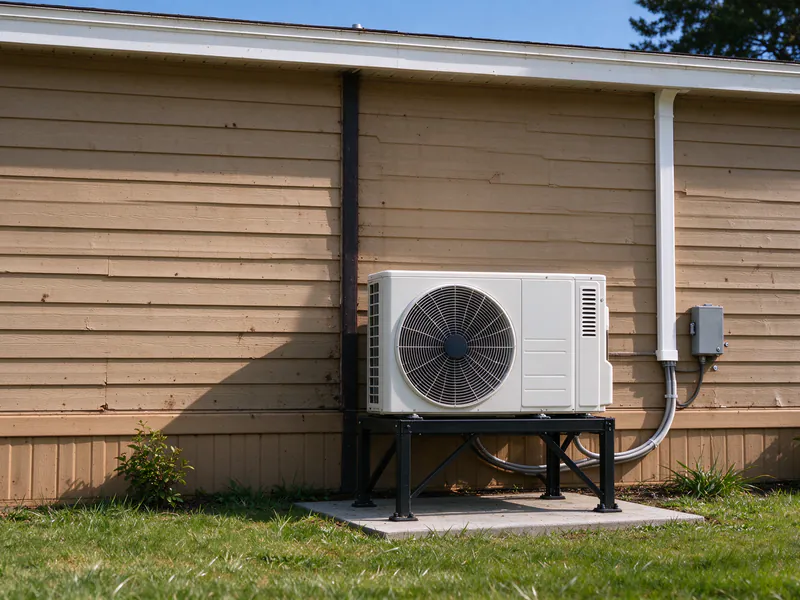
We locate the wall studs, core one three-inch hole, and run the line set and drain in a cover down to the stand. The stand is anchored with wedge anchors so wind can't shift it, and the coil sits 18 inches up, above ice and drifting snow. A new 30-amp, 240-volt circuit runs from the home's panel to a disconnect beside the unit. Pressure test, vacuum below 500 microns, startup.
Clark Public Utilities lists electric-furnace manufactured homes in its ductless rebate, so the $900 applies when the owner lives there. The City of Washougal issues the mechanical permit; the electrical permit is Washington L&I's.
What it changes
The living area heats on a heat pump, the furnace runs only on the coldest nights, and the outdoor unit sits out of the wind that rattles the east end of the home.
- Location
- Washougal, north of SR-14
- House
- 1996 double-wide manufactured home, about 1,450 square feet, electric furnace
- Equipment
- One 18,000 BTU cold-climate wall head and its outdoor unit
- Price
- $7,600, city permit fees included
- Time on site
- 1 day, then the final inspections
How hard the wind blows here
Troutdale’s airport, straight across the Columbia, is the nearest station that measures gusts, and its winter record is rough.
NOAA’s daily records show Troutdale with three times as many winter days of 40 mph gusts as Portland’s airport over the last six winters. During the January 2024 cold snap it saw gusts above 53 mph on two days, with lows down to 14°F. Washougal sits a few miles further east, nearer the Gorge.
Three ways wind works against a heat pump
- blown snow and freezing rain coat the coil on the windward face, and every defrost cycle costs heating time
- meltwater from defrost refreezes in the cold air if it has nowhere to run
- a loose stand can shift or tip when gusts catch the unit broadside
How we set the outdoor unit
The unit goes where the house shields it, on a stand bolted down, with the coil lifted clear of whatever the storm leaves behind.
On most Washougal lots, the sheltered side is west or north. We bolt the stand to a pad or footings, lift the coil 12 to 18 inches, and keep it clear of the eaves. Where no wall is sheltered, a short wind baffle on the windward side helps. Our placement guide has the clearances.
Manufactured homes
About one Washougal home in 23 is a mobile or manufactured home, and many still run on their original electric furnace and belly ducts.
Why a head works well here
A manufactured home’s living area is usually one open space, so a single head of the right size carries most of the heating, and the furnace becomes backup for the bedrooms. Clark Public Utilities names electric-furnace manufactured homes in its ductless rebate, which pays $900 toward the system.
What’s different about the install
- walls are thinner, so we find the studs before coring the hole
- the outdoor unit goes on its own anchored stand, never on the skirting
- the circuit runs from the home’s panel, which often has room once the furnace runs less
- the line set and drain run in a cover down the siding, since there’s no basement or attic route to hide them
If the belly ducts leak badly, the furnace wastes heat even as backup. We look at them from the crawlspace during the visit and tell you what we see.
Wood stoves and backup heat
More Washougal homes burn wood for heat than any of the neighboring towns, and a heat pump changes the stove’s job rather than ending it.
A cold-climate head sized to the main living space keeps the house at a steady temperature without anyone feeding a fire. The stove stays for the coldest nights, for ambience, or for a power outage.
Sizing for the cold snaps
We size the heat pump to Clark County’s 28°F design low and then check its published output at 14°F, the kind of night the 2024 storm brought. Do mini splits work in cold weather? explains how the numbers work.
Washougal permits
Washougal’s city code requires a mechanical permit to install a heat pump, and because the city doesn’t do its own electrical inspections, Washington L&I permits the circuit.
| Permit | Covers | Issued by |
|---|---|---|
| Mechanical | Heat pump, line set, drains | City of Washougal Building Division |
| Electrical | Dedicated circuit, disconnect | Washington L&I |
City fees are in our price, and we handle the applications, the inspection requests and the close-out. Under Washington’s electrical rules, the branch circuit from the panel is an electrical contractor’s work; your estimate shows who does it. More on circuits in mini split electrical requirements.
Older houses and newer ones
Washougal mixes an older downtown with newer houses up the hills, and the two need different plans.
- Near downtown. About one house in 13 predates 1940. Where the upstairs has no ducts, each upstairs room usually gets its own head. Pre-1978 houses get lead-safe dust containment before any drilling.
- Up the hill. Houses from the 1990s on often have a gas furnace and a bonus room or west bedroom it can’t keep comfortable; one single-zone head fixes that.
- Baseboard houses. A house on baseboards gets heads in the main rooms, with baseboard to mini split covering the full conversion.
When the power goes out
A heat pump needs electricity, so in a long winter outage it stops along with the furnace fan and the baseboards.
That’s one reason we rarely pull out every other source of heat in a Washougal house. A wood stove, a gas fireplace or a generator-ready circuit covers an outage; the heat pump covers the other 360-odd days. If you plan a generator, tell us at the visit, because the outdoor unit’s circuit and the generator’s capacity need to match.
Keeping the unit working after a storm
- clear drifted snow from the coil’s intake side once the wind drops
- leave the defrost-water path open, never chip ice off the coil
- if the unit shows an error after an outage, a repair visit checks it
What it costs in Washougal
Firlands’ typical range for one head is $4,000 to $8,500, and for two heads on one outdoor unit $6,500 to $12,000.
Three or four heads run $9,000 to $18,000 and up. An anchored stand and the extra line set to a sheltered wall are on the written estimate from the start, next to the heads, drains, circuit, permits and exclusions. For a rough number tonight, try the cost estimator; how we size a room covers the heat-load side.