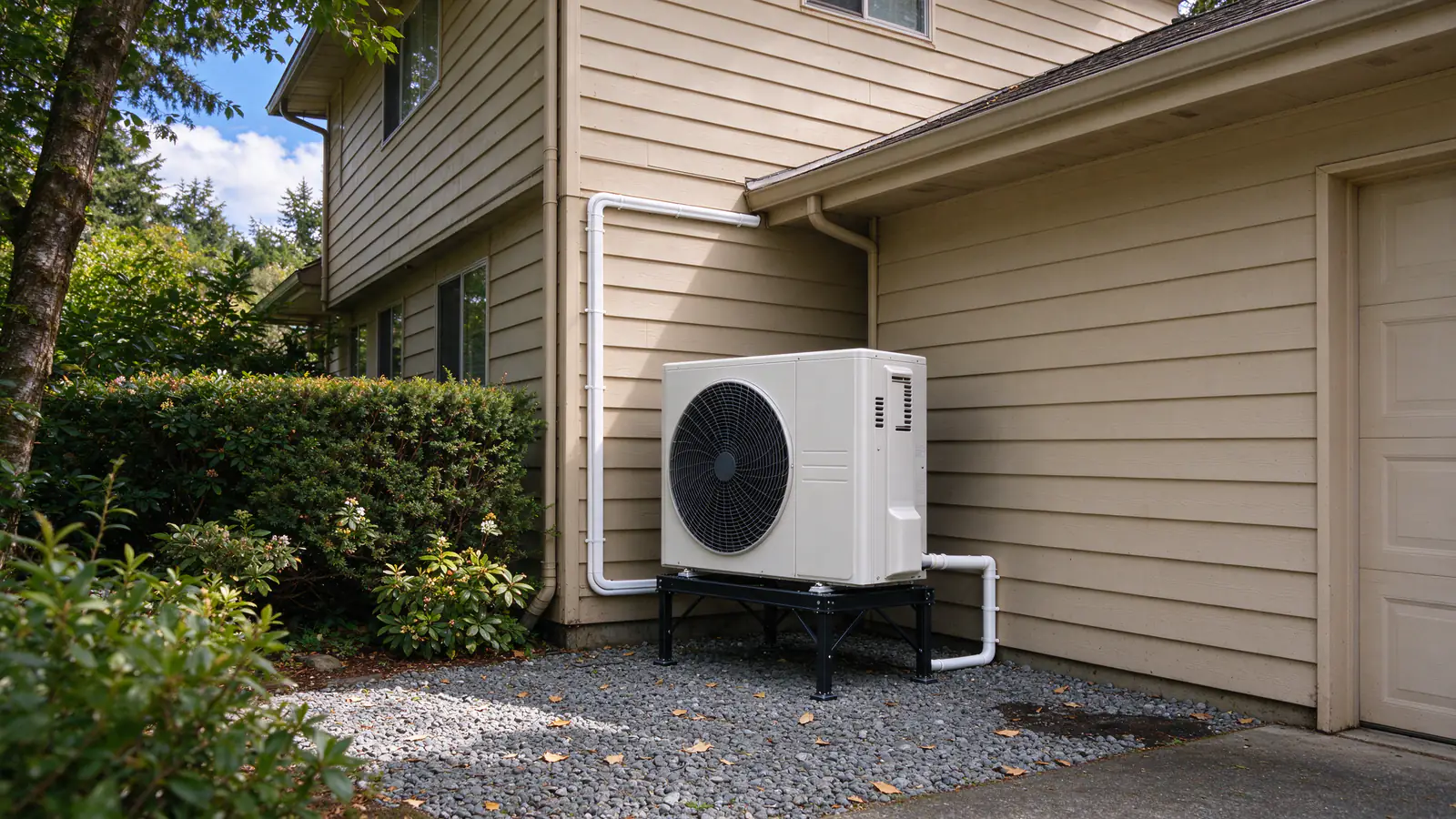
A gas furnace, a hot upstairs, and ducts that can’t carry cooling
Troutdale’s houses are young by metro standards. The median one was built in 1992, and most heat with a gas furnace through ducts.
Those ducts were sized for heat. When you ask them to cool the upstairs, the small runs can’t move enough air, and the bedrooms stay warm. Firlands Portland Mini Splits puts heads in the rooms that overheat and leaves the furnace doing the job it already does.
What we look at first
- the size of the upstairs supply runs and where the return is
- which rooms face west or sit under the roof
- where the outdoor unit can hide from the east wind
Project
Inside a south Troutdale two-story, cooled upstairs without new ducts
The problem
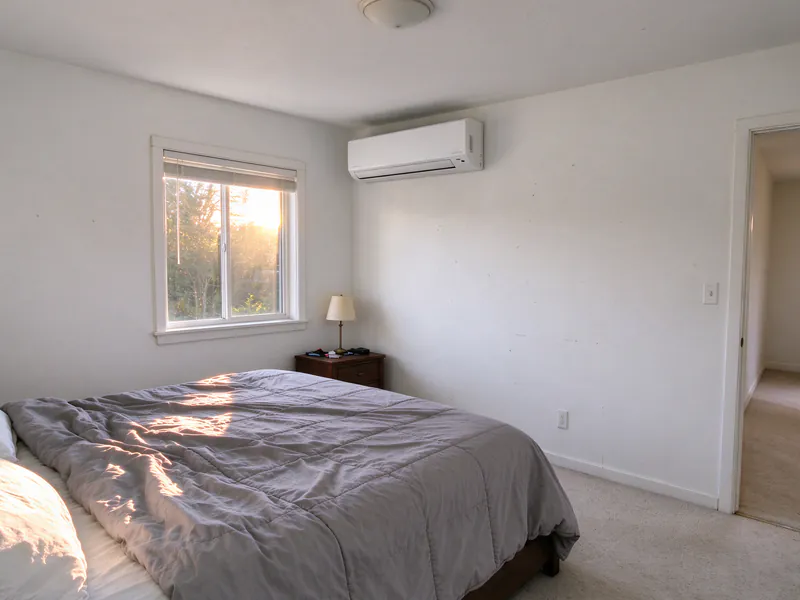
The gas furnace heats the house well enough, but there's no air conditioning, and the two west bedrooms upstairs sit in the low 80s on summer nights. A quote to add a central AC coil came with a warning that the upstairs still runs hot through those ducts.
The house
The furnace sits in the garage with one return downstairs, and the upstairs supply runs are small 6-inch ducts sized for heat, not cooling. The back of the house faces east toward the Sandy River and takes the full gorge wind in winter. The City of Troutdale issues the permits.
What we decide, and why
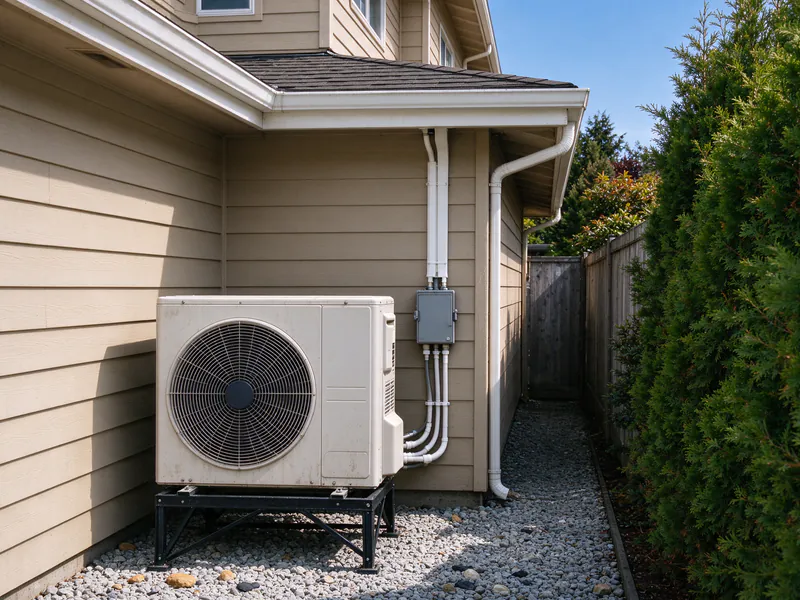
Cooling through the existing ducts means pushing more air through runs too small to carry it, so we put the cooling where the heat builds: a 12,000 BTU head in the primary bedroom and a 9,000 in the second west bedroom. The third bedroom faces north and stays on the furnace. The outdoor unit goes on a pad in the north side yard, tucked behind the garage, which blocks the east wind instead of facing it.
The work
We core two three-inch holes in the west wall, run both line sets along the eave in one cover to the north corner and down to the pad, and set the 18,000 BTU unit on a 12-inch stand so defrost water drains clear. A 20-amp, 240-volt circuit runs from the garage panel through the attic to a disconnect beside the unit. Each line set holds a nitrogen pressure test and a vacuum below 500 microns before the refrigerant goes in, and both heads drain by gravity, tested with water.
The garage-side pad adds about 14 feet of line set over the shortest route, and in return the coil never faces the east wind that packs it with ice during a gorge storm.
What it changes
The two bedrooms that overheat get their own cooling and a second heat source for shoulder-season nights, the furnace keeps the rest of the house, and nothing about the existing ductwork has to change.
- Location
- South Troutdale, off 257th Avenue
- House
- 1994 two-story, about 2,000 square feet, gas furnace with ducts
- Equipment
- Two heads (12,000 and 9,000 BTU) on one 18,000 BTU cold-climate outdoor unit
- Price
- $10,850, permits included
- Time on site
- 2 days, then the final inspections
Troutdale is where the east wind is strongest
Troutdale sits at the mouth of the Columbia River Gorge, and its airport records the metro’s windiest winters.
Over the last six winters, the airport logged 122 days with gusts of 40 mph or more. Portland’s airport logged 40. During the January 2024 storm, Troutdale gusted to nearly 54 mph and dropped to 14°F.
What the wind does to an outdoor unit
Driven snow and freezing rain pack into a coil that faces the wind. The unit then spends its time defrosting instead of heating, and the meltwater can refreeze under it.
Where we put it instead
| Your lot | Where the unit usually goes |
|---|---|
| Back of the house faces east | North or west side yard, or behind the garage |
| Narrow side yards | A wall bracket on the sheltered wall, high enough to clear drifts |
| Open lot on the bluff | A stand on the lee side, with a clear path for defrost water |
Mini split placement covers clearances and mounting.
Cooling through the ducts, or with heads?
Before we quote heads, we check whether your furnace ducts could carry cooling. Sometimes they can, and a ducted heat pump is the better answer.
If the upstairs supply runs are reasonably sized and the return pulls from upstairs too, a central heat pump on the existing ducts cools and heats the whole house. If the runs are small and the only return is downstairs, cooled air won’t reach the bedrooms. Mini split vs a central heat pump lays out both.
Electric heat in the older ranches
About 43% of Troutdale homes heat with electricity, many of them in the town’s older ranches and plexes.
Those are the houses where a heat pump changes the bill most, and where Energy Trust of Oregon’s ductless incentive applies. Baseboard to mini split covers which rooms to convert first. In a ranch, two heads often carry the living space and the primary bedroom, with the small bedrooms left on baseboards.
Permits from the City of Troutdale
Troutdale runs its own building division, so a Troutdale address doesn’t go to Gresham or to Multnomah County for permits.
A mini split needs a mechanical permit for the heat pump and an electrical permit for the new circuit. Both are filed through the city’s online portal. The fees are in our price; we book the inspections and close the job with the final. If your address is on Interlachen Lane or Blue Lake Road, Troutdale issues those permits too.
Sizing for a Troutdale winter
Multnomah County’s heating design temperature is 24°F, and Troutdale’s coldest nights go below it.
We size each head to its room’s load at that temperature and check the outdoor unit’s published output down into the teens. Where heads heat main rooms, we use cold-climate units. Do mini splits work in cold weather? explains why the label rating at 47°F isn’t the number that matters here.
What the first visit settles
We start from your photos and give a rough range on the phone. The visit then pins down the parts that set the price.
What we measure and check
- each room’s size, windows, insulation and which way it faces
- the furnace, its duct sizes and where the return sits
- the panel’s spare capacity, and the attic or crawlspace route for the circuit
- the wall that’s sheltered from the east wind, and how far it is from each head
What the written estimate lists
Every head and its capacity, the outdoor unit, the line-set route, whether each drain falls by gravity or needs a pump, the circuit, the City of Troutdale permits, the price and what’s excluded.
During the install each line set holds a nitrogen test and a vacuum below 500 microns, and you get those readings on paper. The installation process explains each step.
An older mini split that’s failing
Where a Troutdale house already has a mini split that’s 12 or 15 years old, the question is repair or replace, and then where the new one goes.
If yours is struggling, the first question is whether the line set can be reused. We pressure-test it and pull a vacuum; if it holds, a like-for-like swap is simpler. If it fails or the old unit faces the wind, it’s a chance to move it. Mini split replacement covers the choice.
Prices in Troutdale
Firlands’ typical range for a single-zone install is $4,000 to $8,500, and harder single-zone jobs run $8,500 to $12,000 and up.
Two heads on one outdoor unit typically cost $6,500 to $12,000; three or four, $9,000 to $18,000 and up. A sheltered location sometimes needs a longer line set, and that’s on the estimate from the start. Mini split installation cost in Portland lists the other drivers.
From the bluff to the airport
The houses change across town, and so does the first question we ask.
- The Sandy River bluff and south Troutdale. Two-story houses from the 1990s and 2000s, where the upstairs is the problem.
- Downtown and north of I-84. Older ranches and some plexes on electric heat, closest to the airport’s wind.
- Detached garages and shops. A garage mini split on a wall bracket keeps a workshop usable through the windy months.