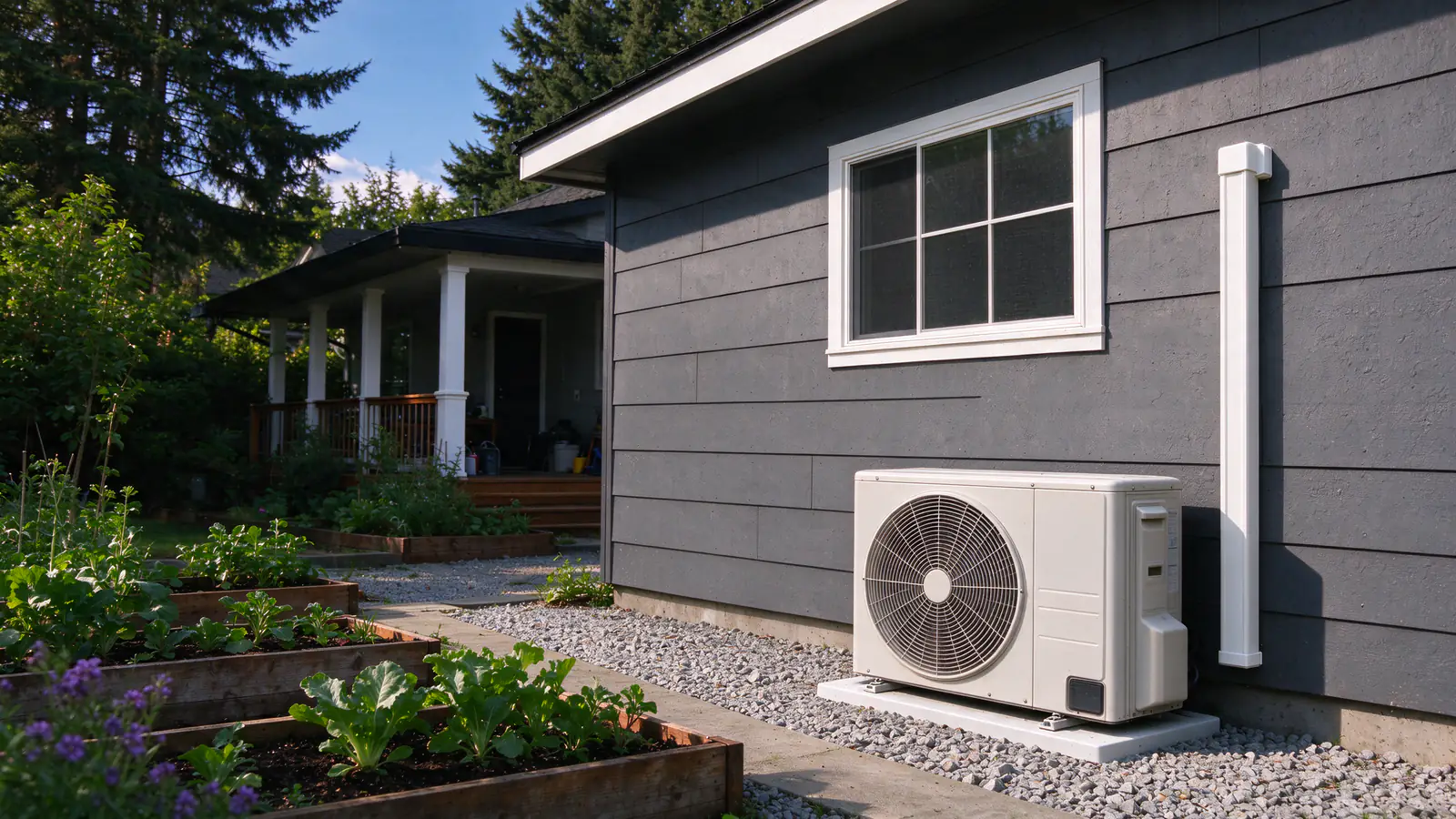
The furnace is old. Replace it, or add heads around it?
Southeast Portland has more permits for taking out or replacing a gas furnace than any other district, so that’s the question most Southeast callers start with.
Firlands Portland Mini Splits answers it house by house. Sometimes heads take over the rooms you live in and the furnace stays as backup. Sometimes the heads replace it. The other common Southeast job is a new ADU or garage conversion that needs its own heat and cooling.
How we decide
- whether the furnace’s ducts reach the rooms you care about, or only the main floor
- how old the furnace is, and what replacing it with another furnace costs
- whether you want cooling, which a furnace never gives you
Project
Inside a Woodstock backyard ADU, planned at framing
The problem
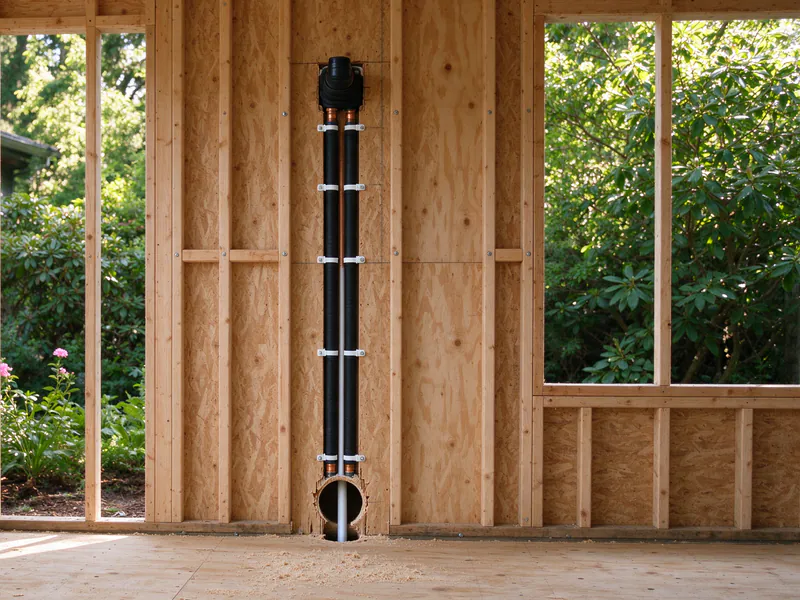
A new backyard ADU needs heat and cooling, and the builder wants the refrigerant lines and drain inside the walls before the drywall goes up, not in a cover across the new siding.
The house
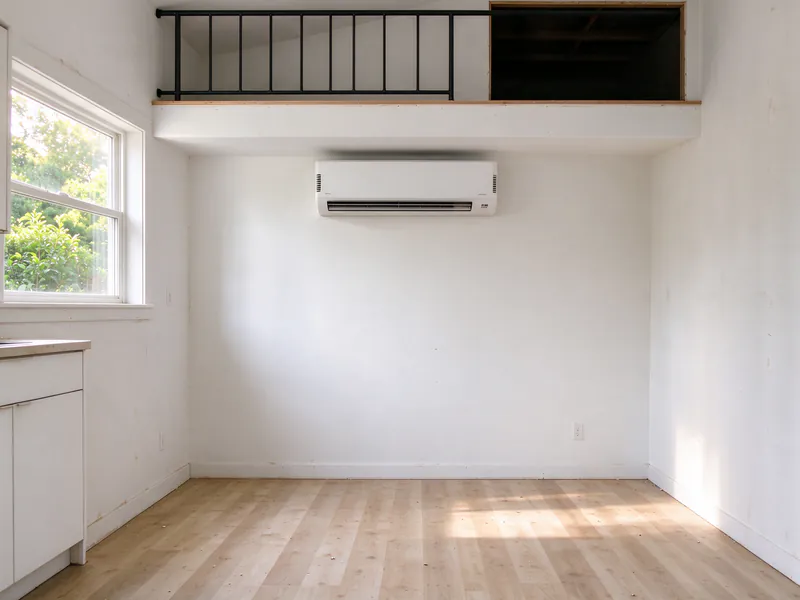
The building has one open main room with a kitchen along one wall, a bathroom, and a sleeping loft over the bathroom end, open to the main room. It has its own electrical subpanel fed from the main house. The back of the ADU faces the rear lot line.
What we decide, and why
Because the loft is open to the main room, one 12,000 BTU head can cover both. It goes high on the end wall opposite the loft, throwing air the length of the room and up into the loft. A second head just for the loft makes a zone too small to run well.
The work
At framing we run the insulated line set and control cable through the wall to a capped stub outside, and slope the drain to daylight. We pressure-test the lines with nitrogen and leave them under pressure so any nick from a drywall screw shows up before we come back. After paint we hang the head, set the outdoor unit on a pad behind the building, wire a 240-volt circuit from the subpanel, pull a vacuum below 500 microns and start it up.
The rough-in visit is coordinated with the builder's framing inspection, so nothing gets closed in until the lines have held their test.
What it changes
A finished ADU with no line-hide on the front wall, one head that heats and cools the room and the loft, and a separate mechanical permit closed out with its final inspection.
- Location
- Woodstock, Southeast Portland
- House
- New 600 square foot detached ADU with a sleeping loft
- Equipment
- One 12,000 BTU wall head, outdoor unit on a pad behind the building
- Price
- $6,900, permits included
- Time on site
- 2 visits: rough-in at framing, then a day to set the equipment after paint
What PGE’s rates mean for the gas furnace
Most of Southeast is PGE territory, where electricity costs more per kilowatt-hour than on Pacific Power, and that shapes the backup decision.
On PGE’s published residential rates, a heat pump costs the same to run as a 95% efficient gas furnace once it averages a COP of about 2.8. A cold-climate mini split does better than that through most of a Portland winter, and worse on the few nights in the teens.
Three ways it usually goes
| Your plan | What it looks like |
|---|---|
| Keep the furnace as backup | Heads carry the rooms you use; the furnace runs on the coldest nights |
| Furnace still good, ducts reach the main floor | Heads only upstairs, furnace keeps the main floor |
| Furnace near the end | Enough heads for the whole house, furnace removed, gas capped |
Mini split vs a central heat pump compares the ducted option if your ducts are in good shape.
Heating and cooling a backyard ADU
Southeast has the most ADU permits in the city: 239 over three years, from backyard cottages to garage conversions.
An ADU is usually one open room and a loft, small enough for one head on its own outdoor unit. The best time to plan it is at framing, so the line set and drain run inside the wall instead of in a cover across the new siding.
What we coordinate with the builder
- a rough-in visit before insulation, with the lines pressure-tested and left under pressure
- a 240-volt circuit from the ADU’s own subpanel
- the outdoor unit behind the building, out of the required front setback
A finished ADU or a converted garage works too; the lines then run outside in a painted cover. ADU mini split installation covers sizing a one-room building.
Ladd’s Addition reviews; Laurelhurst doesn’t
Southeast has two kinds of historic district, and they treat an outdoor unit differently.
| District | Kind | Does a mini split need review? |
|---|---|---|
| Ladd’s Addition, 136 acres | City historic district | Not if the unit and lines fit the zoning code’s exemptions |
| Laurelhurst, Eastmoreland, Peacock Lane | National Register districts | No historic resource review on a non-landmark house |
In Ladd’s, the exemptions are specific: a ground-mounted unit no more than five feet in each dimension, set no closer to the street than the front facade, with line sets off street-facing walls. Ladd’s lots have alleys and deep backyards, so the back of the house usually works.
The Montavilla edge and Pacific Power
A slice of Southeast around Montavilla and SE Stark sits in Pacific Power territory instead of PGE’s. Of 2,072 Southeast heat-pump permits over three years, 98 were there.
It matters for two things. Pacific Power’s rates lower the break-even point against gas to a COP of about 2.3, and its time-of-use plan has different hours from PGE’s. Energy Trust of Oregon serves both utilities, so the incentive rules don’t change. Mini split electric bill runs the numbers for each.
Winter nights and the heads that carry them
Multnomah County’s winter design low is 24°F, and Portland’s airport dropped to 15°F on January 13, 2024.
We size heating heads to carry each room at the design low and check their output below it, because a mini split loses capacity as it gets colder.
With or without the furnace
Where the furnace stays, it covers those nights. Where it goes, we pick cold-climate outdoor units and leave a small electric heater in a bathroom if one is already there. Do mini splits work in cold weather? has the detail.
How a Southeast job runs, start to finish
Most Southeast installs follow the same five steps, and the house only changes how long each one takes.
- Photos and a phone range. You send pictures of the rooms, the panel and the back of the house, and we give you a rough range.
- The visit. We measure each room, check the panel and the furnace, and find a line-set route that stays off the street side.
- The written estimate. It lists every head and its capacity, the outdoor unit, the route, gravity drains or pumps, the circuit, the permits, the price and what’s excluded.
- The install. In a house built before 1978 we set up lead-safe dust containment before coring plaster. Every line set holds a nitrogen pressure test and a vacuum below 500 microns, and every drain is tested with water.
- The final. You get the test readings on paper, and we close the permit with the city’s final inspection.
The mini split installation process explains each test and why it matters.
Southeast prices, and what moves them
Firlands’ typical range is $4,000 to $8,500 for one head, $6,500 to $12,000 for two on one outdoor unit, and $9,000 to $18,000 and up for three or four.
Whole-house systems with five heads or more typically run $15,000 to $30,000 and up. The City of Portland’s permit fees, about $187 to $382 for a typical single-zone job, are inside those numbers. Mini split installation cost in Portland lists every driver.
Richmond to Brentwood-Darlington
The neighborhoods share a permit office and mostly a utility, but the houses ask for different jobs.
- Richmond, Hosford-Abernethy and Mt. Tabor. Bungalows and foursquares with ducts on the main floor, where heads go upstairs and the furnace stays.
- Sellwood-Moreland and Woodstock. Bungalows and a steady run of ADUs; garage conversions are common.
- Brentwood-Darlington. Postwar houses, often with a tired furnace and room for a whole-house system.
- Montavilla. 1920s to 1950s houses on the Pacific Power side, where a multi-zone system upstairs is the usual call.