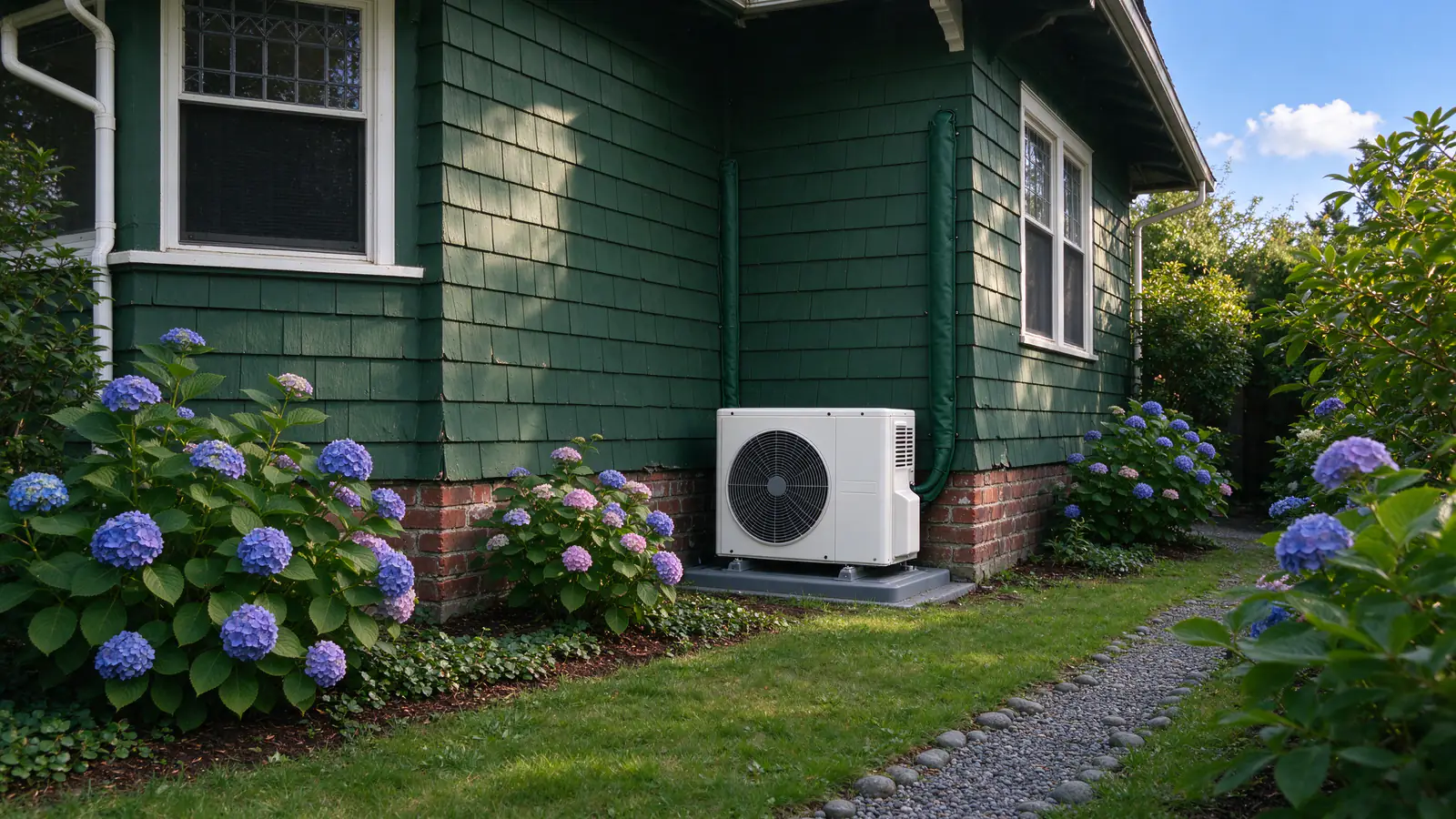
Hot bedrooms upstairs, a furnace that only heats downstairs
In most older Northeast Portland houses the gas furnace heats the main floor through ducts, and the rooms upstairs never got a supply run.
That’s why the upstairs bakes in July and runs cold in January. Firlands Portland Mini Splits puts a head in each of those rooms on one outdoor unit, sized room by room, with the line sets kept off the front of the house.
What the houses are like
Northeast is the oldest part of Portland’s housing stock: 42.7% of homes were built before 1940, and in Irvington and Alameda it’s about nine in ten. Bungalows, foursquares and Old Portland houses have:
- plaster walls that we core once per head, not chase across
- a basement panel two floors below the top bedrooms
- side yards that often leave five or six feet for an outdoor unit
Project
Inside a Rose City Park four-head multi-zone
The problem
The gas furnace heats the main floor through ducts, but upstairs has three bedrooms and a small office with no ducts at all. Two window units roar all July and still leave the west bedroom hot at bedtime.
The house
Every upstairs room has a door that closes. The west bedroom sits under the lowest part of the roof, the panel is in the basement, and the only spot for an outdoor unit is the side yard. The house is in Pacific Power territory.
What we decide, and why
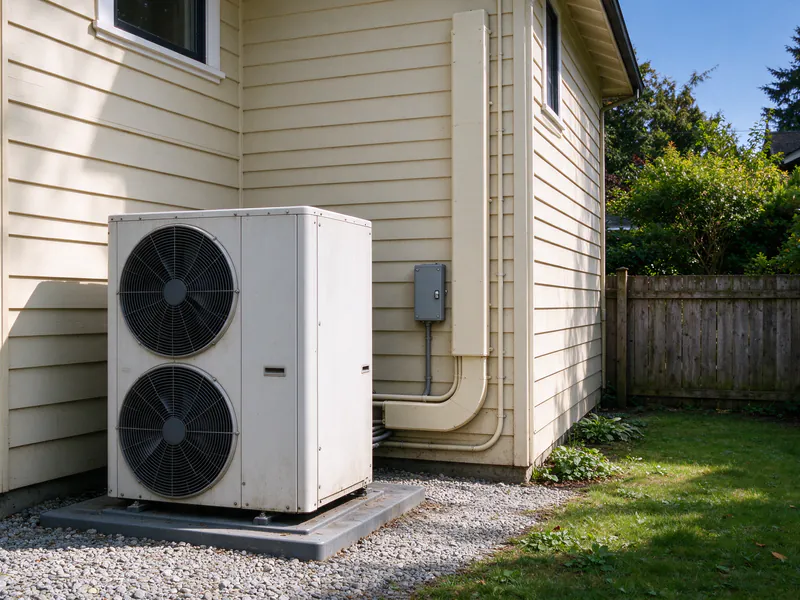
One big head in the hall can't reach behind four closed doors, so each room gets its own head, sized from its load: 12,000 BTU for the west bedroom, 9,000 for the other three. The connected heads add up to 39,000 BTU on a 36,000 BTU outdoor unit, which works because the four rooms never peak at the same moment, and the outdoor unit can still turn down low when only the office is calling.
The work
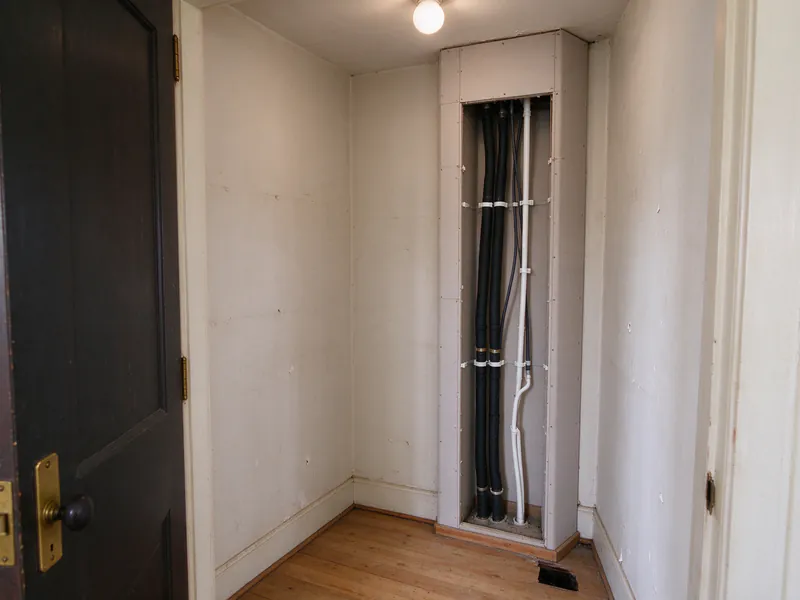
We core four three-inch holes. The two back-bedroom heads sit on outside walls and drain outside by gravity. To keep line sets off the street side of the house, the front bedroom and office heads go on walls that back onto a hall closet, and their lines drop through a chase built inside that closet, then down the back wall in one painted cover to a pad in the side yard. Those two heads get small condensate pumps with float switches. One new 240-volt circuit runs from the basement panel to a disconnect beside the unit; the heads take their power from the outdoor unit.
Each of the four line sets is flared, torqued and pressure-tested with nitrogen on its own, so a slow leak on one run can't hide behind the other three. The pumps are tested with water, and each head is run alone and then all four together.
What it changes
Four rooms set to four different temperatures, the window units gone, and the furnace left to do what it already does well on the main floor.
- Location
- Rose City Park, Northeast Portland, near NE Sandy
- House
- 1940s two-story; gas furnace with ducts on the main floor only
- Equipment
- Four heads (three 9,000 BTU, one 12,000 BTU) on one 36,000 BTU outdoor unit
- Price
- $15,850, permits included
- Time on site
- 3 days after permits, then the final inspections
What changes on the Pacific Power side of town
All of Northeast Portland’s residential heat-pump permits over the last three years sit in Pacific Power territory, not PGE’s.
That changes the running-cost question a little. On Pacific Power’s published residential rates a kilowatt-hour costs less than on PGE, so a heat pump catches up with a gas furnace sooner.
| Your house today | What a mini split does to the heating cost |
|---|---|
| Gas furnace, ducts downstairs | Heads upstairs cost less to run than the furnace once they average a COP of about 2.3 |
| Baseboards or wall heaters | Any heat pump beats them; electric resistance runs at a COP of 1 |
| Oil furnace | Oil prices aren’t published locally, so we work from your own delivery bills |
Pacific Power also offers a time-of-use plan with cheaper off-peak hours. What a mini split does to the electric bill walks through the arithmetic.
In Irvington, where can the outdoor unit go?
Irvington is a city historic district of 595 acres, and exterior changes there can need historic resource review. A mini split usually doesn’t, if it’s planned for the exemptions.
The exemptions we plan to
Portland’s zoning code lets you skip review when:
- the ground-mounted outdoor unit is no more than five feet in width, length or height
- it sits no closer to the street than the house’s street-facing facade
- the line sets and conduits stay off street-facing walls, at six inches across or less, in a matte or painted finish
The Eliot, Woodlawn, Mississippi and Piedmont conservation districts follow a parallel list. We check your address against the district map on the first visit, then route the lines to the back or side. Mini split placement shows the options.
Still on oil in Northeast?
About 2.1% of Northeast homes still heat with fuel oil, roughly 1,100 households, many of them in bungalows from the 1910s to the 1940s.
If yours is one, the heads go in first and run before the oil furnace comes out, so the house is never without heat.
The tank comes with the furnace
Oregon law requires a heating oil tank to be emptied once the house stops using it, so we book the tank provider’s visit for the same week the furnace leaves. Oil heat to mini split covers the sequence and the paperwork you keep for a sale.
Sizing heads for rooms under the roof
We size each head from that room’s heat load, not its floor area, because two upstairs rooms the same size rarely need the same capacity.
What pushes a Northeast room up a size
- a west or south gable window with no shade
- thin or missing insulation in the slopes of a finished attic
- knee walls that were never insulated behind the plaster
- a ceiling that follows the roofline, so the room holds the day’s heat
A 1920s attic bedroom with all four often lands at 12,000 BTU where a modern room its size takes 9,000. An oversized head short-cycles and leaves the room clammy, so we don’t round up for comfort. Mini split sizing explains the method.
Close houses and the neighbor’s bedroom
Northeast lots are narrow, and the outdoor unit often ends up a few feet from the property line.
Portland’s noise code sets 55 dBA at the property line during the day and 50 dBA at night for one house heard from another. A modern inverter unit at low speed sits well under that, but at full speed in a heat wave it gets closer.
- We put the unit where the neighbor’s bedroom window isn’t directly across from it.
- It sits on rubber pads, so the hum doesn’t travel into the slab or the wall.
- It stays clear of a solid fence that bounces sound back toward both houses.
Permits and inspection in the city
The City of Portland issues both permits for a Northeast mini split, and every job ends with the final mechanical inspection.
| Permit | What it covers | Typical city fee |
|---|---|---|
| Mechanical | Heat pump, heads and line sets | Starts at the $167 minimum |
| Electrical | The new 240-volt circuit and disconnect | $174 for the first circuit |
For a typical single-zone install that’s about $187 to $382 with the state surcharge, more for multi-zone. Those fees are in our price, and we schedule the inspections. Mini split permits in Portland has the detail.
What drives the price on a Northeast house
Firlands’ typical range for one head is $4,000 to $8,500, two heads on one outdoor unit $6,500 to $12,000, and three or four heads $9,000 to $18,000 and up.
On a 1910s or 1920s house, three things move the number most:
- Routing. A closet chase that keeps line sets off the street side costs more than a straight run down the back wall.
- Drains. Heads on interior walls need small condensate pumps; heads on outside walls drain by gravity.
- The panel. An older 100-amp panel may need a service upgrade, which Firlands’ typical range puts at $2,500 to $6,000.
What a mini split costs in Portland breaks the rest down.
Alameda to Roseway
The district changes from the inner neighborhoods to the east, and so does the job.
- Irvington, Alameda and Grant Park. Big two-and-a-half-story houses with finished attics. A ducted mini split in the knee-wall space can serve two attic rooms through small grilles.
- Concordia, King and Sabin. Bungalows with one finished room under the roof, often a single head job with a short line run.
- Rose City Park, Roseway and Cully. 1930s to 1950s two-stories and ranches, where three or four heads upstairs carry most of the summer load.