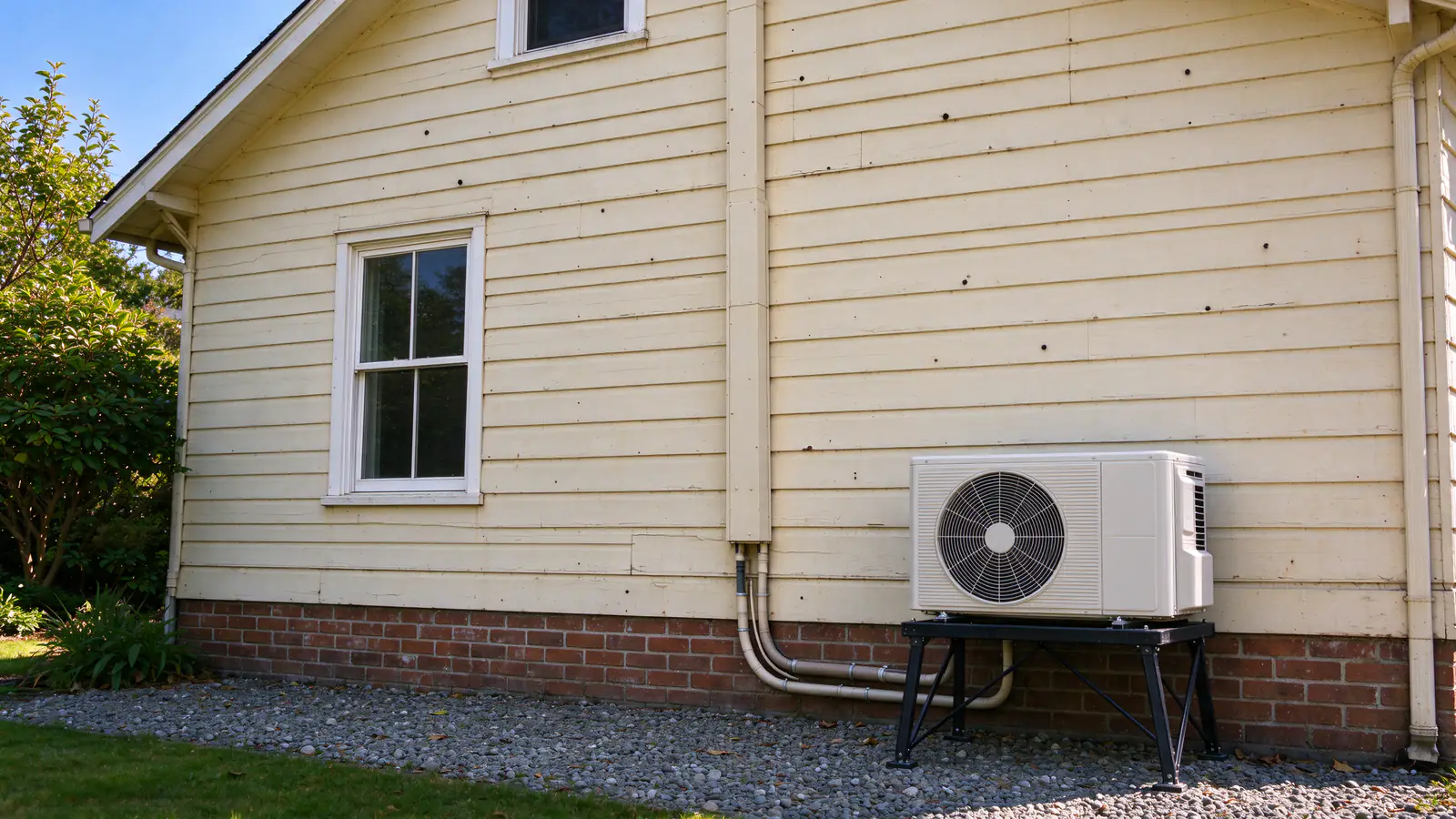
Old houses on the bluff, new ones up the hill
Oregon City is two housing markets. On the bluff, McLoughlin and Canemah hold the city’s oldest houses; up Molalla Avenue and Beavercreek Road, a third of the city’s homes were built in 2000 or later.
Firlands Portland Mini Splits installs mini splits in both, and the job changes with the house. Up the hill, it’s usually one or two rooms the ducts don’t serve. On the bluff, it’s cooling for a house with no ducts at all, planned around the exterior review rules.
What changes on the bluff
- plaster walls and no ductwork, often with a boiler and radiators
- exterior review for locally designated homes in McLoughlin and most homes in Canemah
- line sets that have to stay off the street side
Project
Inside a McLoughlin foursquare that keeps its radiators
The problem
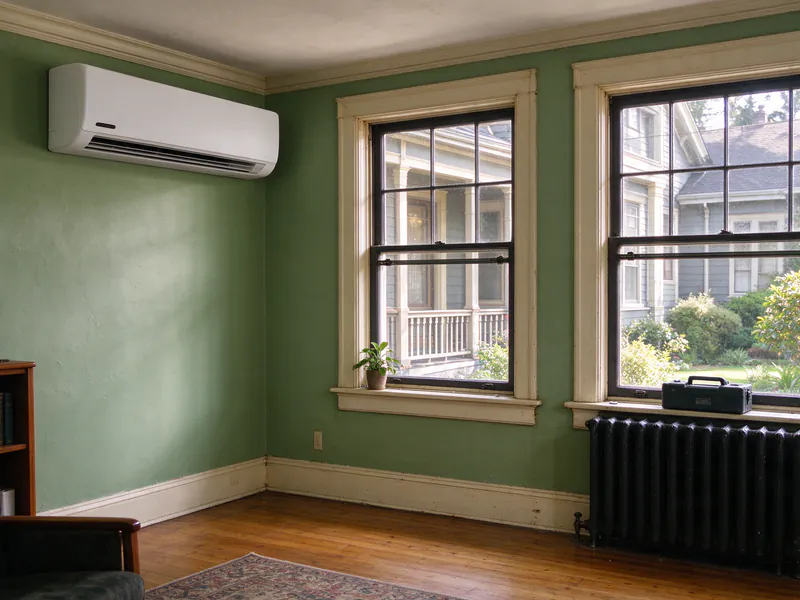
The boiler and radiators heat the house evenly, but there's no cooling, and the bedrooms upstairs hold the heat of a July afternoon well past midnight. Window units don't fit the old double-hung sashes without blocking them.
The house
The house sits on the bluff in the McLoughlin Conservation District and is one of the locally designated homes there, so exterior alterations need the city's review. No ducts anywhere, plaster walls, a full basement with the boiler and a 200-amp panel, and a back porch facing an alley. The City of Oregon City issues the mechanical permit; Clackamas County the electrical.
What we decide, and why
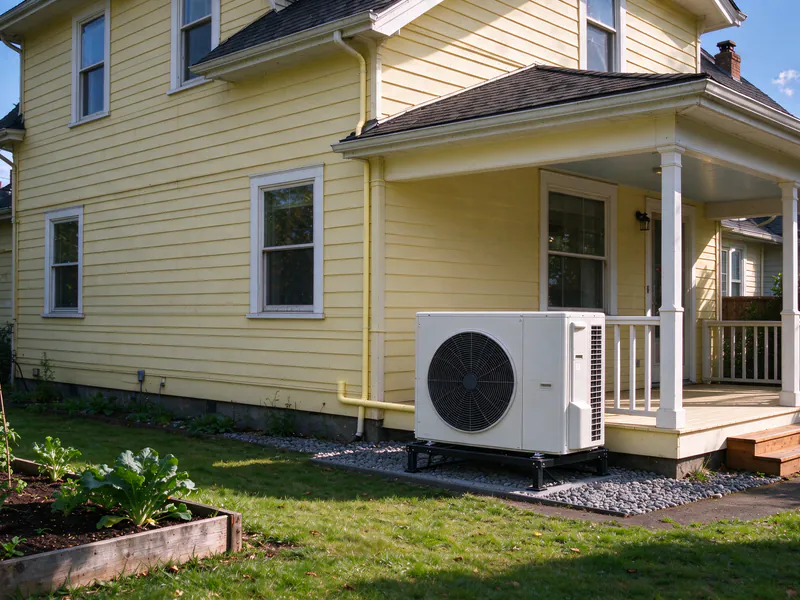
The radiators stay as the main heat; the heads are for cooling and for mild days when firing the boiler is overkill. A 12,000 BTU head goes in the front parlor on its interior side wall, a 12,000 in the primary bedroom above it, and a 9,000 in the back bedroom. Nothing goes on the street side. The outdoor unit sits on a low stand beside the back porch, under five feet in every dimension, and the line sets climb the rear wall in a cover painted the body color.
The work
We prepare the exterior review submittal: a site sketch, photos of the rear wall, the unit's dimensions and the cover color. Once approved and permitted, we core three holes in the rear and side walls under lead-safe containment. The parlor head's line set drops through the basement and out at the rear; the two upstairs runs share one cover on the back wall. The parlor head drains to a small pump in the basement; the bedrooms drain by gravity. Each line set holds a nitrogen test and a vacuum below 500 microns.
Routing the parlor line set through the basement, rather than out the side wall, keeps every penetration and cover off the walls visible from the street, which is what the review looks at.
What it changes
Cooling in the three rooms that need it most, the radiators untouched, and an exterior that reads the same from the street as it did before.
- Location
- McLoughlin neighborhood, Oregon City
- House
- 1908 two-story foursquare, about 2,100 square feet, gas boiler and cast-iron radiators, locally designated
- Equipment
- Three heads (12,000, 12,000 and 9,000 BTU) on one 30,000 BTU cold-climate outdoor unit
- Price
- $15,400, permits included
- Time on site
- 3 days after the exterior review and permits, then the final inspections
One install, two permit offices
Oregon City splits a mini split’s permits between two offices, and both have to sign off before the job is done.
| Part of the job | Plan review and inspection |
|---|---|
| Heat pump, heads and line sets | City of Oregon City |
| New 240-volt circuit and disconnect | Clackamas County |
The county’s Building Codes office is on Beavercreek Road. We apply to both, include both offices’ fees in the price, and schedule the inspections in order so the mechanical final isn’t waiting on the electrical. Mini split permits explains what each permit covers.
West Linn and Happy Valley work the same way
West Linn and Happy Valley split the work the same way: city mechanical, county electrical. Gladstone and the unincorporated areas around Oregon City go to the county for both.
McLoughlin and Canemah: what gets reviewed
Oregon City has two historic areas on the bluff, and they treat exterior work differently.
| District | What the city says | What it means for a mini split |
|---|---|---|
| McLoughlin Conservation District | Only locally designated homes need review of exterior alterations | Most homes: no review. Designated homes: a submittal for the unit and lines |
| Canemah National Register Historic District | Most homes need review of exterior alterations | Plan for review; keep everything at the rear |
How we plan for review
- the outdoor unit at the rear or a back corner, on a low stand, not visible from the street
- line sets inside the house or on the rear wall, in a cover painted the body color
- no penetrations on a street-facing wall
- a submittal with a site sketch, photos, the unit’s dimensions and the cover color
Mini split placement shows how line sets can run inside a house.
Cooling a house with radiators
Some of Oregon City’s oldest houses still heat with a boiler and radiators, and they have no ducts at all, so central air was never an option.
A mini split adds what the radiators can’t do. The heads cool the rooms that overheat and handle mild spring and fall days without firing the boiler. The radiators stay as the main heat on cold days, and nothing in the hot-water system changes. Adding air conditioning to an old house covers the options for houses like these.
Newer houses with one room that won’t keep up
About a third of Oregon City’s homes were built in 2000 or later, mostly with a gas furnace and ducts. The call from these houses is about one room.
It’s usually a bonus room over the garage, a top-floor room at the end of the longest duct run, or a finished basement. One single-zone head on its own thermostat fixes it without rebalancing the whole system. Two problem rooms share one outdoor unit.
Electric heat across the city
About 41% of Oregon City homes heat with electricity, and in those houses a heat pump changes the bill more than anywhere else.
Oregon City is PGE territory, so Energy Trust of Oregon’s ductless incentive applies when a ductless system replaces electric resistance heat in the main living space: $800 for a single-family home, $1,800 for rentals and attached homes. Baseboard to mini split covers which rooms to convert first.
Sizing heads in plaster-walled rooms
An old house on the bluff loses and gains heat differently from a new one, so we size each head to its room’s actual load.
What we measure
- the room’s floor area and ceiling height, often nine or ten feet in the older houses
- window area and which way it faces, including the tall double-hungs
- what’s in the walls and attic, where we can see it
- how the room is used
High ceilings and big windows can push a 1900s bedroom to 12,000 BTU where a modern one its size takes 9,000. Clackamas County’s design temperatures are 24°F for heating and 88°F for cooling. Mini split sizing explains the method.
Lead-safe work in older houses
Most Oregon City houses on the bluff were built long before 1978, and their paint and plaster can contain lead.
Before we core a wall in a pre-1978 house, we seal off the work area, use a shrouded, vacuum-attached core drill and clean up with a HEPA vacuum. It adds a little time to each hole and keeps the dust out of the rest of the house. The installation process covers the other steps.
What your written estimate spells out
On an Oregon City job the estimate does more than price the equipment, because two offices and sometimes a review are involved.
- each head, its capacity and the room it serves
- the outdoor unit, where it sits and what it sits on
- the line-set route, inside the house or on which wall, and the cover color
- each drain: gravity, or a pump and where it discharges
- the circuit, the disconnect and any panel work
- the city mechanical permit, the county electrical permit, and the exterior review if your house needs one
- the price, and what’s excluded, such as plaster repair beyond the wall openings
Oregon City prices
Firlands’ typical range for a single head is $4,000 to $8,500, and harder single-zone jobs run $8,500 to $12,000 and up.
Two heads on one outdoor unit typically run $6,500 to $12,000, and three or four $9,000 to $18,000 and up. Routing line sets inside an old house, or a condensate pump in a basement, moves the price. A ducted mini split in an attic for several bedrooms is another option. Mini split installation cost in Portland breaks it down.
Across Oregon City
The city’s neighborhoods sort roughly by age, and the job follows.
- McLoughlin and Canemah. Pre-1940 houses on the bluff: cooling, radiators, review.
- Park Place, Barclay Hills and Hillendale. 1960s to 1990s houses, a mix of baseboards and furnaces, often a multi-zone system.
- South End, Gaffney Lane and the newer subdivisions. Houses from 2000 on, usually one problem room.