The bedroom level is the problem
In an Oatfield split-level, the furnace sits on the lowest floor and the bedrooms sit at the top. That’s the whole problem. Almost half the homes here were built in the 1960s and 1970s, and six in ten heat with gas.
The bedrooms get the shortest, smallest duct branches and the return is downstairs, so they run warm in summer and lag in winter. Firlands Portland Mini Splits adds heads to the bedroom level and leaves the furnace with the floors it already heats well.
What a ridge house usually has
- a gas furnace and ducts, often with no air conditioning
- bedrooms half a flight or a full story above the living space
- a lot that slopes away from the street or toward it
Project
What a tri-level upstairs job on Oatfield Ridge looks like
The problem
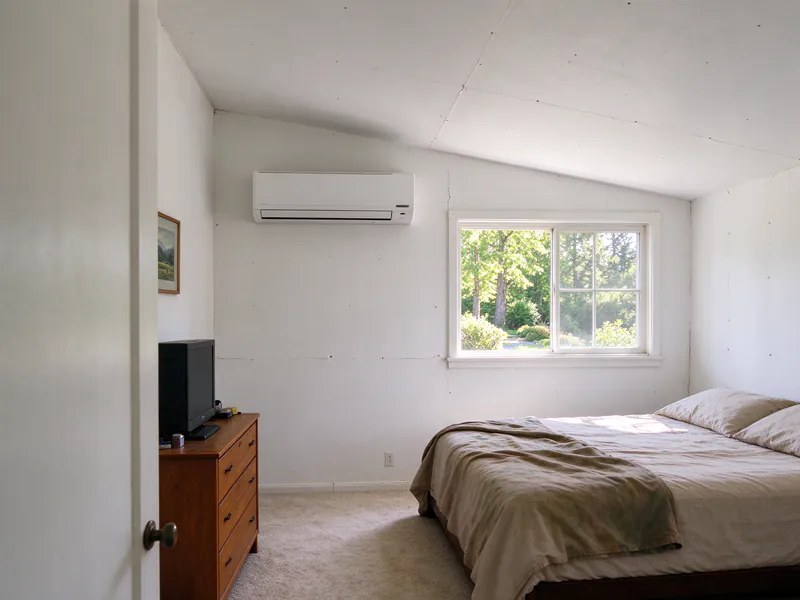
The three bedrooms on the top level run in the 80s on summer evenings, and the gas furnace in the lower level heats the family room long before the bedrooms. The owners want cooling upstairs and less of the furnace running all night.
The house
Kitchen and living room on the middle level, family room and furnace on the lower level, three bedrooms and a bath up half a flight. The upstairs supply ducts are short branches off a trunk in the lower-level ceiling. The lot slopes down from the street, so the back yard sits a full story below the bedroom windows. Clackamas County issues both permits.
What we decide, and why
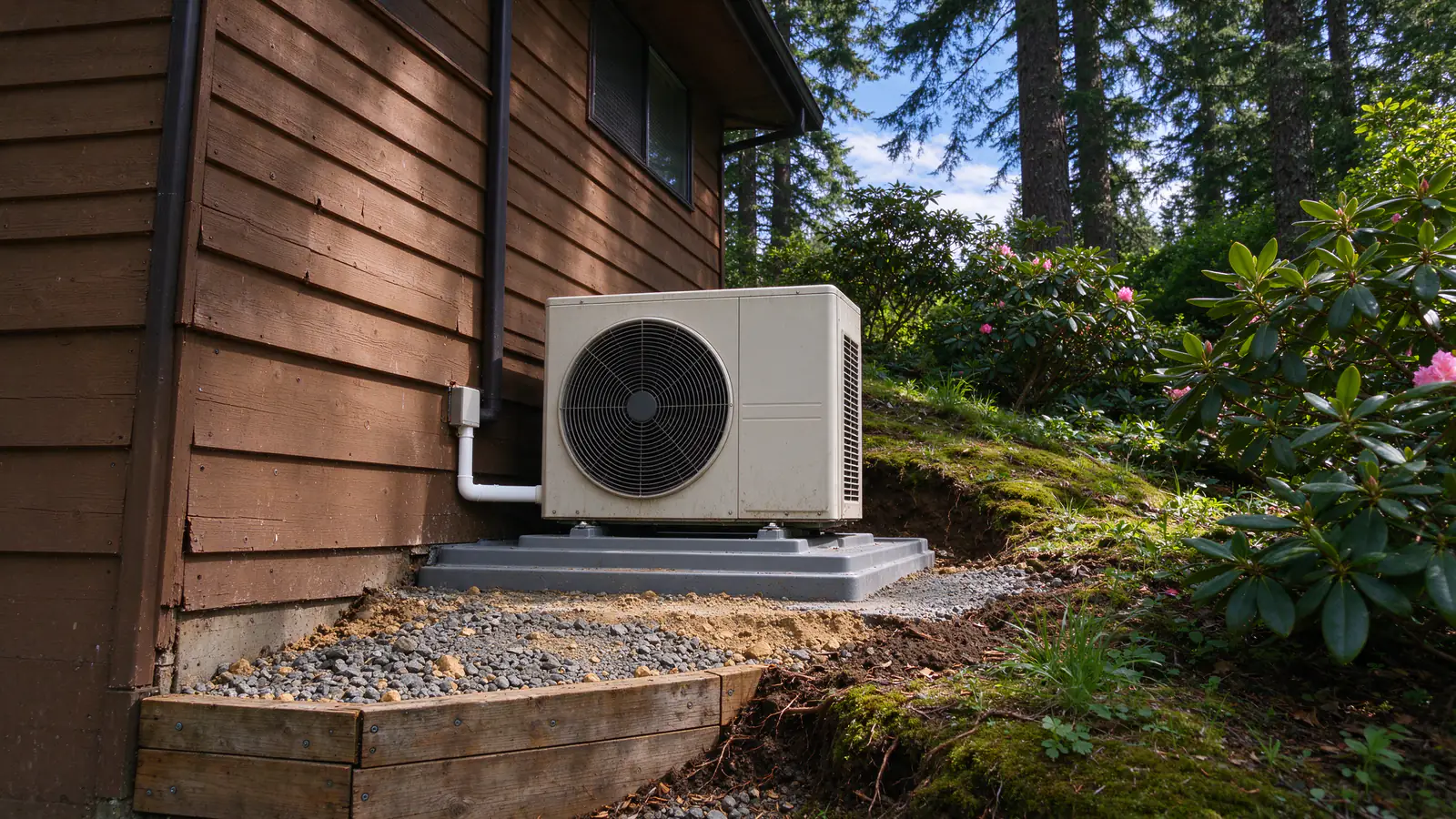
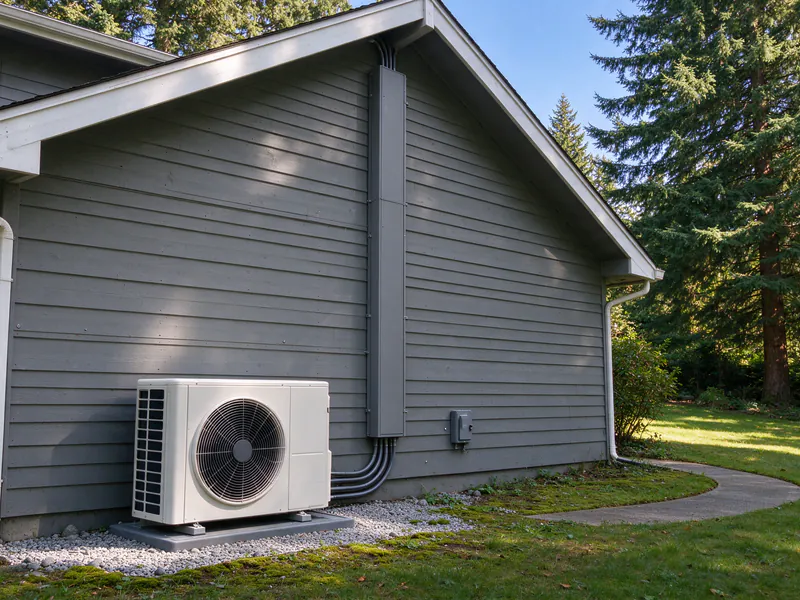
A cooling coil on the furnace pushes cold air up the same small branches that can't heat the bedrooms well, so the bedrooms get their own heads: three 9,000 BTU heads, one per room, each on its own thermostat. The furnace keeps the middle and lower levels. The outdoor unit goes on a pad on the uphill side yard, at the bedroom level, instead of down the slope, which keeps the line sets short and every head draining by gravity.
The work
Three three-inch holes in the bedrooms' outside walls. The line sets run through the attic to the uphill gable and down 9 feet in one cover to the pad. A 20-amp, 240-volt circuit runs from the lower-level panel up a closet chase to the attic and out to a disconnect beside the unit. Each line set holds a nitrogen test and a vacuum below 500 microns, and each drain is tested with a quart of water.
A unit downhill needs nearly 30 more feet of line set per head and a climb of about 18 feet back up to the bedrooms. The uphill pad avoids both and keeps the unit out of the cold air that pools at the bottom of the lot on winter nights.
What it changes
Three bedrooms with their own heat and cooling, a furnace that only has to carry the lower two levels, and a single outdoor unit sized to the three rooms' combined load.
- Location
- Oatfield Ridge, off SE Thiessen Road (unincorporated Clackamas County)
- House
- 1971 tri-level, about 1,900 square feet, gas furnace with ducts, no air conditioning
- Equipment
- Three 9,000 BTU heads on one 24,000 BTU cold-climate outdoor unit
- Price
- $12,600, permits included
- Time on site
- 2 days, then the county's final inspections
Cooling coil or bedroom heads?
Before quoting heads, we look at whether the furnace could cool the house through the ducts it has. In some Oatfield houses it can.
When the ducts are enough
If the bedroom branches are a decent size, the return pulls from the upper level and the furnace blower can move more air, a cooling coil or a ducted heat pump can cool the whole house. Mini split vs a central heat pump compares the two.
When they aren’t
Short, small branches off a trunk in the lower-level ceiling and a single return downstairs mean cool air settles where you don’t need it. That’s when heads in the bedrooms are the better buy.
Sloped lots and the outdoor unit
Oatfield Road runs along a ridge, and many lots on either side fall away from the street. That decides where the outdoor unit can go and how long the lines run.
| Where the unit sits | What it means |
|---|---|
| Uphill side yard, at bedroom level | Short line sets, gravity drains, no climb |
| Down the slope in the back yard | Longer lines, a vertical rise to the heads, and cold air pooling on winter nights |
| Wall bracket on the uphill wall | Works where the side yard is too narrow for a pad |
Every outdoor unit has a limit on the height between it and its highest head, and longer lines cost more. Mini split placement covers the clearances.
One outdoor unit or one per room?
Three bedrooms side by side are a natural multi-zone job: one outdoor unit, three heads, each on its own thermostat.
A single outdoor unit costs less than three and takes one pad.
The trade-off
The trade-off is that it serves all three rooms, so it has to turn down low when only one room is calling. We size it to the rooms’ combined load rather than adding up the heads’ nameplates, so it doesn’t run oversized. Single-zone vs multi-zone walks through when each one fits.
Working inside a 1970s house
Most Oatfield houses were built before 1978, which changes how we cut into them, even when nothing looks old.
What we do differently
- Dust containment. Paint from before 1978 may contain lead, so we seal off the work area and use a shrouded, vacuum-attached core drill for each wall hole.
- Finding the framing. Drywall over 2x4 studs makes the heads easy to hang; we locate the studs and any wiring before we core.
- The panel. A 1970s panel often has spare spaces but may be crowded. We check its rating and the house’s load before adding a 240-volt circuit.
Cold nights on the ridge, hot afternoons upstairs
Clackamas County’s heating design low is 24°F and its cooling design high is 88°F. The bedroom level sees the worst of the summer end.
Heat rises through a split-level and collects on the top floor, and west-facing bedrooms add the afternoon sun.
Sized room by room
We size each head to its own room’s load, so a west bedroom may take more capacity than an east one the same size. For winter we pick cold-climate units, because these heads also become the bedrooms’ main heat. Mini split sizing explains the room-by-room method.
Permits from Clackamas County
Oatfield is unincorporated, so Clackamas County’s Building Codes division issues both permits.
| Permit | Covers |
|---|---|
| Mechanical | The heat pump, heads and line sets |
| Electrical | The new 240-volt circuit and the disconnect |
Many Oatfield addresses mail as Milwaukie or Gladstone, but the permit office follows the parcel, not the mailing address. We check it, file both, include the fees in the price, and close the job with the county’s final inspections.
Electric and wood heat on the ridge
About a third of Oatfield homes heat with electricity, and almost 4% with wood, more than most of the metro.
In an electrically heated house, heads in the main living space can qualify for Energy Trust of Oregon’s ductless incentive, $800 for a single-family home. Where a wood stove carries the living room, the heads go where its heat stops, and that layout doesn’t qualify. Whole-house mini split covers replacing electric heat throughout.
An old furnace and a whole-house decision
When the furnace itself is near the end, the question gets bigger than the bedroom level.
You can replace it with another furnace and keep the bedroom heads, replace it with a ducted heat pump, or put heads in every main room.
Another option for the bedroom level
A tri-level can also take a ducted mini split in the attic for the bedrooms, with grilles instead of wall heads. We price the options side by side so you can compare, and the estimate says which ones keep gas in the house and which ones don’t.
What Oatfield jobs cost
Firlands’ typical range is $4,000 to $8,500 for a single head, $6,500 to $12,000 for two on one outdoor unit, and $9,000 to $18,000 and up for three or four.
A downhill outdoor unit, a condensate pump for a head on an interior wall, or a panel that needs work moves the price up. A short route from an uphill pad keeps it down. Mini split installation cost in Portland lists the drivers, and mini split replacement covers swapping out an older system.