Wall heaters, baseboards and a rising winter bill
If your Beaverton home heats with wall heaters or baseboards, a mini split takes over the rooms you use most and cuts what the heat costs.
Firlands Portland Mini Splits plans those conversions room by room across Beaverton. More than half the homes here heat with electricity, a higher share than Portland’s, and electric resistance heat is the most expensive way to warm a room on PGE’s rates.
Why a heat pump changes the bill
A wall heater turns one unit of electricity into one unit of heat. A heat pump moves heat in from outside, so on a typical Beaverton winter day it delivers several units of heat for each one it uses. It also cools, which wall heaters never did. Baseboard to mini split covers the conversion in detail.
Project
Inside a Greenway townhouse, wall heaters out
The problem
Four recessed electric wall heaters carry the whole townhouse, and the winter bills climb every year. Upstairs, the bedrooms hold the day's heat well into a July night, and the only cooling is a window unit that blocks the sliding window.
The house
The unit shares both side walls with its neighbors, so the only outside walls are front and back. The back patio is about 12 by 10 feet behind a wood fence, the panel sits in the garage at the front, and the association's rules cover what can go on the front of the building.
What we decide, and why
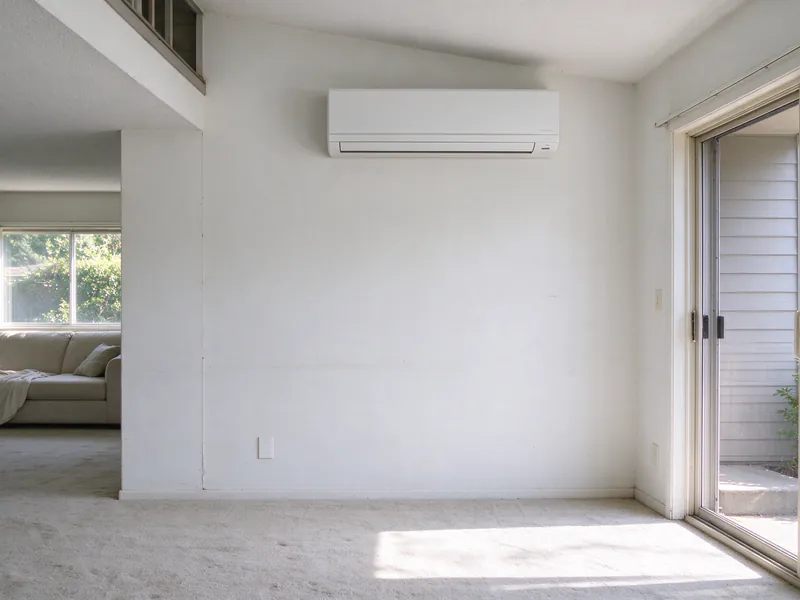
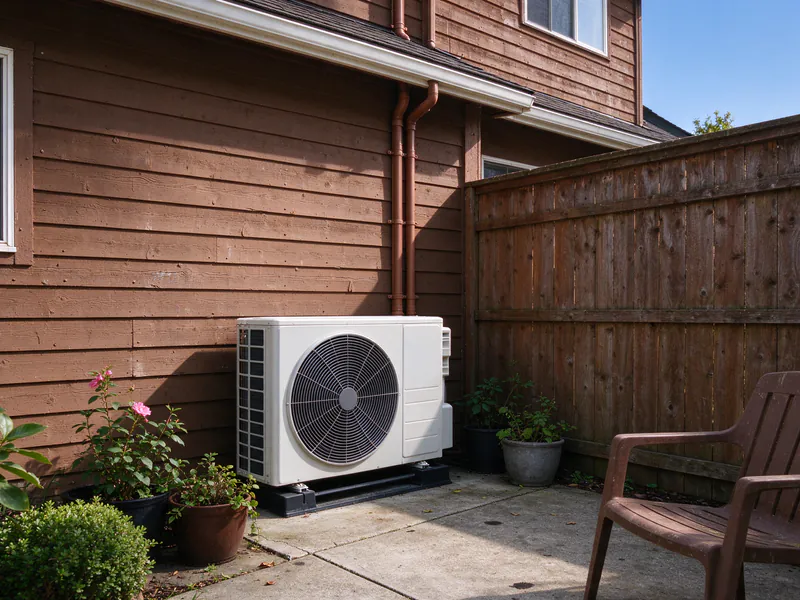
Everything goes on the back wall: one head in the living room on the main floor, one in the primary bedroom above it, and the outdoor unit on a low stand in the patio corner. We size the living room at 12,000 BTU for the sliding glass door, and the bedroom at 9,000. A single outdoor unit keeps the patio usable, where two take half of it.
The work
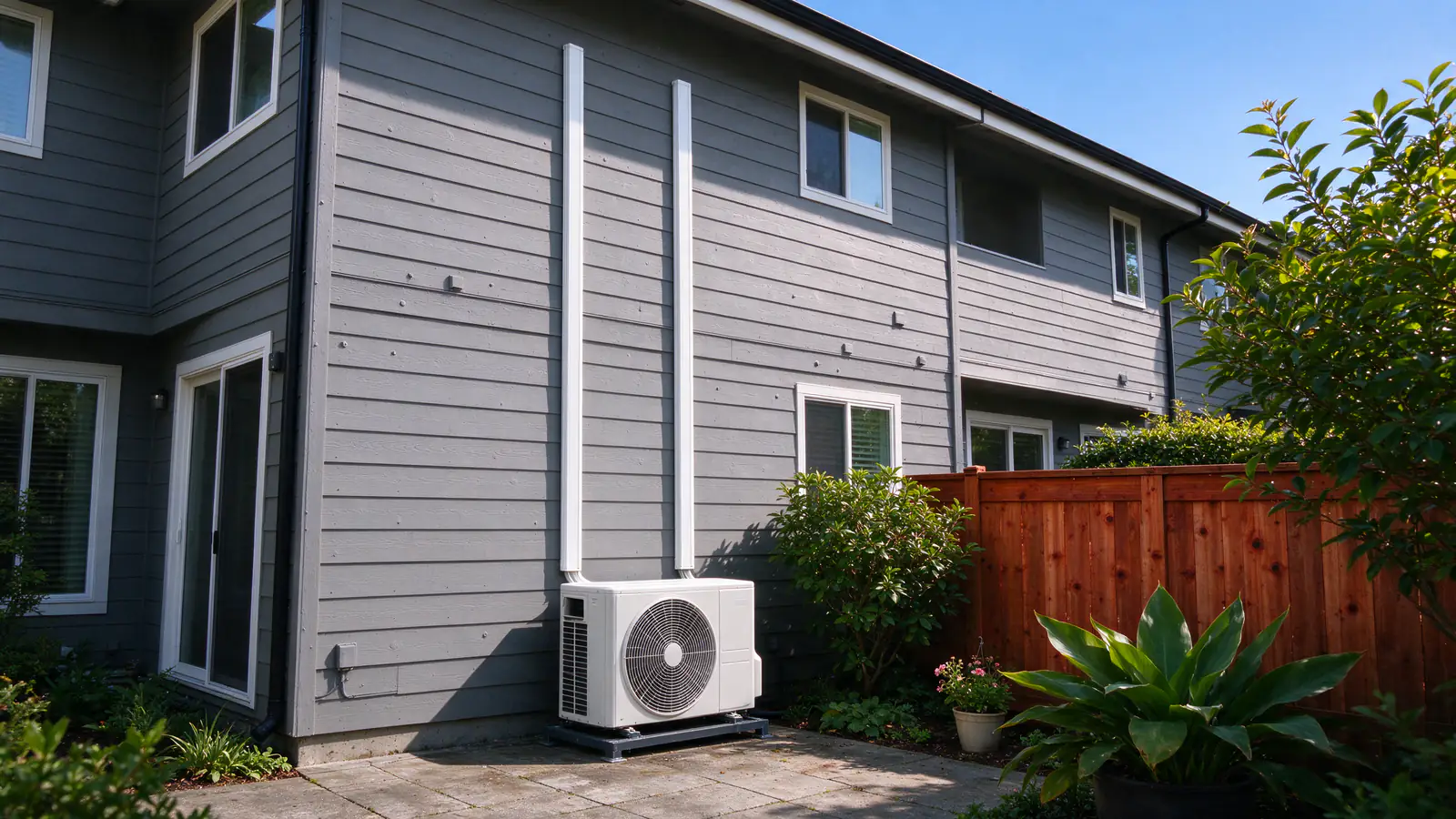
Both line sets drop down one painted cover on the back wall, stacked so the upstairs set runs beside the downstairs one into the outdoor unit. The new 240-volt, 20-amp circuit runs from the garage panel through the attic and down an interior closet. The flares are torqued, the lines hold a nitrogen pressure test, and we pull a vacuum below 500 microns and watch it hold before opening the valves. Each drain gets a pitcher of water before we close up.
The living room and primary bedroom wall heaters come out and get blanked plates; the two small bedroom heaters stay on their thermostats as backup. That still counts as replacing the main living space heat, so the attached home qualifies for Energy Trust's $1,800 incentive.
What it changes
The main floor and the primary bedroom heat and cool from one quiet outdoor unit, the patio keeps its table, and the wall heaters only run on the coldest nights.
- Location
- Greenway, Beaverton
- House
- 1979 two-story attached townhouse, about 1,280 square feet, electric wall heaters
- Equipment
- Two heads (12,000 and 9,000 BTU) on one 18,000 BTU cold-climate outdoor unit
- Price
- $9,480, permits included
- Time on site
- 2 days, then the final inspections
Townhouses and apartments: where can everything go?
In a Beaverton townhouse, condo or plex, the outside walls you control decide the layout, and we plan from those first.
Beaverton has more attached housing than most of the west side: well over half of its homes are townhouses, plexes or apartments rather than detached houses. That changes the job.
- Shared side walls. Heads go on the front or back wall, and line sets leave the house there too.
- One outdoor unit, not two. A multi-zone system puts two to four heads on one outdoor unit, which keeps a small patio usable.
- Association rules. Where an association controls the exterior, we send you a sketch with the unit spot and cover color to submit before we schedule.
- Upper-floor condos. Units with no patio need a wall bracket or a roof spot, and the building’s own rules. Condo mini split installation covers those.
Which rooms get heads first?
Start with the living room and the bedroom you sleep in, and leave rooms you barely use on their wall heaters.
The living room drives the bill, and replacing its heat is what qualifies the house for Energy Trust’s incentive. The primary bedroom comes next, because it’s the room that stays hot on summer nights.
| Room | What we usually put there | Why |
|---|---|---|
| Living room | 12,000 BTU head | Biggest load, and the incentive needs it |
| Primary bedroom | 9,000 BTU head | Summer comfort where you sleep |
| Small bedroom or office | Later head, or keep the heater | Size the outdoor unit with room to add it |
| Bathroom | Keep the wall heater | Too small for a head |
How many mini splits do I need? walks through the count for bigger houses.
Permits from the City of Beaverton
Inside city limits, the City of Beaverton’s Building Division issues and inspects the permits for a mini split, both the mechanical side and the new circuit.
We apply, schedule the inspections and close the job out with the final. The permit fees are already in your price.
A Beaverton address isn’t always the City of Beaverton
An Aloha home can carry a Beaverton mailing address and still sit in unincorporated Washington County, where the county issues the permits instead. We check the jurisdiction for your address on the first call. The mini split permit guide explains what the inspector looks for at the final.
What we check on the first visit
On the visit we measure each room you want heated or cooled and look at the panel, the outside walls and where water can drain.
- The panel. A heat pump needs its own 240-volt circuit. An older panel may have room once a wall heater circuit comes off; if it doesn’t, we say so before you commit.
- The walls. Which outside walls are yours, what’s on the other side, and where a line set can run without crossing a window.
- The drains. Every head needs its condensate to fall outside or reach a pump. We plan each one on the spot.
- The outdoor unit spot. Level ground or a bracket, out of a roof drip line, and away from a bedroom window next door.
You get a written estimate listing the heads and their sizes, the outdoor unit, the line-set route, the drains, the circuit, the permits and the price.
Would a ducted heat pump be better?
If your Beaverton house already has ducts in good shape, a ducted heat pump can be the better fit; if it has wall heaters or baseboards, ductless usually is.
A house built with wall heaters or baseboards never had ducts, and adding them means opening ceilings and closets, which costs more than the heads themselves. Where an electric furnace already feeds good ducts, we tell you, and mini split vs central heat pump lays out the trade-offs.
What it costs in Beaverton
Firlands’ typical range for a single head is $4,000 to $8,500, and two heads on one outdoor unit run $6,500 to $12,000.
Bigger jobs and add-ons
Three or four heads run $9,000 to $18,000 and up. Where a head can’t drain by gravity, as on an interior townhouse wall, a condensate pump typically adds $150 to $500. Permit fees are in the price. Mini split installation cost breaks it down line by line.
The incentive
Beaverton is PGE territory, so Energy Trust of Oregon’s ductless incentive applies when the new system replaces electric resistance heat in the main living space:
- $800 for a detached single-family home
- $1,800 for townhomes, duplexes and other attached homes, rentals, and income-qualified households
- applied for within 60 days of the install, with the application signed by the installing contractor
Mini split rebates in Oregon lists the rest of the conditions.
Heat-dome summers and frosty winters
Beaverton sits between Portland’s milder winters and Hillsboro’s colder nights, and a heat pump has to carry both ends.
Washington County’s winter design low is 27°F, and the June 2021 heat dome reached 114°F at Hillsboro’s airport, a few miles west. We size each head from the room’s load at both ends and pick cold-climate outdoor units by their published low-temperature output. Do mini splits work in cold weather? explains the equipment side.
From Greenway to Five Oaks
Beaverton’s housing changes from one part of town to the next, and so does the layout of a job.
- Greenway, Vose and Central Beaverton. Townhouses, plexes and small 1970s houses: short line runs, back-wall installs and attached-home incentives.
- Highland and Sexton Mountain. Two-story houses on slopes, where the outdoor unit often needs a stand or bracket where the yard falls away. Mini split placement covers siting.
- Five Oaks and Denney Whitford. Newer detached houses, often with ducted heat, where a single-zone head solves the one room the ducts miss.