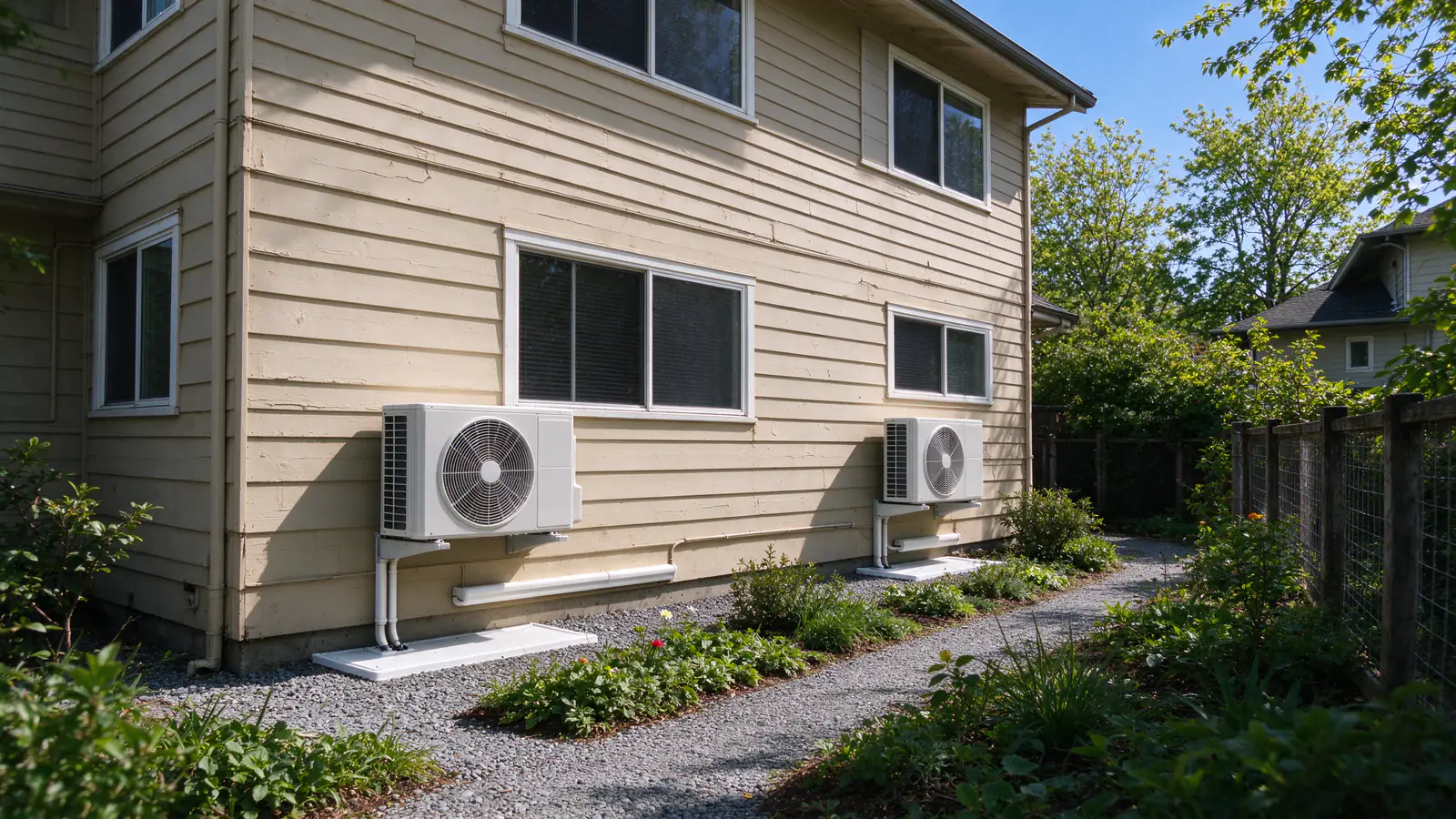
If you own a rental in Portland, heat and cooling now come with rules, incentives and a bill someone else pays. Firlands Portland Mini Splits plans mini splits for rental houses, duplexes and fourplexes as well as owner-occupied homes. This guide covers what’s different when you won’t be the one living with it.
Why mini splits suit rentals
A mini split heats and cools, needs no ductwork, and runs on the unit’s own meter. For a rental, those three things solve most of the usual problems.
- No ducts to build. Most older Portland rentals, and many 1970s and 1980s units, heat with baseboards or wall heaters. A ductless head goes on the wall with one hole.
- Lower bills for the people living there. A heat pump delivers two to four times the heat per kWh that baseboards do, which matters most to whoever pays the electric bill (electric bill guide).
- Cooling that stays put. A wall head isn’t carried out at the end of a lease, and it doesn’t block a window.
- Room by room control. Each head has its own remote, so residents heat the rooms they use.
What Oregon law says about cooling in rentals
Two Oregon laws matter: one sets a cooling requirement for newer units, the other protects residents’ portable cooling.
Newer units must have cooling
Under ORS 90.320, a dwelling unit whose building permits were issued on or after April 1, 2024 must have adequate cooling in at least one room that isn’t a bathroom. Central air, an air-source heat pump or a portable unit the landlord provides all qualify. A mini split head in the main living space or a bedroom meets it.
Portable cooling devices
Oregon’s 2022 portable cooling law, Senate Bill 1536, now ORS 90.355, limits when a landlord can bar the person living there from using a portable or window air conditioner. The listed exceptions include building code, the manufacturer’s guidelines, damage and insufficient amperage, and the landlord can require removal from October 1 to April 30.
The law doesn’t cover permanent equipment like a mini split, which needs the owner’s approval.
Why it matters in Portland
Since the June 2021 heat dome, cooling in rented homes has had more attention in Oregon: the 2022 portable cooling law and the cooling rule for buildings permitted on or after April 1, 2024 both came after it.
Incentives for rental homes
The main incentive in Portland is Energy Trust of Oregon’s, and it pays more for rentals than for owner-occupied houses.
| Program | Amount | Conditions |
|---|---|---|
| Energy Trust of Oregon, ductless heat pump | $1,800 for a rental of any type, or an owner-occupied duplex to fourplex; $800 for a typical owner-occupied single-family home | PGE or Pacific Power customer; replaces electric resistance heat in the main living space; apply within 60 days of install |
| Oregon Heat Pump Purchase Program | $2,000 per heat pump | Paid through Oregon Department of Energy approved contractors; rental funding has been drawing down |
| Oregon Rental Home Heat Pump Program | Closed | No longer accepting general applications |
Energy Trust’s offer doesn’t apply to gas-heated units, because it pays for replacing electric resistance heat. The contractor signs your Energy Trust application. State programs open and close as funding allows, so we check what’s open for your address before you sign. See mini split rebates in Oregon.
Planning a duplex, triplex or fourplex
In small multifamily buildings, we plan each unit as its own system: its own outdoor unit, its own circuit from that unit’s panel, and its own controls.
Why one system per unit
- Billing. Each household’s heating and cooling shows up on its own meter.
- Faults stay local. A problem in one system doesn’t leave the whole building without heat.
- Easier turnover. You can service or replace one unit’s system between leases.
Outdoor units on a small lot
Two to four outdoor units on a Portland lot take planning.
Portland allows outdoor equipment in a side or rear setback if it’s no more than five feet high. Its noise code limits sound at a residential property line to 55 dBA by day and 50 dBA at night, and units stacked beside a neighbor’s bedroom add up. Mini split placement covers the details.
Heads per unit
Most rental units need one head in the main living space, plus one per bedroom you want cooled or heated well. A studio or one-bedroom often needs a single head. How many mini splits do I need? explains the counting. For larger buildings, see commercial mini split installation.
Condos and HOAs
If the rental is a condo or in a planned community, the association has a say. Oregon’s portable cooling law voids association rules against portable units, but not against permanent ones.
Associations keep authority over exterior condensers, wall brackets and line sets. Get written approval for the outdoor unit’s spot and the line route before you book the work. Condo mini split installation covers what boards usually ask for.
What it costs per unit
Firlands’ typical range for a single-zone install is $4,000 to $8,500, and $6,500 to $12,000 for two heads on one outdoor unit.
For an ADU or a small unit with one or two heads, Firlands’ typical range is $5,000 to $12,000 and up. Energy Trust’s $1,800 rental incentive comes off afterward where it applies. A multi-unit job is priced unit by unit on the written estimate. The cost guide has every range.
Upkeep between leases
A mini split asks little of the people living with it, but someone has to own the yearly cleaning.
- Filters: washed every few weeks in heavy use; a minute’s job for whoever lives there.
- Coil and drain: cleaned every year or two, or at turnover (cleaning and maintenance).
- Outdoor unit: kept clear of leaves, bikes and storage.
- Remotes: they go missing; a wall control is harder to lose.