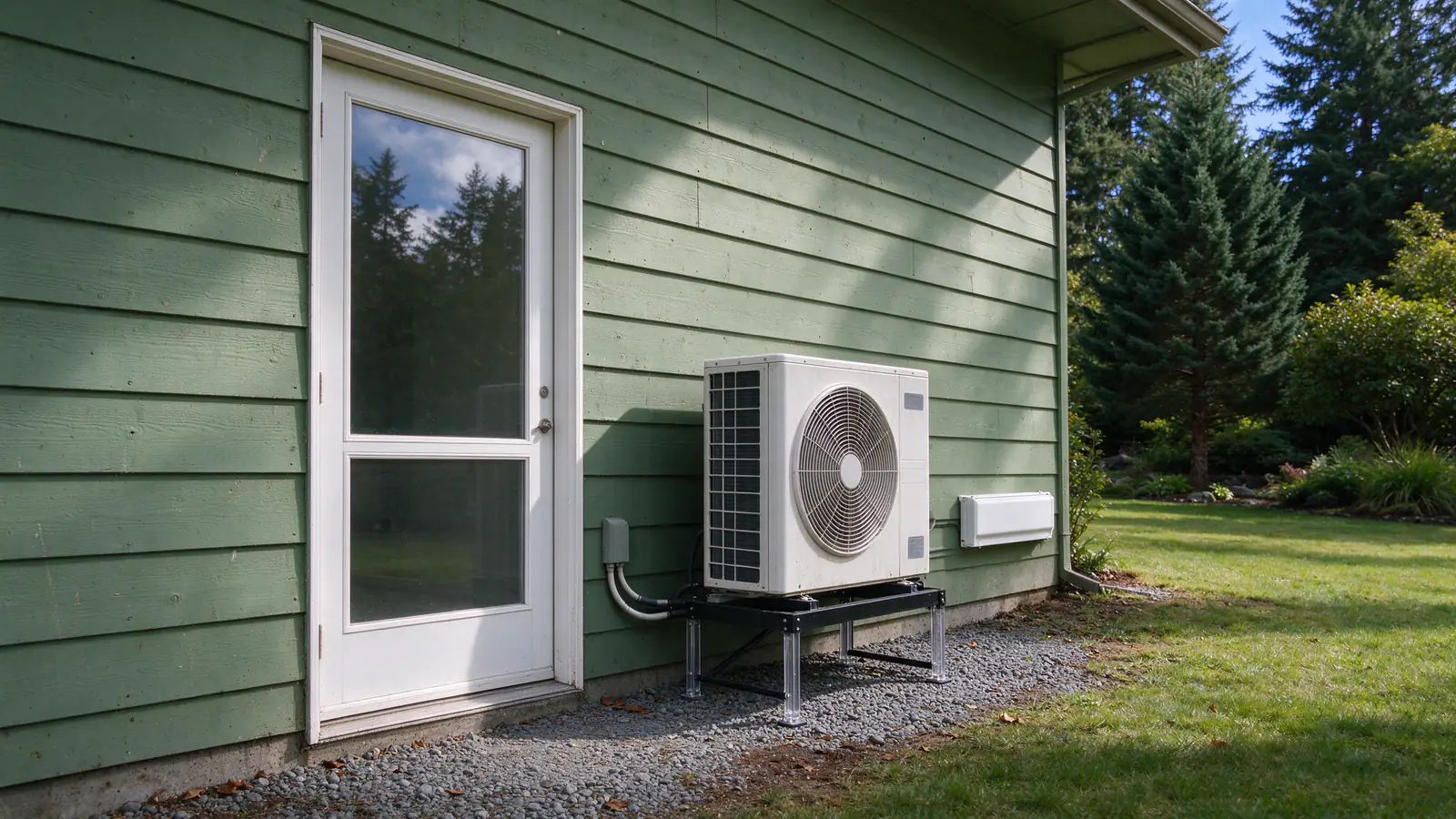
Wood stove in the living room, cold rooms everywhere else
Damascus houses are almost all detached and mostly owner-occupied, built largely in the 1960s and 1970s, and a lot of them heat in a way the rest of the metro doesn’t.
About 4% heat mainly with wood and 3.5% with fuel oil, many times Portland’s share. Firlands Portland Mini Splits plans around what you have: heads for the rooms the stove can’t reach, or enough heads to replace an oil furnace outright.
What we find on a Damascus visit
- a wood stove or insert carrying the living room
- baseboards in bedrooms down a long hall, or a daylight basement
- an oil furnace and tank, or a propane furnace, on some properties
- a detached shop or garage that also wants heat
Project
Inside a Damascus daylight ranch that keeps its wood stove
The problem
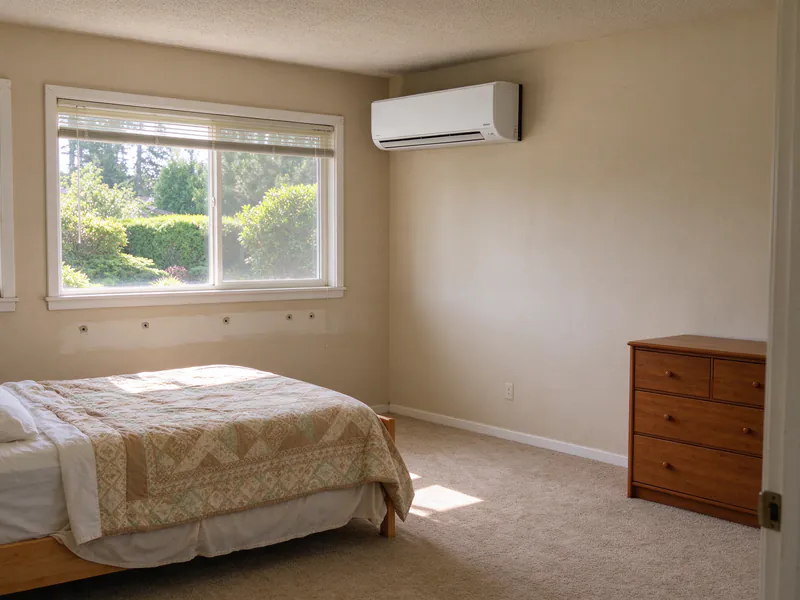
A wood stove heats the living room well, but the bedrooms at the far end of the house and the basement family room run on baseboards that the stove never reaches. Summer afternoons push the bedrooms past 85°F, and there's no cooling anywhere.
The house
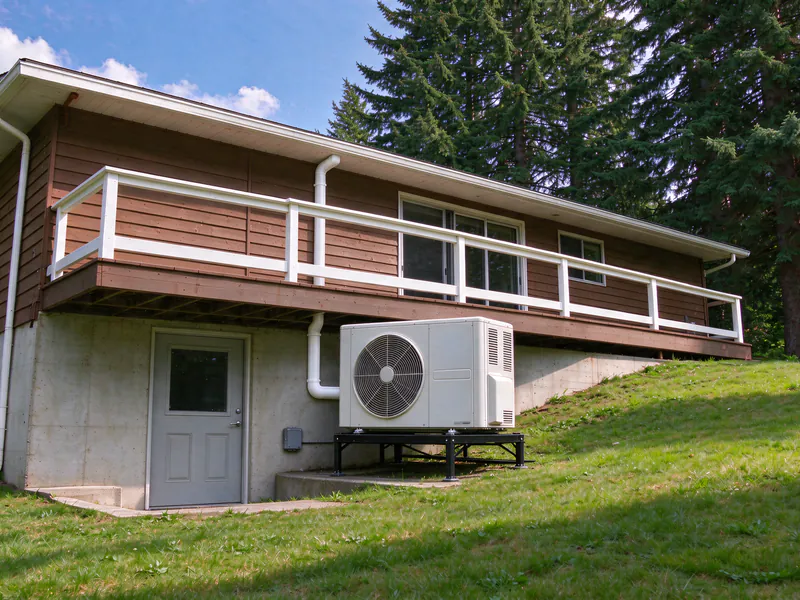
The main floor sits on a full daylight basement that walks out to the back yard. The panel is in the basement, the stove sits at one end of the living room, and the bedrooms are down a hall at the other end. The address is unincorporated county land, so Clackamas County issues both permits.
What we decide, and why
The owners want to keep the stove, so the heads go where the stove's heat doesn't: a 9,000 BTU head in each of the two bedrooms that face south and west, and a 12,000 BTU head in the basement family room. The outdoor unit sits on a stand beside the walkout, where the basement head can reach it through the wall at the same level and every head can drain by gravity.
The work
Three three-inch holes. The two bedroom line sets run through the attic and down the back wall in one cover to the walkout; the basement head goes straight out through the rim joist. A 25-amp, 240-volt circuit runs from the basement panel to a disconnect beside the unit, and the baseboard circuits in the three rooms come off, which frees breaker space. Each line set holds a nitrogen test and a vacuum below 500 microns, and each drain is tested with water.
Because the heads replace baseboards in the bedrooms and basement, not in the main living space the stove heats, this job doesn't qualify for Energy Trust's ductless incentive. We tell the owners that at the visit, before they choose the scope.
What it changes
The stove keeps the living room, the heads take over the rooms that ran on baseboards, and the bedrooms get cooling for the first time.
- Location
- Damascus, off Highway 212 (unincorporated Clackamas County)
- House
- 1977 daylight-basement ranch, about 2,200 square feet, wood stove and electric baseboards
- Equipment
- Three heads (12,000, 9,000 and 9,000 BTU) on one 24,000 BTU cold-climate outdoor unit
- Price
- $12,400, permits included
- Time on site
- 2 days, then the county's final inspections
Damascus isn’t a city anymore. Who issues the permit?
Damascus voted to disincorporate in 2016, and after years in court the former city is unincorporated Clackamas County. For most addresses, the county issues every permit.
The annexed part
Happy Valley annexed more than 1,000 acres of former Damascus land. Inside that area, Happy Valley reviews and inspects the mechanical permit and Clackamas County the electrical.
| Your address | Mechanical permit | Electrical permit |
|---|---|---|
| Unincorporated Damascus | Clackamas County | Clackamas County |
| Annexed into Happy Valley | City of Happy Valley | Clackamas County |
A Damascus mailing address doesn’t settle it, so we look up your parcel before applying. The fees are in our price either way. Mini split permits explains what each permit covers.
Keeping the stove, adding heads
Most Damascus owners with a stove want to keep it, and that’s a fine plan. The heads go where the stove’s heat stops.
How we lay it out
- The stove stays on the living room. It’s usually the room it heats well.
- Heads in the far rooms. Bedrooms down the hall and a basement family room get their own heads.
- Cooling everywhere the heads go. The stove never did that.
How many mini splits do I need? explains why one head rarely carries a long hall of closed rooms.
Off oil or propane completely
If your house runs on an oil furnace, the heads replace it outright, sized to carry every main room on the coldest night.
The heads go in and run first, so the house is never without heat.
The furnace and the tank
Then the furnace comes out, and a DEQ-licensed tank provider empties and decommissions the oil tank, which Oregon law requires once the house stops using it. Oil heat to mini split covers the order and the paperwork you keep for a sale. A propane furnace comes out the same way, and the propane supplier handles the tank.
Big houses, long line runs
Damascus houses spread out, and a single-story house with a long hall puts the heads far from each other and from the outdoor unit.
Every outdoor unit has a limit on total line length and on the height between heads and unit.
One outdoor unit or two
On a big ranch we sometimes split the house between two smaller outdoor units, one at each end, instead of running long lines to one. That costs more in equipment and less in labor, and it keeps each system inside its limits. A whole-house mini split covers the larger layouts.
The incentive depends on which room the heads replace
Damascus is PGE territory, so Energy Trust of Oregon’s ductless incentive is available, but only when the heads replace electric resistance heat in the main living space.
| Your house | Does the ductless incentive apply? |
|---|---|
| Baseboards in the living room, heads replace them | Yes: $800 for a single-family home |
| Wood stove in the living room, heads in the bedrooms | No |
| Oil or propane furnace replaced by heads | No; the offer is tied to electric heat |
| Gas furnace kept, heads added | No |
We say which line your house falls on at the visit, before you decide the scope. Mini split rebates in Oregon has the full conditions.
Shops and detached garages
Many Damascus properties have a detached shop or garage, and it’s often the next thing the owner wants heated.
A shop is a separate building, so it gets its own outdoor unit and its own circuit, usually from a subpanel already in the building. Garage mini split installation covers insulation, sizing for a big door and keeping the unit above drifting snow.
Cold nights out east
Clackamas County’s heating design temperature is 24°F. The January 2024 freeze took Troutdale, a few miles north, down to 14°F with strong east winds.
We size each head to its room’s load at the design low and check the outdoor unit’s published output below it. On an open lot, the unit goes on the side away from the east wind, on a stand above drifting snow. Do mini splits work in cold weather? has the detail.
From photos to the final inspection
Damascus is a drive from most of the metro, so we get as much as we can from your photos before the visit.
- Before the visit. Photos of each room, the panel, the stove or furnace and the outside walls give us a rough range on the phone.
- The visit. We measure every room, trace the route for each line set, check the panel and find the sheltered spot for the outdoor unit.
- The estimate. It lists the heads and their capacities, the outdoor units, the routes, the drains, the circuit, the county permits, the price and what’s excluded.
- The install. Each line set holds a nitrogen pressure test and a vacuum below 500 microns, and each drain is tested with water. The readings are yours on paper.
- The close-out. The county inspects, and we close the permits with the final.
What Damascus jobs cost
Firlands’ typical range runs from $4,000 to $8,500 for one head to $9,000 to $18,000 and up for three or four on one outdoor unit.
Whole-house systems with five or more heads, often two outdoor units on a big house, typically run $15,000 to $30,000 and up. An older 100-amp panel may need an upgrade, typically $2,500 to $6,000. Mini split installation cost in Portland lists the drivers.