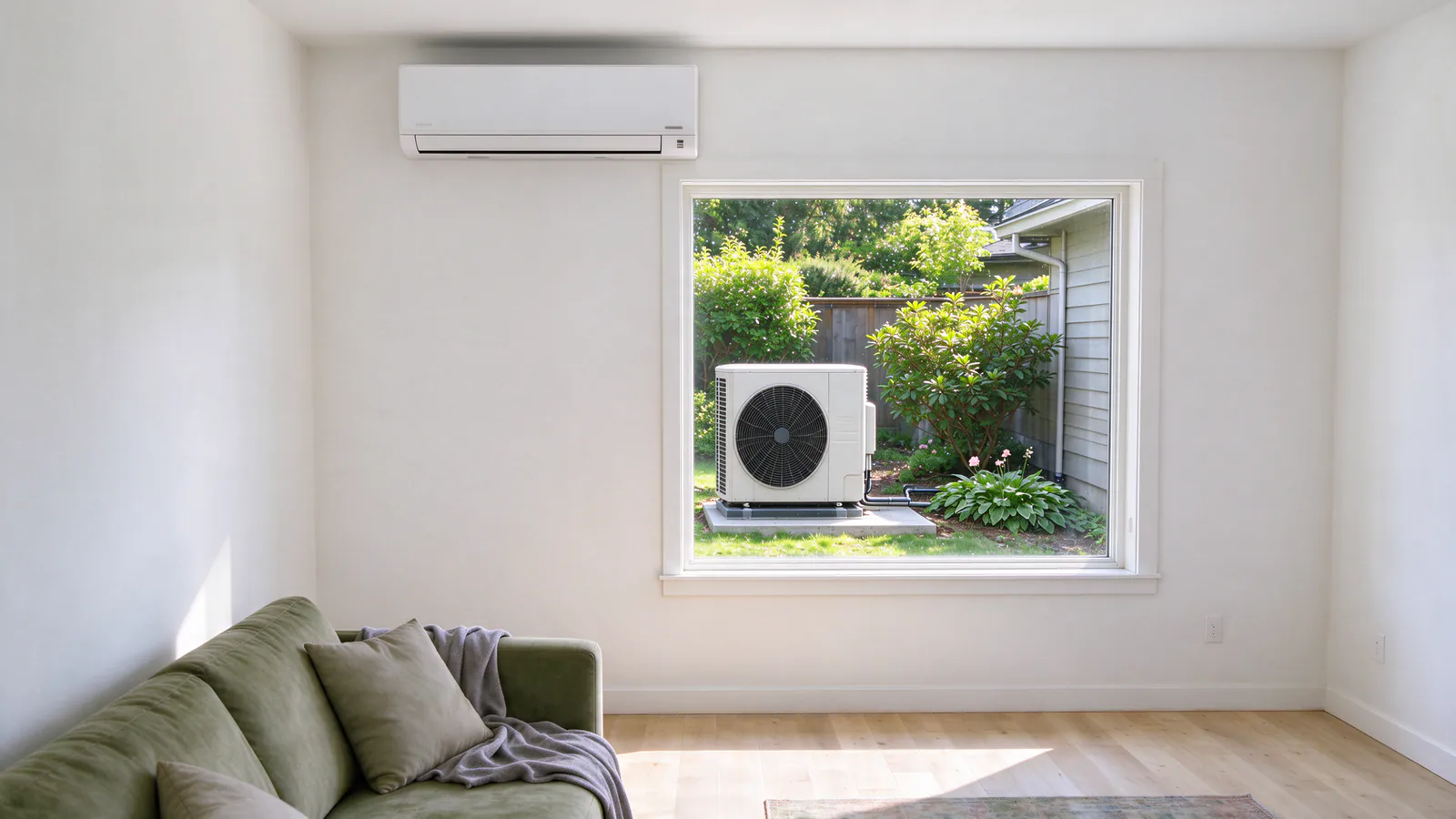
You’ve seen both names on quotes, rebate forms and the City’s permit records, and it’s fair to wonder whether you’re comparing two different things. At Firlands Portland Mini Splits we use both words, and in a Portland house they almost always mean the same equipment.
So are they the same?
For nearly every Portland house, yes. A ductless heat pump is a mini split with heating, and that’s what almost every mini split sold here is.
The two names come from looking at the same box from different sides:
- Mini split describes the layout. It’s a split system, with the compressor outside and the fan coil inside, in a small size that serves one room or a few.
- Ductless heat pump describes the job. It moves heat in both directions and delivers it without ducts.
- DHP, MSHP, ductless, mini-split heat pump are the shorthand you’ll see on permits and invoices.
Portland’s own permit records use all of them. Of the roughly 6,500 heat pump mechanical permits the City issued on one- and two-family homes over the three years to November 2026, about 2,800 named a mini split, ductless unit, DHP, MSHP or indoor heads.
Why Portland says “ductless heat pump”
The Northwest’s utilities sold the equipment as a heating upgrade first, so the heating name stuck here more than in hotter parts of the country.
For years the pitch to Oregon and Washington households was about replacing electric baseboards and wall heaters, not about air conditioning. That’s still how the incentives read:
| Program | What it calls the equipment |
|---|---|
| Energy Trust of Oregon (PGE and Pacific Power customers) | Ductless heat pump |
| Clark Public Utilities (Vancouver and Clark County) | Ductless heat pump |
| City of Portland mechanical permits | Heat pump; mini split; ductless |
| Equipment makers’ spec sheets | Mini split, or by series and capacity |
After the June 2021 heat dome the cooling side became the main reason many Portland owners called, so the “mini split” name caught up. Adding air conditioning to an old Portland house covers that shift.
When the two words point at different things
There are three cases where “mini split” and “ductless heat pump” don’t match, and each changes what you’re buying.
A ducted mini split
It’s still a mini split, with the same outdoor unit and line set, but it isn’t ductless. The indoor unit is a slim air handler hidden in an attic, knee wall or soffit, feeding two or three small rooms through short ducts.
Nothing hangs on the wall. We install these as ducted mini splits, and they suit a pair of small bedrooms under a roof.
A cooling-only mini split
Some mini splits only cool. They lack the reversing valve that lets a heat pump run backward in winter, and they’re usually a little cheaper. In Portland that saving rarely makes sense. You give up winter heat, and with it Energy Trust’s and Clark Public Utilities’ offers, which pay for heating that replaces electric resistance heat.
A central heat pump
A central heat pump is ducted too, but it’s a different class of system. One large air handler feeds the house’s whole duct network, the way a furnace does. That’s a different job from ours. Mini split vs central heat pump explains when it’s the better fit.
How the heat pump part works
A heat pump doesn’t make heat. It moves it, which is why it can deliver two to three units of heat for each unit of electricity on a mild day.
In summer the outdoor unit pumps heat out of the room and dumps it outside. In winter a reversing valve flips the flow, and the outdoor coil pulls heat out of the outside air, even cold air, and the indoor head releases it into the room.
What changes in cold weather
The colder it gets outside, the harder the outdoor unit works to find heat, so output and efficiency fall. Cold-climate models hold much more of their output on a 20-degree night.
Portland’s winter design low is 24°F, and for any head you’ll heat with, we choose a model that holds its output there. Do mini splits work in cold weather? has the detail.
What the name changes for you
The label on the box rarely matters. What matters is whether the system heats, where its indoor unit sits, and how its ratings read.
| On the quote | What to check |
|---|---|
| “Ductless heat pump” or “heat pump mini split” | It heats. Look for its HSPF2 heating rating and its output at low temperatures. |
| “Mini split AC” or “cooling only” | Ask whether it heats. If not, it won’t qualify for heating incentives. |
| “Ducted mini split” or “concealed” | The indoor unit sits in an attic or soffit, so check where the drain and filter go. |
| A head count and capacities | Each head is sized to its room, not just to the house total. |
Ratings that follow either name
- SEER2 is the cooling efficiency.
- HSPF2 is the seasonal heating efficiency, and Energy Trust’s ductless offer asks for at least 8.1.
- Low-temperature capacity is how many BTUs the unit still delivers at 17°F or 5°F, from the maker’s published data.
What we put in
Every system we install for a room you live in is a heat pump. We choose cold-climate models for any head that has to heat through a Portland January.
Whether it’s one head, several on one outdoor unit or a whole house, the written estimate names each head, its capacity, and the outdoor unit by model. If you’re replacing baseboards, we also check whether the layout meets Energy Trust’s rules before you sign.
- Tell us which rooms you want heated, cooled, or both.
- Send photos of those rooms and the outside walls behind them.
- We’ll call back with the kind of mini split that fits each room and a rough range.
Call us with the rooms you’re thinking about, and we’ll tell you which kind of mini split fits each one.